
In this guide7 sections
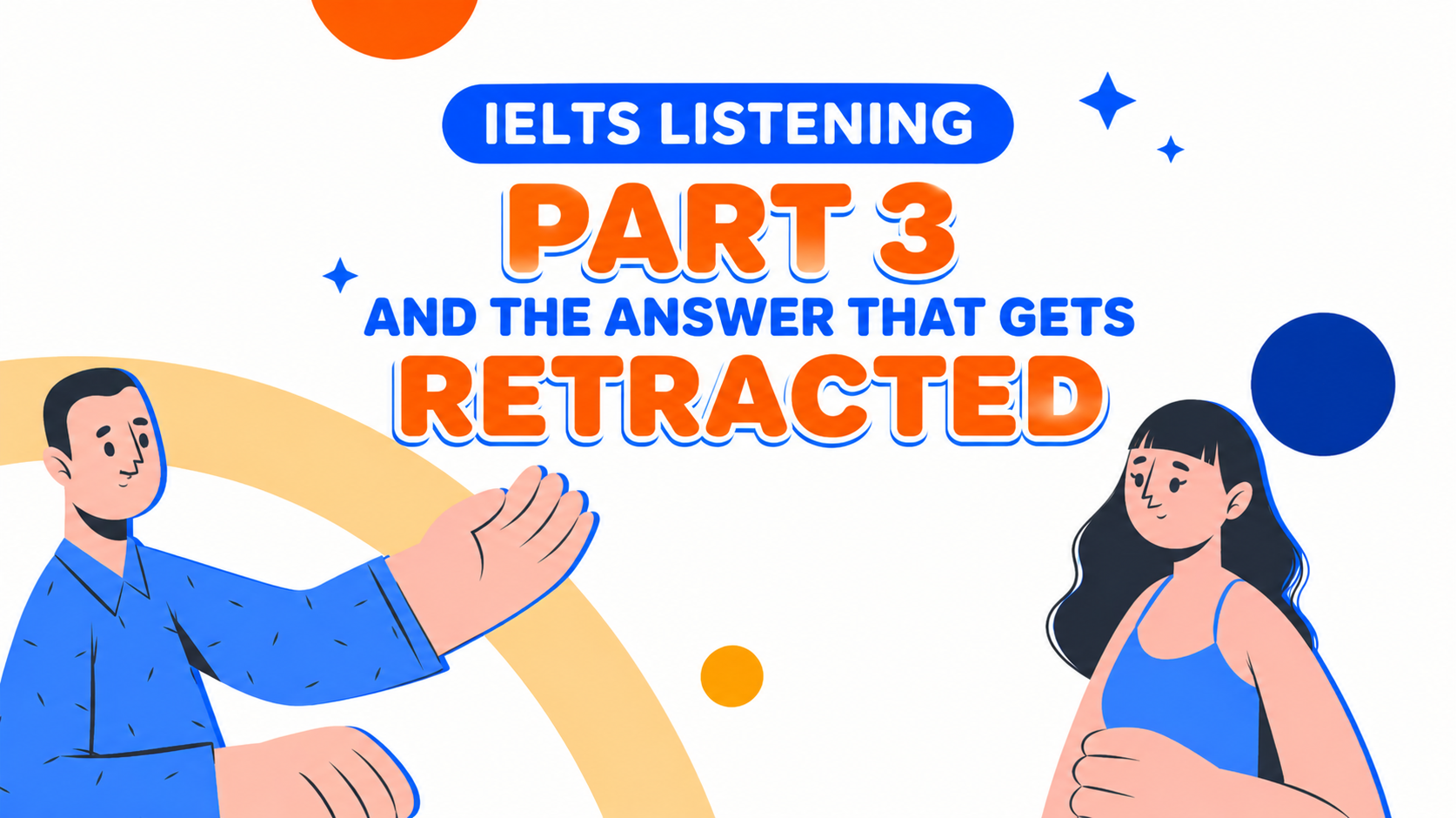
Most IELTS Listening Part 3 tips tell you to concentrate harder. The real trap is narrower than that: the first plausible answer you hear in Part 3 is usually the one the speakers are about to take back.
Not always. Often enough that if you write it down, half-close your attention for four seconds and wait for the next question, you'll lose the mark — and you'll lose it while understanding every single word of the sentence that removed it. A Part 3 collapse is rarely a listening-ability failure. It's a failure to recognise a shape you've heard forty times without ever naming it.
Where the forty marks in IELTS Listening actually go
Ask a candidate in Dhaka which part of IELTS Listening hurt them and most say Part 4. It's the one they remember — the lecture, four or five minutes of one voice, no one to interrupt it, and that horrible feeling around question 35 of having fallen off the back of a moving vehicle. Then you look at the marked paper and the damage is in Part 3.
It isn't speed. Part 3 isn't spoken faster than Part 1, and the recording is the same length for everyone: around 30 minutes of audio, 40 questions, played once. Three things change at question 21.
There are suddenly two, three, sometimes four voices, and half the question types depend on which of them said the thing. The register goes academic — a supervision meeting about a dissertation, two students arguing about a methodology, a tutor being politely unconvinced. And the paraphrase density goes up: the question stem and the audio share almost no vocabulary, so the moment you start matching words, the exam starts feeding you the wrong ones on purpose.
| Part | What you hear | Voices | Question types you'll usually meet |
|---|---|---|---|
| 1 | An everyday conversation — a booking, an enquiry | 2 | Form and note completion |
| 2 | An everyday monologue — a tour, an induction talk | 1 | Map or plan labelling, matching, multiple choice |
| 3 | A discussion in an educational or training context | 2–4 | Multiple choice, matching, flow-chart, note completion |
| 4 | An academic lecture | 1 | Note and sentence completion |
The anatomy of a distractor
Below are three exchanges. I wrote them for this article — they aren't lifted from a Cambridge recording, and you shouldn't practise on transcripts copied out of the books either, because the words on the page are not the thing being tested. The shape is.
It gets taken back inside the sentence
The question: The students agree that the main weakness of their first survey was
Priya: The sample was too small, obviously — well, no, that's not fair, we ended up with ninety-odd responses. The real problem was sending it out in exam week. The only people with time to answer it were the people with nothing due.
The option "the number of responses was too low" is offered, by name, within two seconds. It's then retracted by four words: well, no, that's not fair. A candidate who has already clicked A hears the retraction perfectly well and does not act on it, because the question feels finished. The answer is the timing of the survey, and it arrives in a sentence that never uses the word "timing".
Notice the retraction marker. It's not "however". It's "well, no". Spoken English withdraws things with tiny words, and those are the words your ear has been trained to discard as noise.
The second speaker says no without saying no
The question: What do they decide to put in the appendix?
Rahim: I assumed we'd put the raw interview transcripts in the appendix. Tutor: You could. They'd run to about sixty pages, mind you, and I've never met a marker who reads them. Rahim: Fair enough. Priya: The coding frame, then? That's the thing somebody might actually want to check against our claims. Tutor: Yes. That's the one.
"You could" is a refusal. So is "mind you". A tutor in a Part 3 recording almost never says "no" — they say "you could", "I'd have thought", "that's one way of doing it", and the disagreement lives entirely in the hedge. If your English is functional but your ear for British academic politeness isn't, this is where you're quietly bleeding marks, and no amount of vocabulary study fixes it. You fix it by listening to a great many British people being polite at each other — and the cheapest source going is the review drill at the end of this article, because the hedges are already sitting in the papers you've sat.
The third-speaker variant is nastier. Same appendix discussion, four lines on:
Priya: Honestly, the transcripts are the interesting bit. I'd read all sixty pages. Rahim: Wouldn't you just.
The answer is still the coding frame. Priya is enthusiastic about the transcripts, not about putting them in the appendix, and because the enthusiasm arrives after the decision was made, it lands like confirmation of an option that was already killed.
The number is amended after you've written it
Tutor: So you're presenting on the fifteenth. Priya: The nineteenth, actually. The fifteenth was the original slot, but the lab was double-booked. Tutor: Nineteenth. Right.
And in note completion:
Rahim: We got two hundred and forty responses back — sorry, two hundred and four. Two-oh-four.
Numbers and dates get amended more often than any other answer type in Part 3, and they're the answers you're most confident about, because a number sounds like a fact. So don't lift your pen off a number until another speaker has repeated it or the topic has changed. The confirmation ("Nineteenth. Right.") is the exam telling you the amendment is over.
Who said it, and the two-column habit
Matching tasks in Part 3 print the speakers' names in the stem — Which student had which concern about the fieldwork? — and multiple choice often does the same: What does the tutor advise Rahim to change first? In both, the content of the answer may be perfectly clear to you and still worthless, because you attached it to the wrong person.
The fix is mechanical. Before the audio starts, on whatever you've been given to write on, put the speakers' initials at the top as two or three narrow columns. Every opinion you hear goes under an initial, in two or three words. Not sentences. P — exam week, R — transcripts, dropped.
It saves you from the shared opinion, where two speakers voice more or less the same view and only one of them is the answer. And from the option that was spoken aloud by the person who then dropped it.
On the computer-delivered test the questions sit in a pane you scroll through while the audio runs, and there's no margin to scribble in — your notes live off to the side and your eyes leave the screen to make them. That's a physical habit and it needs rehearsing on the screen you'll actually sit at, not on a photocopied page. Our IELTS Listening papers run in a replica of the computer-delivered interface, transcribed from the real thing down to the typeface, for exactly this reason. If the pane and the scrolling are already boring by the time you sit down, the two minutes at the end are two minutes of checking rather than two minutes of surprise.
The seconds before the audio — and the advice you should ignore
You've been told to underline the keywords in each question before the recording starts. In Part 3, that advice actively costs you marks.
Part 3 stems are heavily paraphrased, so the words you underline are, by design, not the words you'll hear. Meanwhile the distractor is usually built out of the stem's own vocabulary — it's the option that sounds like the question. If you've spent your preparation time underlining "main weakness of the survey", you've trained yourself to lunge at the sentence containing "the sample was too small", which is the one being retracted. Keyword-spotting is a Part 1 skill. Carried into Part 3, it's a liability.
Use those seconds differently. Underline the verb in the stem: agree, decide, advise, warn, regret, recommend. That verb tells you what kind of event to listen for. Underline the name. Then read the options against each other and find the one axis on which they differ; often three options describe the same event and differ only in cause, or only in timing, and once you know that, you're listening for one small thing rather than a whole meaning.
Do not predict the wording. In Part 1 predicting works — you know a postcode is coming. In Part 3 a predicted phrase becomes a template your ear tries to fill, and the recording will hand you something that fits the template and is wrong.
None of which helps if the marks are going somewhere else entirely. For Bangla speakers, a depressing share of lost Listening marks are gap-fill answers that were heard correctly and written wrong: advices, informations, a missing plural -s, an article inserted into a two-word limit that pushes the answer over the count. The audio said "survey data" and you wrote "the survey data". That's a mark gone, and it isn't a Part 3 problem at all.
Two other things decide Listening marks before comprehension does: how much of your Listening score is actually spelling, and the Part 2 map that loses people at the first turn.
Mark by part, not by total
26 out of 40 tells you nothing about where to spend the next three weeks; 9, 8, 4, 5 tells you where to spend them.
Break every Listening paper you sit into four scores. Do it across at least three sittings, because one bad Part 3 is noise — a topic you disliked, a bad night, a section where you lost your place at question 24 and never recovered. Three sittings is where a pattern becomes visible. If Parts 3 and 4 hold two-thirds of your errors, everything in this article is your work for the next three weeks. If they don't, you're reading the wrong article, and I'd rather you found that out from a spreadsheet than from a test day.
And four marks in Listening is not a rounding error. Say your Reading and Speaking sit at 6.5 and your Writing at 6.0. With Listening at 6.0, your mean is 6.25, which rounds up to an overall 6.5. Drop Listening half a band to 5.5 and the mean is 6.125 — which rounds to 6.0, because .25 goes up and .125 doesn't. One Part 3 decided that. How the overall band rounds works through that arithmetic properly, and if Listening is the single skill holding your overall down, One Skill Retake may be cheaper than sitting all four again.
Reviewing a Part 3 properly takes twenty minutes, not two
Re-listening to the whole recording with the transcript open is the most common review method and close to the least useful. You already know the answers by then, so everything sounds obvious, and you learn nothing except that you can understand English when there's nothing at stake.
Do this instead, for each Part 3 question you got wrong.
Find the line in the transcript where the wrong option was offered. Note the timestamp. Then find the line where it was withdrawn — the well, no, the you could, the sorry, two-oh-four. Note that timestamp too. The gap between them is usually under fifteen seconds and it is the entire lesson.
Re-listen to that stretch only. Three or four times. Then write down the exact words that did the withdrawing, in a list you keep adding to. After a handful of papers your list will look something like: actually, mind you, though, well no, I'd assumed, to be fair, hang on, it turns out, in the end, or rather. That list is the thing you're building. It's short, it repeats across all 21 Cambridge books, and once your ear flags those words as stop, something is changing, Part 3 stops being a different test from Part 1.
What three full papers will tell you
Timed. Full length. Audio once, no pausing, no rewinding, notes on paper beside you and the questions on the screen. Anything less and you're testing your comprehension, which is fine, but it isn't the thing that's failing.
You'll get Listening marked the second you submit, with the answer key sitting beside each of your errors and the raw score converted to a band — split by part, so the diagnosis in this article is one glance rather than an afternoon of counting. Same for Reading: 60 minutes, 40 questions, three passages, Academic or General Training, marked instantly. Writing goes to a human instructor who scores Task Achievement or Task Response, Coherence and Cohesion, Lexical Resource, and Grammatical Range and Accuracy separately — four criteria, equally weighted — and writes a line on each. Speaking is marked the same way, from a recording of your answers.
Every Cambridge paper is free, so the three cost you nothing but the time.
Start the list this week. One sheet, one column, every phrase that took an answer back, collected from your own wrong answers rather than from someone else's advice. Ten entries is enough to change what your ear does at question 21.
Published 18 Sept 2026 · Last checked 10 Oct 2026