
Of all the Part 2 cards, the describe-a-person family is the one candidates feel safest with and the one I most often hear fall apart at the ninety-second mark. The speaker runs out of adjectives, pauses, and fills the last half-minute with "so yeah, that's the person I admire the most".
The problem is almost never vocabulary. It is that the answer was built as a list instead of as a shape. The video above is the short version.
What the card actually asks for
ielts.org describes the task card in one sentence that candidates read past:
Two different instructions are in there. The bullet points tell you what to include. The final line — almost always "and explain why…" — tells you what to develop. They are not equal, and treating them as equal is the structural habit that caps people at a 6.
A typical card:
The first three bullets are setup. The fourth is the answer. Most candidates spend ninety seconds on the setup and fifteen on the thing being asked.
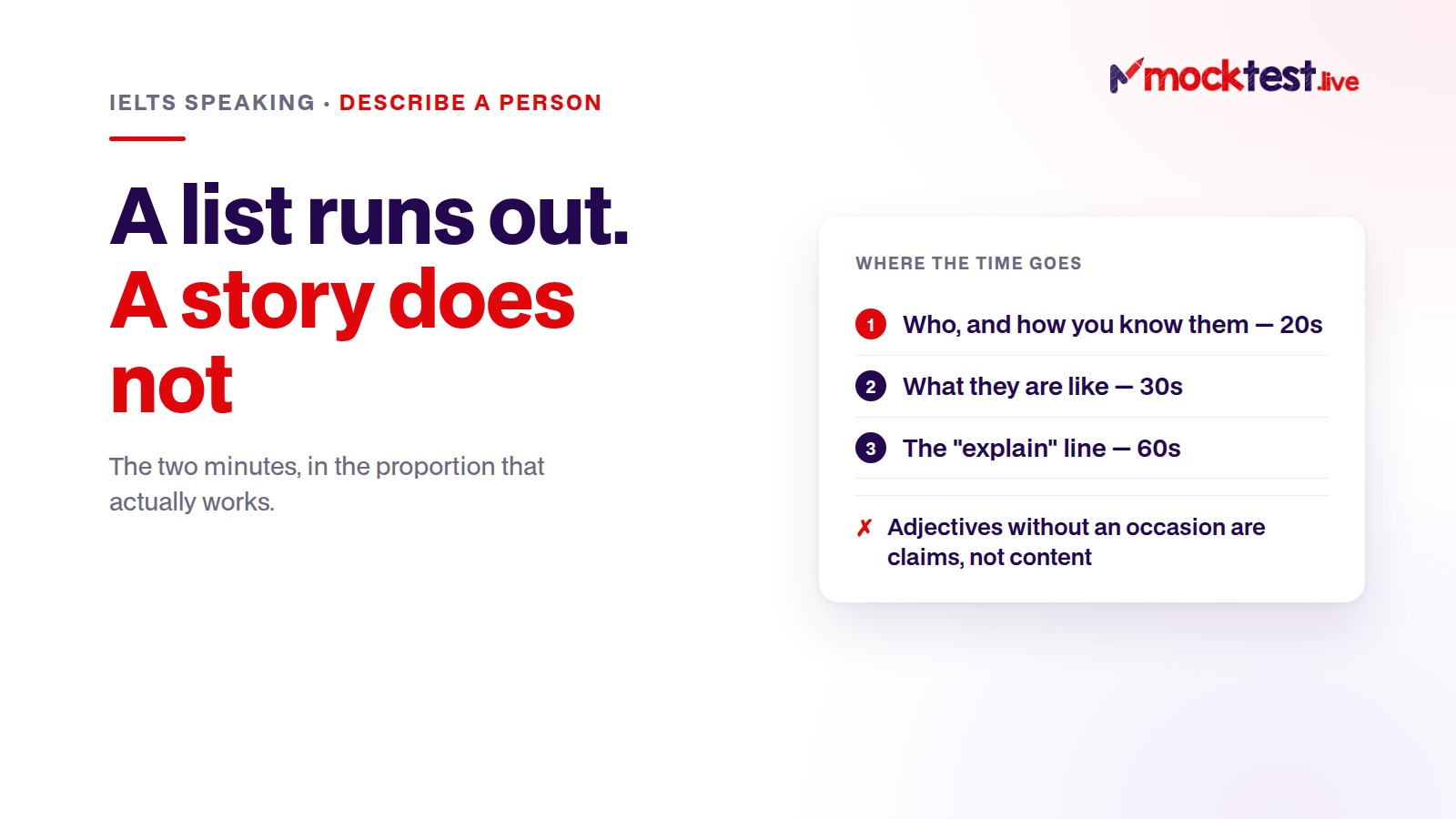
The two minutes, in proportion
ielts.org frames two minutes as a target rather than a ceiling: using the card and your notes, "you should be able to think of appropriate things to say, and have time to structure your talk so that you keep talking for 2 minutes." The examiner stops you when time is up — being cut off mid-sentence is normal and costs nothing.
Here is the division that works:
| Part of the card | Time | Why |
|---|---|---|
| Who, and how you know them | ~20 seconds | Setup. Do not linger. |
| What they are like | ~30 seconds | Two traits, each with evidence. |
| The "explain" line | ~60 seconds | The question. One concrete story. |
| A closing sentence | ~10 seconds | Optional. Silence is fine too. |
If the explain line is not getting half your time, you are answering a different card.
A model answer, with the scoring marked
Card as above. Read it once, then read the annotations.
Why this scores, against the four criteria ielts.org publishes:
Fluency and coherence — defined as speaking "at a normal speed without too much hesitation" and putting ideas "in a logical order". The answer moves in one direction: person → relationship → trait → the evening → what it changed. There is no backtracking, and the hesitation that is there ("What she's like…") is natural thinking time, not stalling.
Lexical resource — the range you use and "how accurately and appropriately you use vocabulary to express meaning". The strongest word here is unhurried, and it works because it is exact, not because it is rare. Note what is absent: no "she is a very kind-hearted and humble person with a golden heart".
Grammatical range and accuracy — "the range of grammar you use and how accurately and appropriately you use it". The story does the work automatically: past simple for the events, past perfect for I'd been memorising, present perfect for she's never mentioned, and a conditional in if I can't explain something. Nobody planned those. They arrived because a story needs them.
Pronunciation — "your ability to speak in a way which can be understood without too much effort". Nothing in that definition is about accent.
The one move that fixes most answers
Notice where the answer stops describing and starts narrating: "There was one evening…"
That sentence is the engine. Before it, the answer is a list of qualities, and a list of qualities runs out — there are only so many adjectives for a person you admire. After it, the answer is an event, and events have detail built in: a time, a place, something said, something that changed.
So when you plan during your minute, do not write adjectives. Write one occasion. The adjectives will come out of it, and they will come out attached to evidence rather than floating.
This is also the answer to running out of things to say at ninety seconds. You have not run out of topic; you have run out of list. Switch to a story.
What to do with the preparation minute
You get a pencil and paper, and one minute. Do not write sentences — you will read them aloud and it will sound read.
Four notes is enough:
aunt — chem teacher, Khulna
unhurried — never gives answer
THE EVENING: failed test, explain out loud, couldn't
→ now: can't explain = don't know
That is a route, not a script. More on the minute itself in what the Part 2 cue card is actually scored on, which also covers why the topic lists circulating online are worth practising from and not planning from.
The three habits that cost the most
Memorising a person and forcing them onto every card. It is audible, and ielts.org is blunt about it: "Examiners are highly trained to spot memorised answers, which never bodes well for test takers." A prepared story bent to fit a card it does not fit is worse than an unprepared one that does.
Listing adjectives with no evidence. "She is honest, she is kind, she is hardworking" is three claims and zero content. One trait with an occasion attached beats five without.
Stopping when the bullets run out. The bullets are a minimum, not the task. If you have covered them in eighty seconds, keep going on the explain line — that is what the card asked for.
What comes next in the test
Part 2 does not end with your two minutes. The examiner "may then ask you one or two questions on the same topic", and then Part 3 opens the same subject out — ielts.org describes it as discussing "issues related to the topic in Part 2 in a more general and abstract way".
So a card about a person who influenced you is very likely followed by questions about teachers, role models, or how people change. Knowing that, choose a person you can think about abstractly: Part 3 is where a 6 separates from a 7.
The other card family that fails in its own specific way is describe a place, where the trap is tense rather than structure.
And if Part 1 is still where you tighten up, the warm-up questions have their own shape: Part 1 questions and answers that sound real.
Practise it out loud, and listen back
Reading a model answer teaches you almost nothing. Record yourself answering the card above for two minutes, then listen once with a single question: where did I stop telling a story and start listing?
Our Cambridge papers include Speaking, where you record your answers and an instructor marks them against all four criteria with a line of reasoning on each. A recording is not a live examiner — treat it as a check on where you stand rather than a rehearsal of the conversation. Every Cambridge paper is free. We are not affiliated with Cambridge, IDP or the British Council.
The task card description, the two-minute target, the Part 2 and Part 3 timings and all four assessment-criteria definitions are quoted from ielts.org's Speaking format page; the memorised-answers warning from ielts.org's preparation guidance — checked on 10 October 2026. The cue card and the model answer above are ours, written in the published format; no IELTS partner releases live task cards.