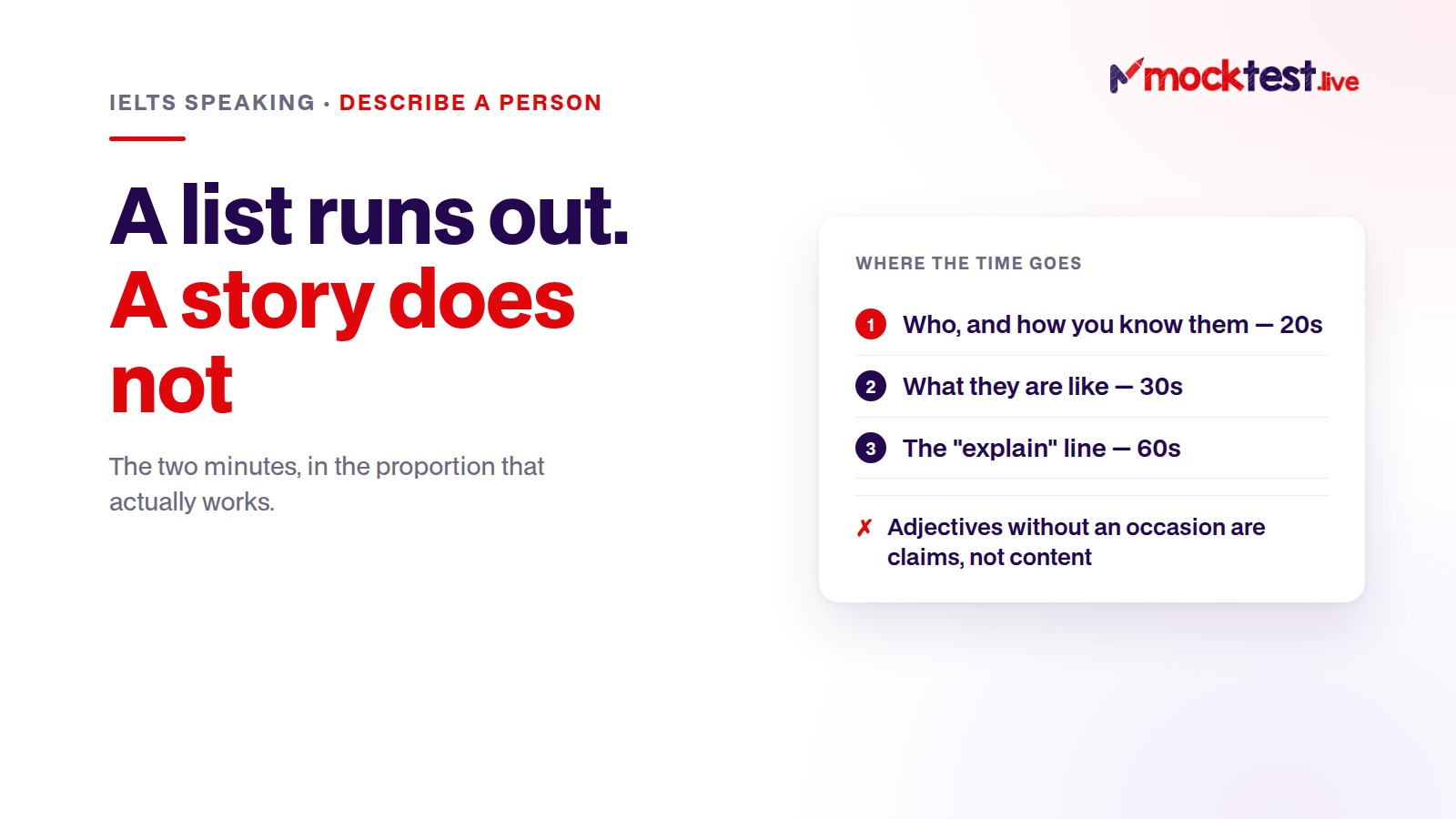

Place cards look like the easy ones, and they produce the flattest answers I hear. The candidate describes a location accurately for about eighty seconds — the buildings, the food, the weather — and then stops, because there is nothing left to describe.
The problem is a point of view. The answer was delivered from above, like a guidebook, when the card wanted it from inside. The video above is the short version.
The card, and the line that matters
A standard place card:
As with every Part 2 card, ielts.org describes the structure the same way: the card "tells you what points you should include in your talk and instructs you to explain one aspect of the topic". The first three bullets are inventory. The last line is the question.
On a place card, that final line is almost always about you — why you like it, why it matters, why you go back. Which means a correct answer is not mainly about the place.
The tense trap, which is specific to this card type
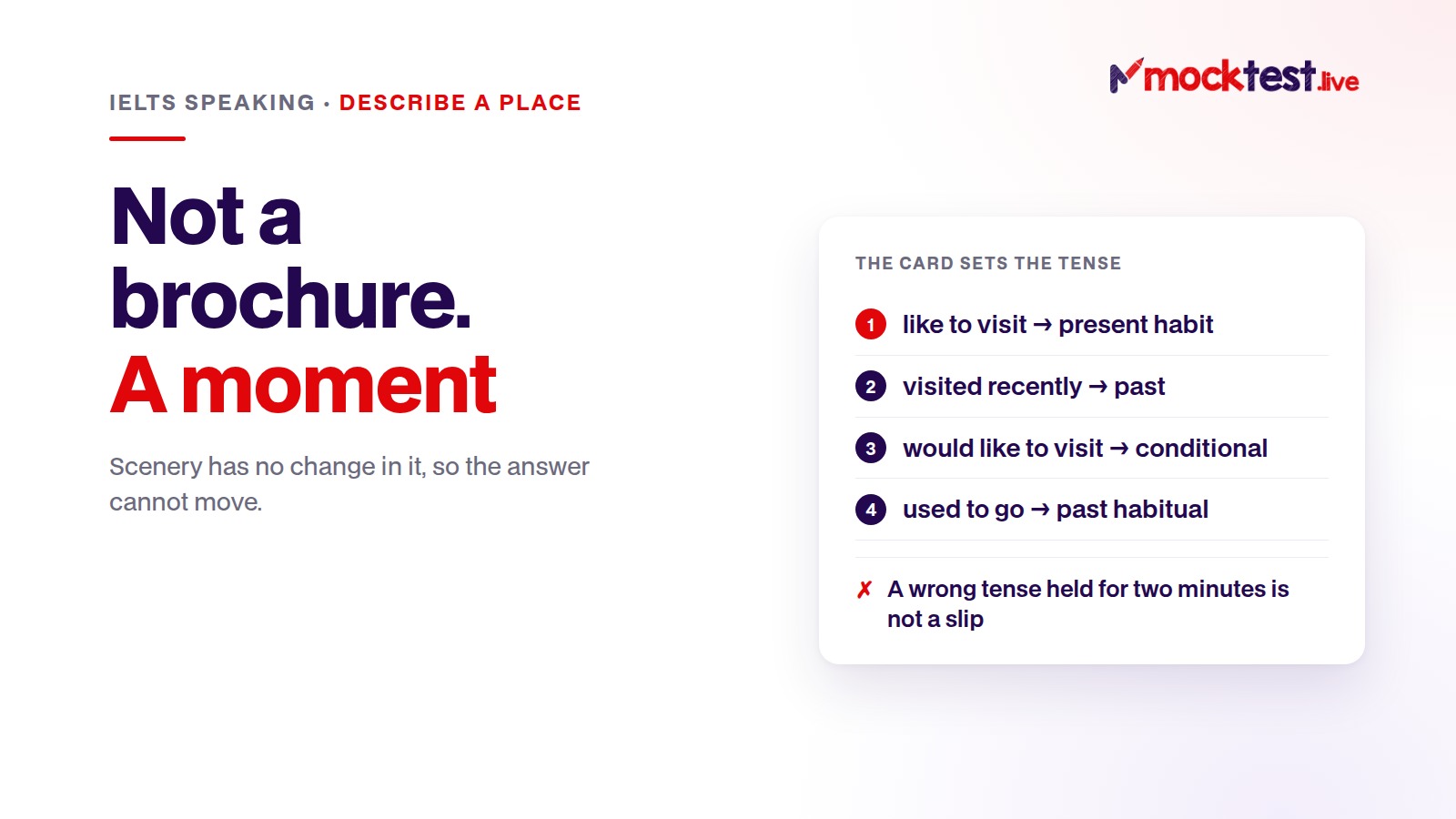
Person cards are forgiving about tense. Place cards are not, because the wording quietly sets one:
| The card says | The tense it wants |
|---|---|
| a place you like to visit | habitual present — I go there most Fridays |
| a place you visited recently | past — I went in March |
| a place you would like to visit | conditional / future — I'd probably start with… |
| a place you used to go as a child | past habitual — we'd go every summer |
Choosing the wrong one and holding it for two minutes is not a slip; it is a sustained error in grammatical range and accuracy, which ielts.org defines as "the range of grammar you use and how accurately and appropriately you use it". Read the card's verb before you plan anything else.
The fourth row is the one people fluff. Used to and would both work for past habits, and mixing them naturally — "we used to go every summer, and my father would always stop at the same tea stall" — is exactly the range the descriptor is looking for.
A model answer, and where the marks are
Card as above.
Against the four criteria ielts.org publishes:
Fluency and coherence — "putting your sentences and ideas in a logical order and using cohesive devices… appropriately so that what you say is not difficult to follow". The answer moves outward: the roof → the routine → what he does → why → a realisation. The cohesion is carried by ordinary linking (so, which, the reason) rather than by a memorised list of connectors.
Lexical resource — notice the location language doing the heavy lifting: on the ledge at the far end, the side that looks away from the main road, over the rooftops towards the river. None of those words is rare. They work because they position the speaker in a space. That is what "accurately and appropriately… to express meaning" buys you on a place card.
Grammatical range and accuracy — the card set habitual present (I go there most Friday afternoons), and the answer holds it, then moves deliberately: present perfect for I've been going since, past for I noticed last winter, past perfect for I'd started saving. The tense changes because the content changes, not to show off.
Pronunciation — "the ability to speak in a way which can be understood without too much effort". Nothing about accent.
The move: a moment, not a map
Look at where the answer stops being about the roof: "I noticed last winter that I'd started saving problems for it."
That is the same engine as on a person card, but it solves a different problem here. On a place card the risk is not running out of adjectives — it is that scenery has no change in it, and an answer with no change has nowhere to go.
So plan a moment, not a map. One occasion when you were in the place, or one thing you realised about it. The description will come out around the moment, and it will come out as experience rather than inventory.
Two questions that reliably produce one:
- When did you first go there, and what were you doing?
- What is the last thing you remember noticing there?
What not to do
Do not deliver a brochure. "It has beautiful natural scenery and the people are very friendly and the food is delicious" is three claims nobody can picture. One tea stall beats all of it.
Do not pick a place you have only seen in photographs unless the card asks for one. You will be fine for forty seconds and then you will start inventing, and invented detail is vaguer than remembered detail — it comes out as adjectives.
Do not stop at the third bullet. The bullets are the minimum. If they are done in eighty seconds, keep going on the explain line, which is where the marks are.
Where it goes next
Part 3 opens the topic out — ielts.org describes it as discussing "issues related to the topic in Part 2 in a more general and abstract way". After a place card, expect questions about cities, public space, how neighbourhoods change, whether people need quiet. Choose a place you can think about in those terms: Part 3 is where a 6 separates from a 7.
The mechanics of the card itself — the preparation minute, the two follow-up questions, what the circulating topic lists are actually worth — are in the Part 2 cue card, without the stopwatch. And the companion to this one, built on the same engine but failing differently, is the describe-a-person card.
Record it once, listen once
Take the card above, speak for two minutes, and listen back asking one question: could a stranger draw a rough sketch of where I was standing? If not, the answer was a brochure.
Our Cambridge papers include Speaking — you record your answers and an instructor marks all four criteria with a line of reasoning on each. A recording is not a live examiner, so treat it as a check on where you stand. Every Cambridge paper is free. We are not affiliated with Cambridge, IDP or the British Council.
The task card structure, the two-minute target, the Part 3 description and all four assessment-criteria definitions are quoted from ielts.org's Speaking format page — checked on 10 October 2026. The cue card and the model answer above are ours, written in the published format; no IELTS partner releases live task cards.