
There is one line in the instructions that decides this entire task, and candidates skim past it because it looks like boilerplate: do the following statements agree with the views of the writer?
Not with the facts. With the views. Yes/No/Not Given looks like True/False/Not Given in a different costume, and the evidence test really is the same — but what you are testing the statement against has moved, and that is where the marks go. The video above is the short version.
The same machinery, pointed somewhere else
Cambridge English publishes one set of teacher's notes covering both task types together, which is itself the clearest statement of how close they are. The distinction, in its words:
And then the sentence that saves you learning a second method:
So everything in the three questions that decide a True/False/Not Given item carries over intact. Same meaning? Yes. Something different? No. Talking about different things? Not Given.
What you add is one prior question: whose claim am I testing this against?
What the three answers mean here
ielts.org defines the two that are not obvious, and the wording is worth reading closely:
Read the second one again, and notice what it is measured against: not the information in the text, but the writer's view or claim. In True/False/Not Given, Not Given means the information is absent. Here it means the writer's position is absent — and the topic can be all over the passage while the writer's position on it is nowhere. A passage can describe a policy in detail across two paragraphs and never once say whether the writer thinks it is a good idea. A statement claiming they approve of it is Not Given, in a passage that is entirely about that policy.
That is the trap this task is built around, and it catches people who are looking for the subject rather than the stance.
The verbs that mark where the writer is standing
Once you know you are hunting for a position rather than a fact, the question becomes practical: where in a paragraph does the writer's view actually sit?
Cambridge answers this in its notes for a different task — matching features — but the distinction is exactly the one this task turns on:
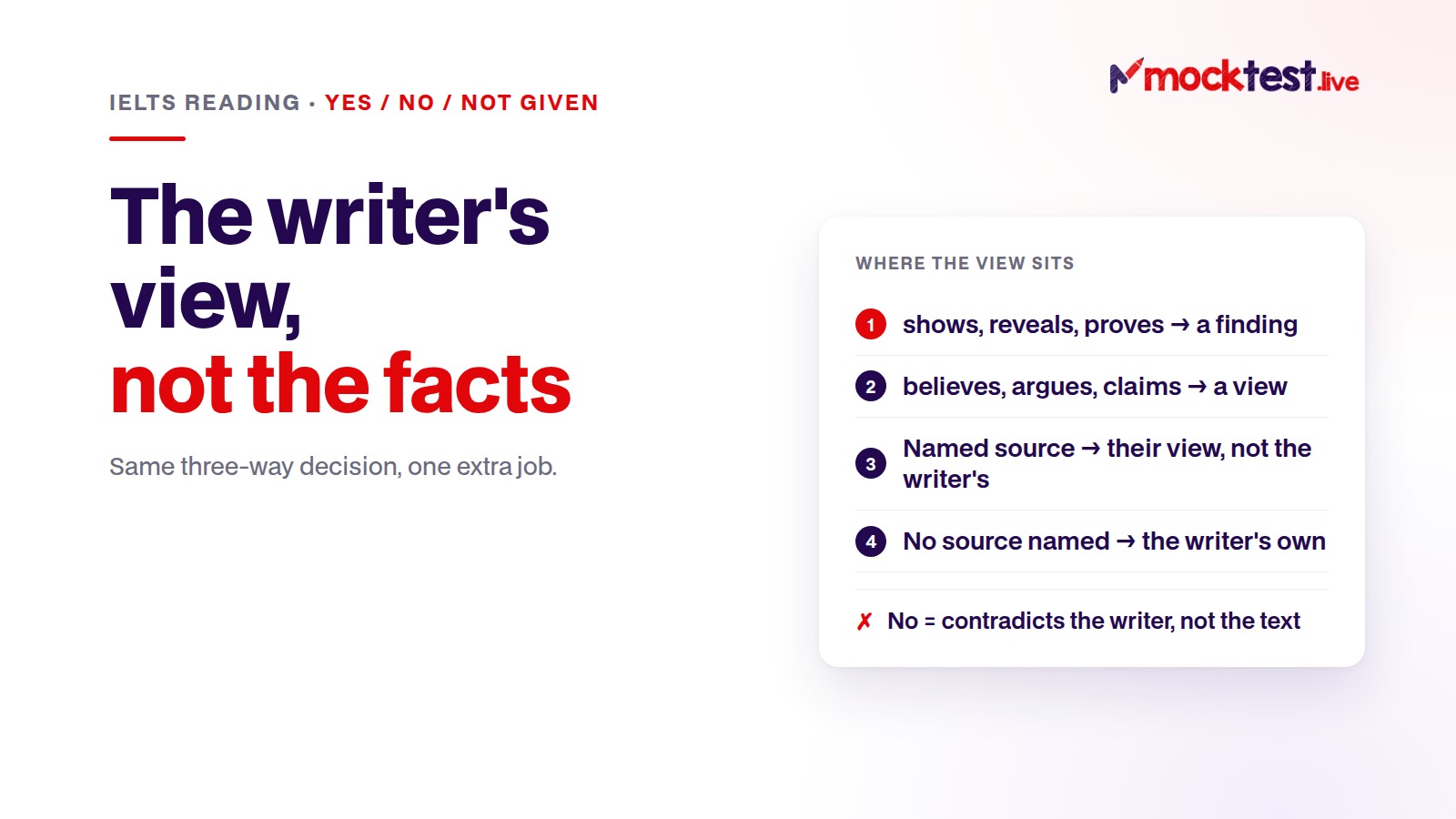
| The verb | What follows it |
|---|---|
| shows, reveals, proves, demonstrates, found | A finding. Evidence, presented as settled. |
| believes, argues, claims, suggests, maintains | A position. Someone's reading of the evidence. |
So when you reach the place in the passage, look at the verb carrying the sentence before you decide what kind of claim you are holding.
But check whose position it is. This is the half that Cambridge's sentence does not do for you: "the researchers believe" is the researchers' view, not the writer's. A passage that reports three experts disagreeing contains three positions and possibly none of the writer's. The writer's own view appears where there is no attribution — where the sentence simply asserts, or evaluates, in the writer's own voice.
A rough test that holds up in practice: if you can put "according to X" in front of the sentence and it still reads naturally, it is X's view. If there is nobody to name, it is the writer's.
Three habits to drop
Treating a reported view as the writer's. Covered above, and it is the single biggest source of wrong Yes answers.
Answering from your own knowledge. ielts.org warns against it in the instructions for this task, and IDP's examiner-approved tips say the same thing the other way round: "The Reading passages always contain the information you need to answer the question. You won't have to use your own knowledge of a topic." A statement can be plainly true in the world and still be Not Given here.
Writing TRUE when the task says YES. Use the labels the instruction gives you. They are not interchangeable, and the set tells you which it wants at the top. If the False-versus-Not-Given line is still where your marks go, the long version is False versus Not Given, without guessing.
Where this sits in the paper
Yes/No/Not Given usually appears on passages with an argument in them rather than a description — which tends to mean passage 3, and the end of your hour. That is worth planning for rather than discovering: the 60-minute plan budgets for it.
And the skill underneath it — recognising the same idea in different words — is the one that decides why the question's words are not the passage's words.
Practise where you can see the deciding line
For every item you get wrong, write out the sentence in the passage that settles it and mark the verb. Ten of those and the fact/opinion boundary stops being something you reason about and becomes something you see.
Our Cambridge papers are free and run on a screen built to match the computer-delivered test, with a highlighter for the sentence that decided the answer. Reading and Listening are marked the moment you submit. We are not affiliated with Cambridge, IDP or the British Council.
The definitions are quoted from ielts.org's Academic Reading format page; the relationship between the two task types and the shared strategy from Cambridge English's teacher's notes for identifying information and identifying the writer's views; the findings-versus-opinions verbs from its matching-features notes, where that guidance is published; and the knowledge warning from IDP's examiner-approved tips — all checked on 7 October 2026.