
In this guide9 sections
- The words that are not in the Speaking band descriptors
- What the IELTS Speaking Part 2 cue card actually looks like
- How long should you speak in IELTS Speaking Part 2?
- Do you have to cover all the bullet points?
- What to do with the preparation minute
- The two questions afterwards, and how much Part 2 is worth
- The 2026 cue card lists, and what memorising costs you
- Does your accent affect your Speaking band?
- Sitting Speaking in Bangladesh
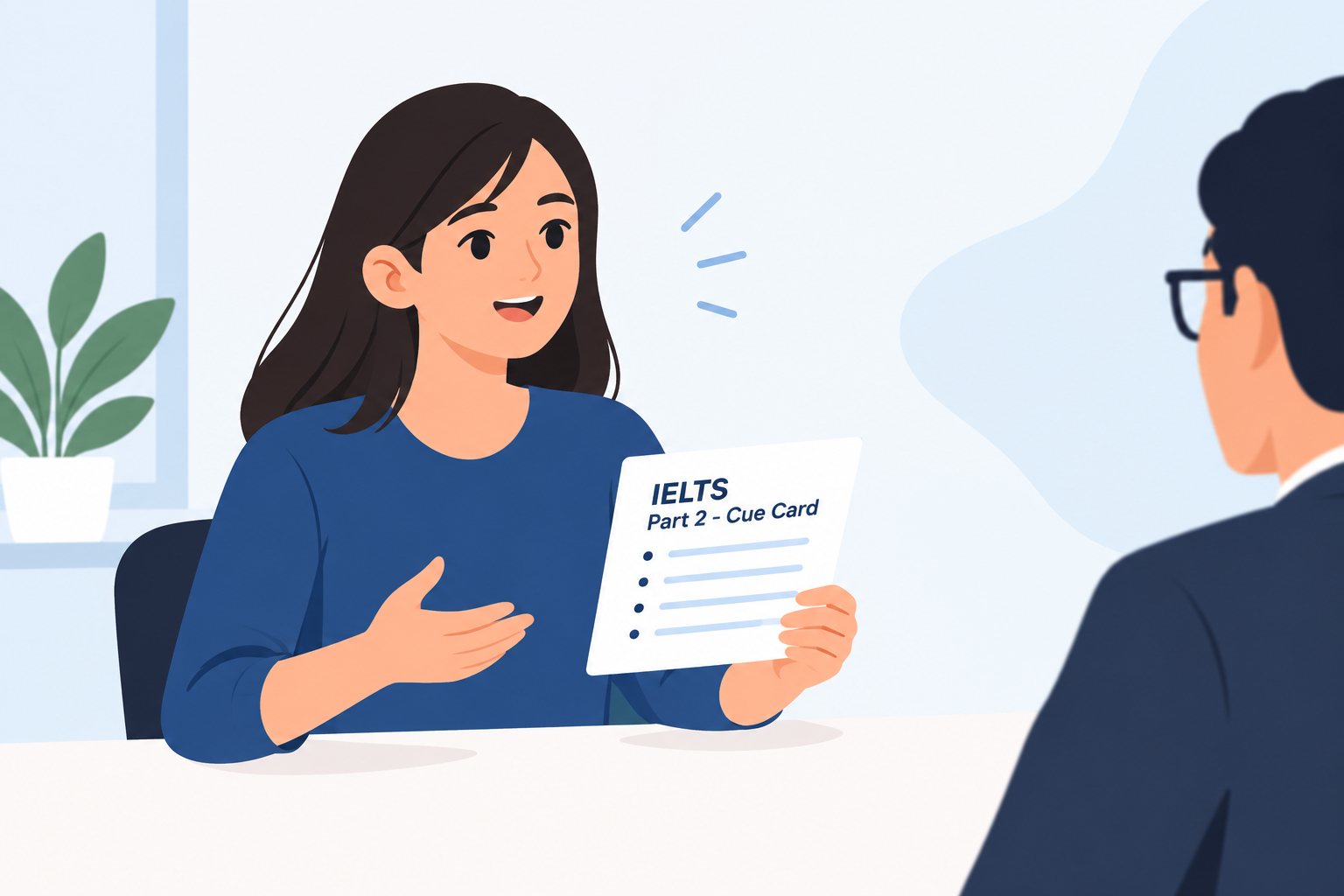
A student in a mock finished her long turn at one minute twelve, and then apologised. Not for anything she had said. For the clock. Somebody had told her the IELTS Speaking Part 2 cue card is marked out of two minutes and that stopping before ninety seconds costs you a band, so she spent the next half-minute saying sorry in visibly worse English than the English she had just been using.
She had answered the card in order, without a stall, and stopped when she was finished. Then she undid part of it.
So I went looking for the rule she had been taught.
The words that are not in the Speaking band descriptors
Download the public Speaking Band Descriptors from ielts.org and search the text. The words minute, second, two minutes, bullet and cue card appear nowhere in the document. Not in Fluency and coherence, not in a footnote.
The Key Assessment Criteria, the other published document examiners work from, defines fluency by exactly two indicators. Speech rate, "ideally, not too slow". Speech continuity, meaning a flow that "will not be excessively interrupted by false starts, backtracking, functionless repetitions of words and phrases, and/or pausing during which the test taker searches for words". How long the turn lasts is not among them.
That is the entire basis of the ninety-second rule, the one-minute-forty-five target and every variation of "you lose marks if you stop early". There isn't one. They are coaching heuristics repeated until they acquired the grammar of regulation.
What the IELTS Speaking Part 2 cue card actually looks like
The official name is not cue card. The published documents say task card, which is why the official sites turn up so little when you search for "cue card". Everyone in Dhaka says cue card. Same piece of paper.
The examiner "gives you a task card which asks you to talk about a particular topic", then gives you "one minute to prepare your talk" along with "a pencil and paper to make notes". You talk for one to two minutes. The examiner "may then ask you one or two questions on the same topic".
On the number of prompts, be careful with what you have read. IDP states that "every task card will have a topic that you will have to describe followed by three bullet points, and a final question". ielts.org commits to no number at all. Every card my students have brought back out of a test has had a topic line, three prompts and a closing and explain, so that is the shape to practise on — but that is IDP's wording plus my own tally, not a rule. Count the closing prompt as a fourth bullet if you like. Plenty do.
The whole of Part 2 is officially "3-4 minutes, including the preparation time", inside a Speaking test of 11-14 minutes. A minute of prep and two of talking does not fill that slot, and isn't meant to.
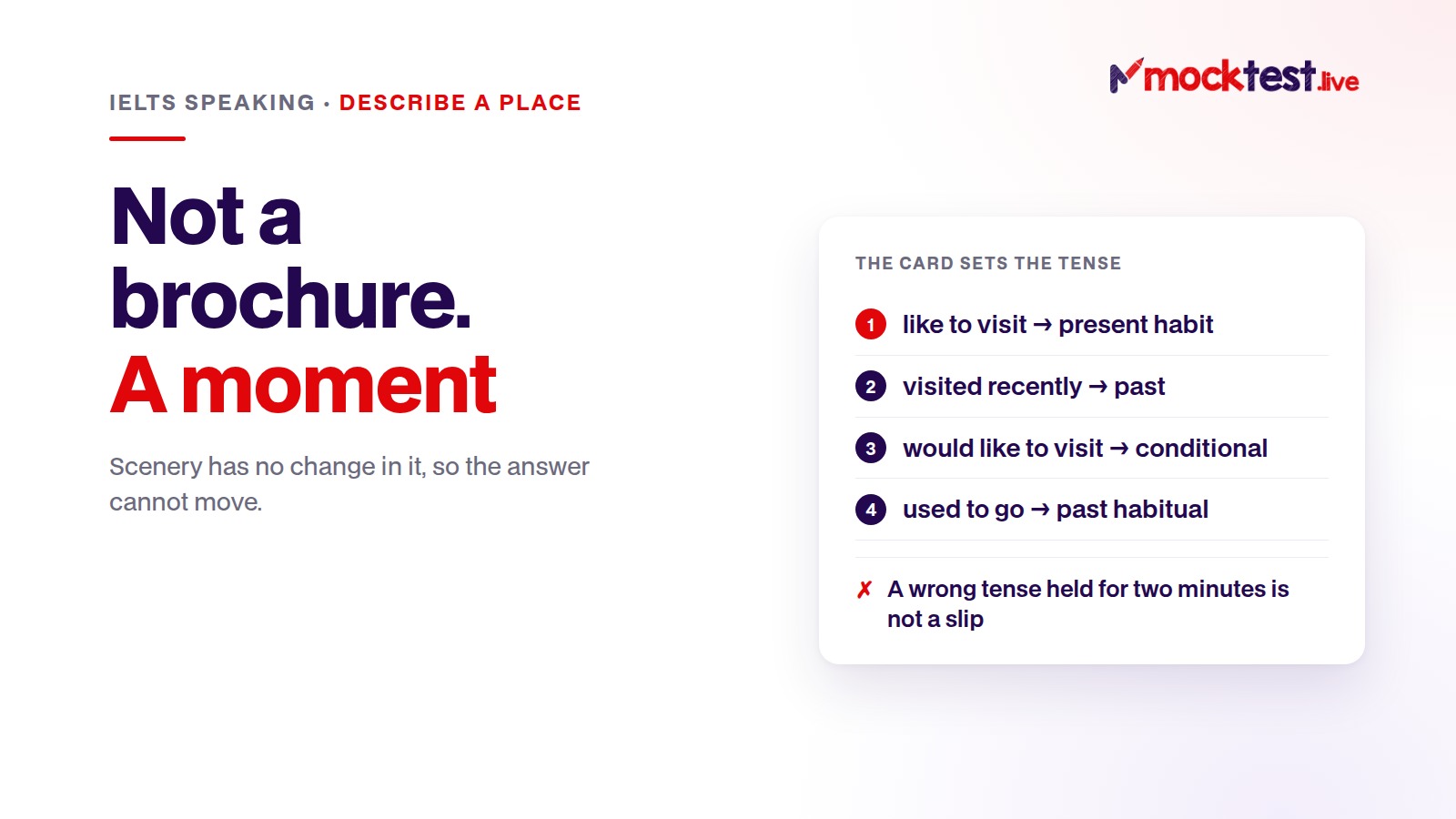
A card in the shape you will meet, written for this article and not an official one, followed by an illustrative answer written for this article too:
Describe a piece of advice you were given that you did not take.
You should say:
- who gave you the advice
- what the advice was
- why you decided not to follow it
and explain what happened as a result.
An illustrative answer to that card
Not a model, not a template, and not anybody's real turn. It runs to about two minutes at an unhurried pace.
The advice came from my uncle, my mother's older brother, who has run a pharmacy in Mymensingh for something like twenty years. This was the year I finished my HSC. I wanted to study economics, and he told me over lunch, quite seriously, that I should do a BBA instead, because economics graduates in this country end up teaching and nothing else.
I did not take it. Partly because I was eighteen and he was the fourth person that week to tell me what to do. Mostly because economics was the only class I had ever stayed awake in.
What happened afterwards was less dramatic than either of us expected. I did the degree, I did not become a teacher, and I ended up in a bank doing work my uncle now describes to other relatives as basically business. So he was right, but by accident.
The part I still think about is why I ignored him. It was not bad advice. It was reasonable advice from someone who had made his own decision at nineteen and never had to look at it again, and he was handing me the end of his story as though it were the start of mine.
Read that against the fluency column below rather than against a structure. It takes two of the prompts and leaves one nearly untouched. It has no signposted introduction, no firstly, secondly, and no idioms. The pauses it invites are the band 9 kind, the ones you take to work out what you think, not the ones you take to hunt for a word.
How long should you speak in IELTS Speaking Part 2?
Read the fluency column downwards.
| Band | Fluency and coherence, current published wording |
|---|---|
| 4 | "Unable to keep going without noticeable pauses." |
| 5 | "Usually able to keep going, but relies on repetition and self-correction to do so and/or on slow speech." |
| 6 | "Able to keep going and demonstrates a willingness to produce long turns." |
| 7 | "Able to keep going and readily produce long turns without noticeable effort." |
Nothing there is a stopwatch reading. What moves you up the ladder is what continuing costs you. At 5 you continue by repeating yourself and slowing down. At 6 you are evidently willing to. At 7 it has stopped looking like work.
Higher up the criterion adds a second thing. Band 8: "Topic development is coherent, appropriate and relevant." Band 9: "Topic development is fully coherent and appropriately extended", with hesitation used "only to prepare the content of the next utterance and not to find words or grammar". That is what the long turn exists to expose. Pausing because you are thinking, or pausing because you are hunting for the word.
What happens to the clock is documented and dull. The examiner uses a timer. If you stop early, IDP says the examiner "will wait for the test taker to keep going, and if they don't, they will be asked if they have anything more to say". If you are still going at two minutes, "the examiner will interrupt you at the 2-minute mark", which the same article says not to worry about: "you have already shown the examiner that you can speak at length".
Now the boundary of what is published. No official source says a short turn lowers your score, and none says it doesn't. What I can say is that a turn collapsing at forty seconds is, on its face, evidence against "able to keep going" — an inference from the descriptor, and I want it labelled as one. What I tell candidates: aim to be stopped, because a turn that runs to the interruption has demonstrated the thing being measured.
Do you have to cover all the bullet points?
No, and the reason is structural rather than generous.
IELTS Speaking has four criteria and none of them is task response: Fluency and coherence, Lexical resource, Grammatical range and accuracy, Pronunciation. Compare Writing, which does have a Task Response criterion, so an unaddressed part of the prompt is a direct, findable loss there, as we set out in band 6 versus band 7 in Writing. Speaking has no equivalent column, and nothing on the sheet to deduct from for a missed bullet.
Relevance does count, but it enters elsewhere. The Key Assessment Criteria list the coherence indicators as logical sequencing, clear marking of stages with pausing and discourse markers, "relevance of spoken sentences to the general purpose of a turn", and cohesive devices. And topic development is named in the descriptors only at bands 9 and 8, inside Fluency and coherence.
So the bullets are scaffolding for a developed, relevant turn, not a checklist, and reciting them as four labelled paragraphs with a signposted conclusion is a template nobody asked for. My reading of the published wording — and it is a reading, not a rule — is that a candidate who takes one prompt and develops it properly for ninety seconds sits closer to "topic development is coherent, appropriate and relevant" than one who touches every prompt in twenty-second instalments.
What to do with the preparation minute
Three things about that minute are actually in the official guidance, and none of them is the thing candidates spend it on.
You may ask what a word means. ielts.org: "If you don't understand a particular word on the Speaking Part 2 task card, point to the word and ask the examiner what it means at the beginning (not the end) of your preparation time." At the beginning, and it costs you nothing.
You may read your notes while you talk. The same page confirms "you can check them if you need to during your 1 to 2 minute speaking time", and recommends "phrases rather than full sentences". That glancing down costs you fluency marks is in no published document.
And nobody marks the notes. IDP: "you won't be tested on what you write, so don't worry about spelling." Misspell them, abbreviate them, leave them half-finished.
What I would actually write
Opinion from here, and treat it as opinion. Do not write sentences. In sixty seconds you can write perhaps twenty words, and if they form sentences you will read them aloud: flat delivery, an audible register shift, a stall each time you look away.
What I would put down: a name, a place, a time, three or four nouns I want to reach, and one thing to say about why, because the closing prompt is often a why, and in my experience that is where candidates run out of road. The prompts are already printed on the card in front of you. Copying them wastes half the minute.
If you go blank, describe something concrete. Where you were standing, who else was there. Detail is easier to produce under pressure than opinion, and it keeps speech moving while the answer assembles.
Whether you may ask for a different card, no official source I can find addresses, so assume the card you get is the card you have. Whether the story has to be true, nobody has ruled either way, and anybody confident about it is giving you an opinion; mine is that a real memory is easier to sustain for two minutes than an invented one.
The two questions afterwards, and how much Part 2 is worth
After the long turn the examiner "may then ask you one or two questions on the same topic" — may, not will. After the card about advice you did not take, that is something on the order of "do people in your family often give each other advice?", and then it stops. They are not Part 3 and do not want Part 3's extended answers: the students I see who have been drilled on Part 3 hear a question like that and launch ninety seconds of signposted argument. A couple of sentences and the examiner moves on, though no published document sets a length.
As for weight, the four criteria "carry equal weighting and the overall average gives the IELTS score for Speaking". No separate band is reported for Part 2 and no percentage is attached to it. The footnote to the official descriptors settles the panic. Note (ii): "A candidate will be rated on their average performance across all parts of the test." Note (i) is the harder one: "A candidate must fully fit the positive features of the descriptor at a particular level." Fully. A criterion is not rated on your best thirty seconds of it, so a feature you produce sometimes is not a feature you fully fit, and the criterion settles at the band you actually sustained.
You get one Speaking band, in whole or half bands from 0 to 9. A bad two minutes in the middle of a good fourteen is not the catastrophe it feels like on the way home.
Our Cambridge papers cover all four modules on a screen built to match the computer-delivered interface. For Speaking you record your answers to all three parts, the Part 2 long turn included, and an instructor marks them on the four criteria. A recording cannot follow up on what you said the way an examiner does, so practise the conversation with a person as well. Every Cambridge paper is free.
The 2026 cue card lists, and what memorising costs you
No IELTS partner publishes upcoming task card topics, a topic cycle, a four-month window or a country list. What the compilations are, instead, is real in one narrow sense: somebody sat the test and wrote down what they remembered on the way out. That is the whole provenance. A candidate posts "describe a piece of technology you find difficult" to a forum in March, forty sites have scraped it by April, and by January somebody has arranged the pile into a seasonal rotation that no partner has ever published. Practise from them. Do not plan from them.
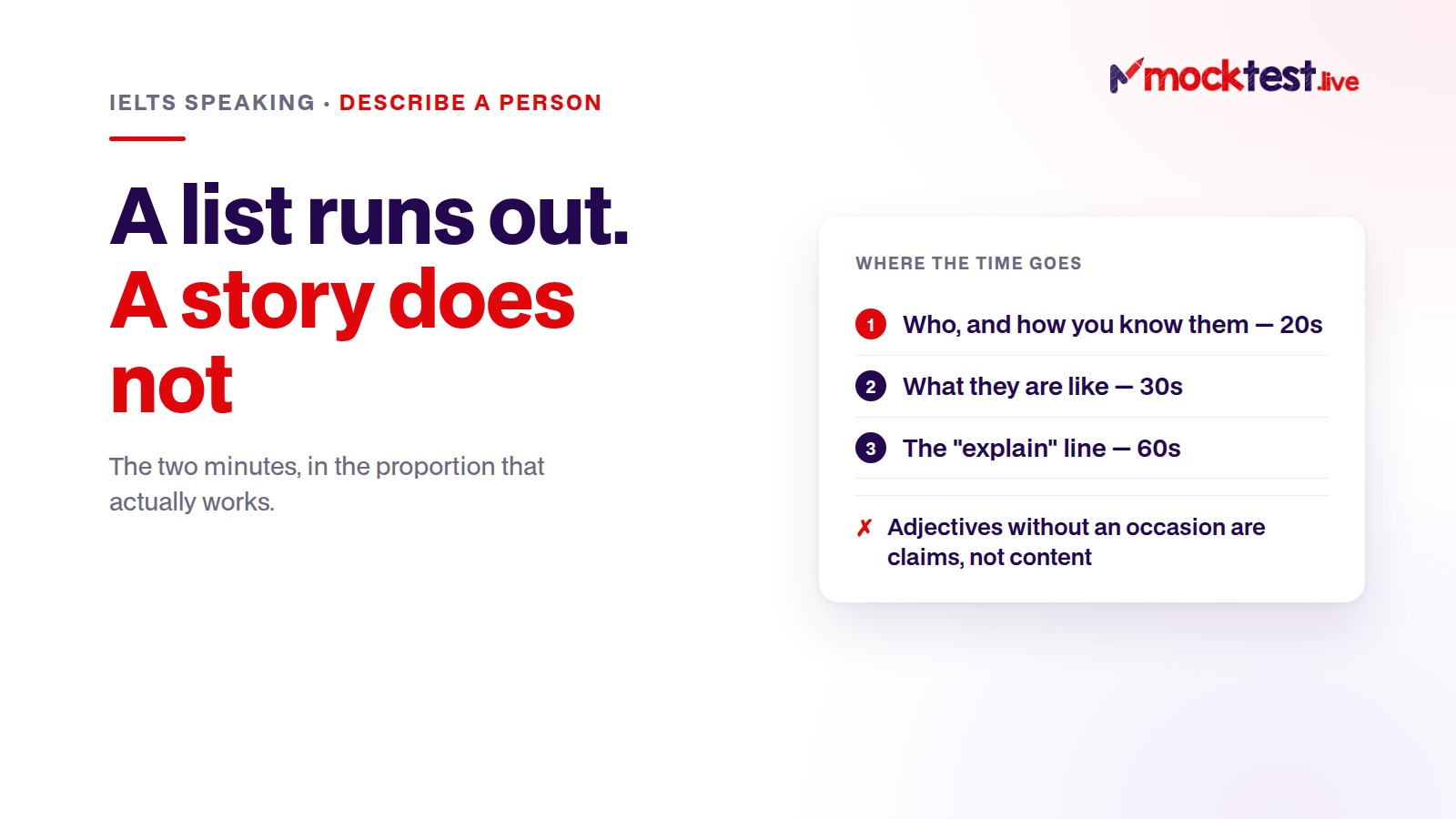
Two of the card families have their own piece, each built on a worked model answer: describe a person and describe a place.
Memorisation is the failure mode those lists produce. ielts.org: "Examiners are highly trained to spot memorised answers, which never bodes well for test takers." No published rule sets a deduction, so nobody can honestly tell you what it costs. In practice sessions, a memorised answer is usually audible by about the fourth word: the rhythm goes wrong and the vocabulary stops matching the vocabulary of Part 1, which the examiner has just spent four or five minutes listening to.
Stuffing the turn with idioms is the same error in another coat. The band 7 lexical cell does not ask for a display of idiom: it asks for some ability with less common and idiomatic vocabulary, and expects some inappropriate choices at that band. (Summarised from the current Lexical resource column, not quoted.) An idiom used wrong is more visible than a plain word used right.
Does your accent affect your Speaking band?
Accent needs one clean distinction. ielts.org says "a natural accent or slang will not have any effect on your test score". The descriptors are more precise: band 9 pronunciation includes "Accent has no effect on intelligibility", band 8 "Accent has minimal effect on intelligibility". No accent is preferred and none is penalised as an accent. What is scored is whether you are understood. In the Bangla-speaking learners I work with, that tends to come down to word stress, /v/ sliding towards /bh/, and the final consonant clusters in words like asked and months.
Sitting Speaking in Bangladesh
Bangladeshi press reported that IELTS on Paper was withdrawn here from 1 February 2026, ahead of the global date, and that is what we covered in what changes now paper has ended. We could not confirm it on an official British Council Bangladesh or IDP Bangladesh page when we checked on 11 September 2026, so check your centre's booking page before you assume there is no paper seat. Globally, IELTS has said that "from mid-2026, we will no longer offer IELTS as a paper-based test", announcing no change to Speaking.
Speaking did not move onto the screen. It remains a live interview: "The Speaking section is completed during a face-to-face session with a trained IELTS examiner." IDP Bangladesh says that for IELTS on Computer "the Speaking test will be taken on the same day, either before, or after the other three parts of the test", subject to change without prior notice. Confirm your own timing on your booking confirmation, not here.
Fees, from the IDP Bangladesh page on 11 September 2026 and stated there as identical across their Bangladesh centres: IELTS on Computer BDT 29,600, One Skill Retake BDT 18,600, Speaking reschedule BDT 1,500. I could not retrieve a British Council Bangladesh figure, and the two partners' prices here are not always the same, so check theirs on their own site. Fees here track the exchange rate and move.
One Skill Retake is the rule worth knowing. It lets you resit a single section, Speaking included. Your original test must have been an IELTS on computer test, you must sit the retake within 60 days of it, and you can use it once per original test. Availability is per centre; the official page says to check with yours.
Before any of that, get assessed out loud by a person, the fifth of the five checks before you book and the one I can hear has been skipped inside the first thirty seconds. Hand someone a card. Take the minute with a pencil. Talk until they stop you at two, and record it. You will hear the four-second gaps you did not notice and the word you used eleven times.
You will not hear a band. Nobody can give you one of those from a phone recording.
Published 18 Sept 2026 · Last checked 10 Oct 2026