
Speaking Part 1 is the shortest part of the test and the one people prepare for worst. They either ignore it because it looks easy, or they over-prepare it with a notebook full of memorised answers. Neither works well.
I coach Speaking, and most of what goes wrong in Part 1 has nothing to do with English level. It is about answer length and sounding like yourself. This article covers the common questions, how to answer them, and a few sample answers you can learn from without copying.
What IELTS Speaking Part 1 is
The Speaking test is a face-to-face conversation with an examiner, and it is recorded. It has three parts and takes 11 to 14 minutes altogether.
Part 1 lasts four to five minutes. ielts.org describes it as general questions on familiar topics such as home, family, work, studies and interests. It is meant to be the warm-up: the examiner wants to hear you talk about ordinary things you know well.
Part 2 is the long turn with a task card, and Part 3 is a more abstract discussion. I have written separately about the Part 2 cue card.
How Part 1 is marked
You are scored on four criteria, each worth the same:
- Fluency and coherence: whether you can keep talking without long stops, and whether your ideas connect.
- Lexical resource: the range and precision of your vocabulary.
- Grammatical range and accuracy: whether you use a mix of structures, and how accurately.
- Pronunciation: how easy you are to understand.
Notice what is not on that list: whether your answer is interesting, clever or "correct". Nobody marks you down for saying you do not like cooking. They mark how you say it.
Common IELTS Speaking Part 1 questions
Nobody outside IELTS knows which questions will come on your day. The lists you find online, including "latest questions" for this year, are things candidates remembered afterwards. They are useful for practice and useless for prediction.
What you can rely on is the kind of topic. These come up again and again.
Work or study
The examiner usually opens here, or with where you live.
- Do you work or are you a student?
- What do you study? Why did you choose it?
- What do you like most about your job?
- Is there anything you would like to change about your work?
Home and hometown
- Where are you from?
- What do you like about living there?
- Do you live in a house or a flat?
- Has your area changed much in recent years?
Daily life
- What do you usually do in the morning?
- How do you get to work or university?
- Do you prefer mornings or evenings?
Free time and interests
- What do you do in your free time?
- Do you like reading? What kind of books?
- Do you enjoy watching sport?
- Have you ever learned a musical instrument?
Food, weather and other everyday things
- What is your favourite food?
- Do you like cooking?
- What kind of weather do you like?
- Do you use your phone a lot?
How to answer: the two-or-three-sentence rule
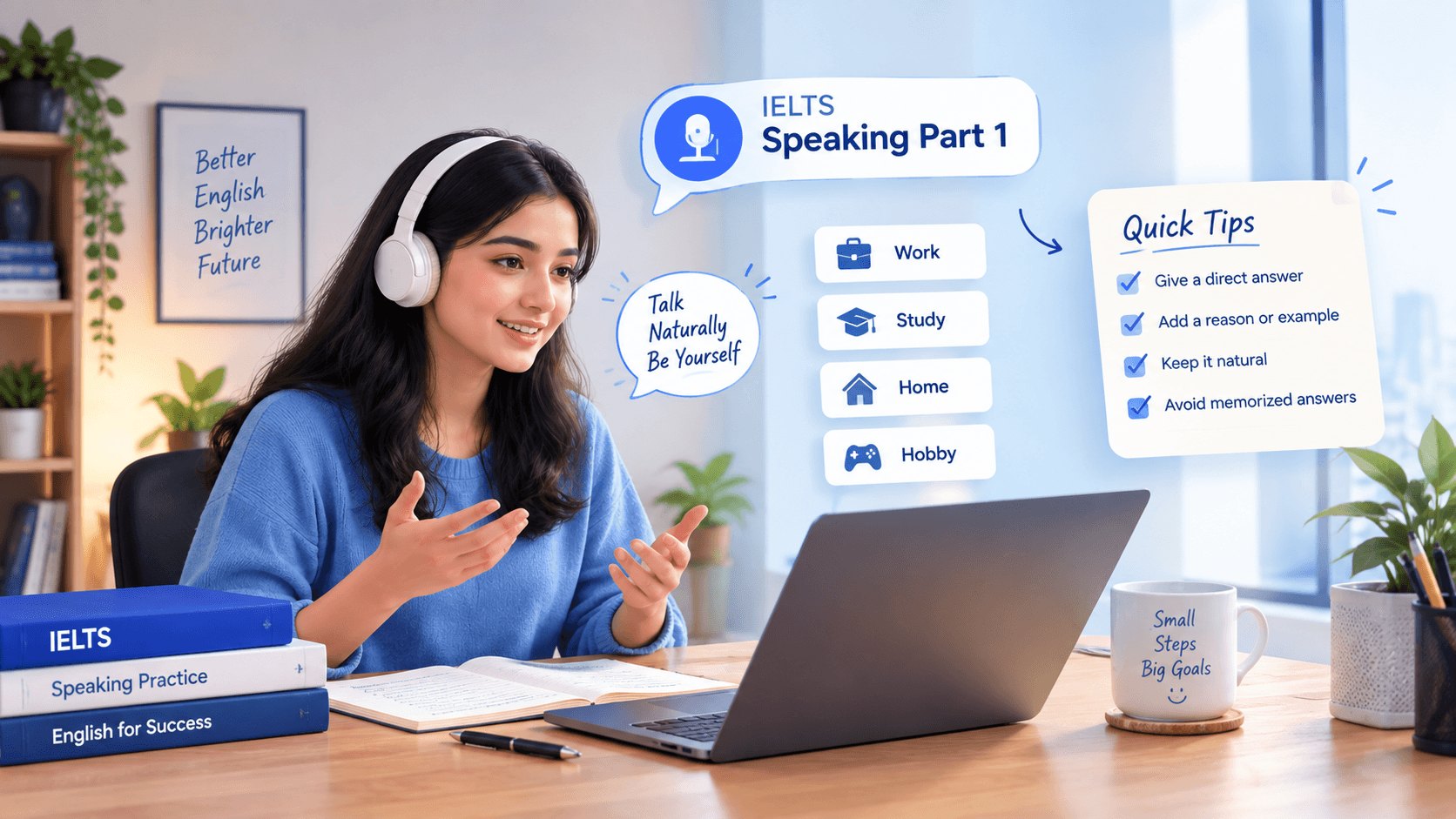
There is no official answer length. What I tell my students is simple: give a direct answer, then add one reason or one small example. That usually comes to two or three sentences.
Here is the same question answered three ways.
Do you like cooking?
Too short: "Yes, I do."
This gives the examiner almost nothing. There is no vocabulary to hear and no grammar beyond three words.
About right: "Yes, quite a lot, although I only cook properly at weekends. During the week I leave home early and get back late, so on Fridays I usually make something slow, like a beef curry, because I actually have time to enjoy it."
A direct answer, a reason, a concrete detail. It sounds like a real person, and it quietly shows a range of structures without trying.
Too long: a two-minute story about learning to cook from your grandmother, the recipe, and the time you burned the rice.
Nothing is wrong with the English, but this is Part 1. The examiner has several questions to get through in four or five minutes and will stop you to move on. Save the long, detailed answers for Part 2.
Sample answers
These are written to show the shape of a good answer. Please do not memorise them. Read them, notice what they do, then answer the same questions about your own life.
Where are you from?
"I'm from Sylhet, in the north-east of Bangladesh, but I've lived in Dhaka for about six years now because of university. Sylhet is much greener and quieter, so whenever I go home it takes me a day or two to get used to how calm it is."
What do you do in your free time?
"Mostly I play cricket with friends on Friday mornings, if the weather allows. The rest of the time I'm honestly quite lazy. I watch a series or scroll through my phone more than I'd like to admit."
Do you like rainy weather?
"I used to love it when I was a child, because rain meant no school sometimes. Now I have to travel to work, so heavy rain mostly means flooded roads and traffic. I still like the sound of it at night, though."
Look at what these have in common. None of them is formal or impressive. Each one has a small personal detail, a bit of contrast ("I used to... now I..."), and ends naturally. That is exactly what Part 1 rewards.
The mistakes that cost marks
Memorised answers
This is the big one. Coaching centres sometimes hand out booklets of "band 9 answers", and candidates learn them word for word.
The problem is practical. The examiner asks follow-up questions and can move to a new topic whenever they like. A memorised paragraph rarely fits the exact question asked, and it tends to come out at a strange, even speed that sounds recited rather than spoken. When the next question arrives and there is no script for it, the difference in fluency is obvious.
Learn the topics. Do not learn the answers.
Answering a question you were not asked
Candidates who have prepared a speech on "my hometown" sometimes deliver it whatever the question. If you are asked whether your area has changed, talk about change.
One-word answers from nerves
The opposite problem. Nervous candidates answer "yes" and wait. The examiner will ask the next question, and you will have missed a chance to show your English. Give the reason, even a short one.
Worrying about the "right" answer
There is no right answer. If you do not like reading, say so, and say why. An honest "not really, I find it hard to concentrate on long books" is better than an invented passion for novels.
Not asking for a repeat
If you did not catch the question, say "Sorry, could you repeat that?" It is normal in any conversation, and it is much better than guessing wrong.
How to practise Part 1 at home
You do not need a partner. You need a phone.
- Pick one topic from the lists above.
- Record yourself answering four questions on it, as if the examiner were asking.
- Listen back once. Notice where you stopped for a long time, and where you used the same word three times.
- Record the same four questions again the next day, without reading anything first.
The second recording is usually noticeably better, and that improvement is the skill you are building: talking about ordinary things smoothly, in your own words.
Speaking is only one quarter of your band, and the other three are just as easy to leave untested until the real day. A full paper under real timing shows you where they stand.