
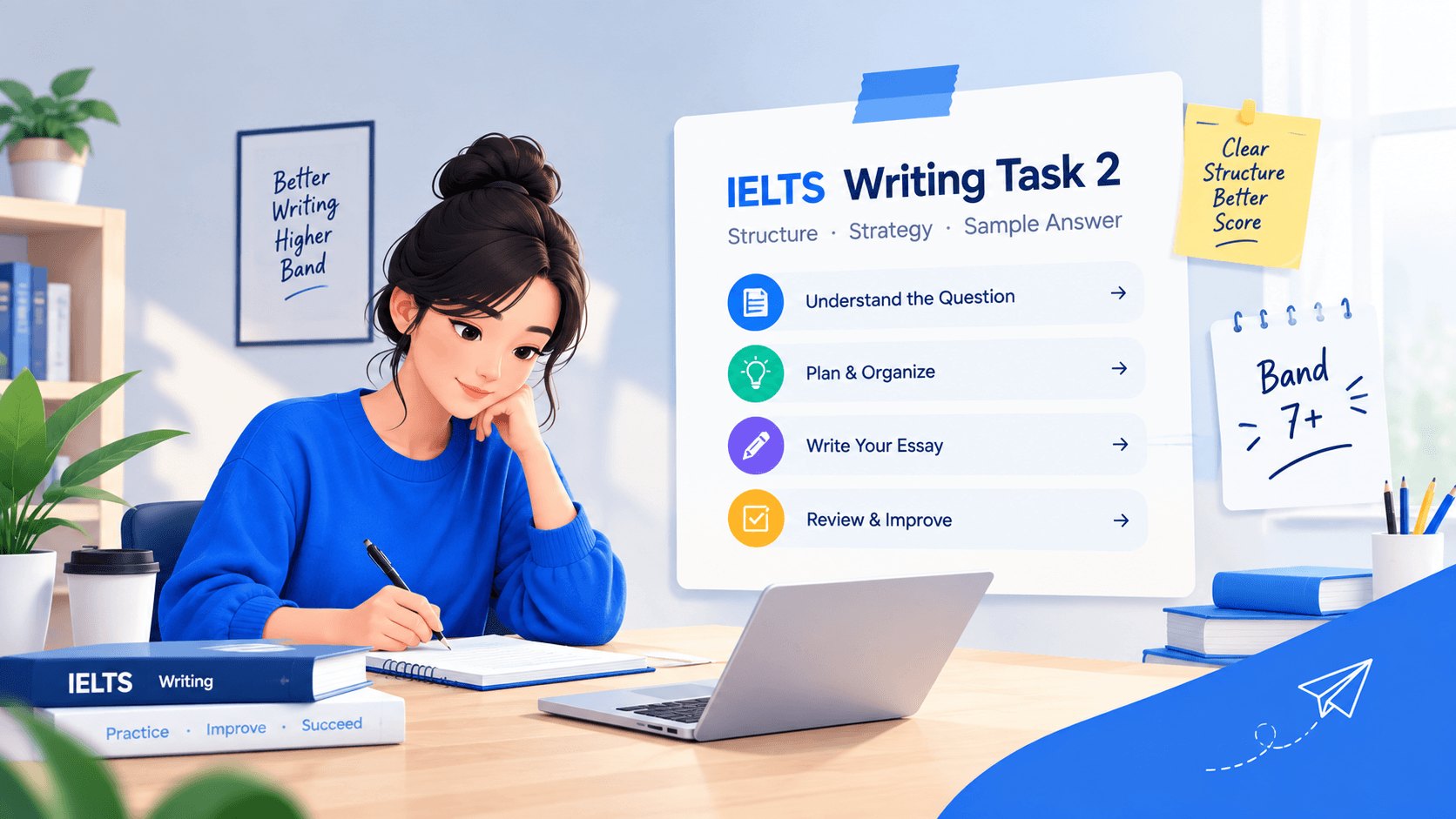
Writing Task 2 is where most IELTS scores are won or lost. It counts for twice as much as Task 1, and it is the part candidates tell me they dread most.
I mark Writing. The good news from the marking side is that the structure of a strong answer is not complicated. The scripts that score badly rarely fail because the structure was too simple. They fail because they did not answer the question, or because they were built from a memorised template that answered a different one.
What Writing Task 2 asks for
Here are the official facts, from ielts.org:
- You should spend no more than 40 minutes on it, out of 60 minutes for the whole Writing test.
- You must write at least 250 words.
- You write in an academic or semi-formal, neutral style.
- Task 2 contributes twice as much as Task 1 to your Writing score.
It is marked on four criteria of equal weight: task response, coherence and cohesion, lexical resource, and grammatical range and accuracy.
On length, ielts.org puts it carefully: if your answer is too short, "there may not be enough evidence of the language features needed in order to award higher bands." Aim for roughly 270 to 300 words. Writing 400 does not earn extra credit, and it eats the time you need for checking.
The shapes a Task 2 question takes
IELTS does not publish a list of question types. But if you read enough past questions, you see the same few shapes, and it helps to recognise them because each one asks you to do something slightly different.
| Shape | Typical wording | What you must do |
|---|---|---|
| Opinion | To what extent do you agree or disagree? | Take a clear position and defend it |
| Discussion | Discuss both views and give your own opinion. | Explain both sides, then say where you stand |
| Advantages and disadvantages | Do the advantages outweigh the disadvantages? | Weigh both, and say which is greater |
| Problem and solution | What are the causes? What can be done? | Answer both questions |
| Two questions | Two separate direct questions | Answer each one fully |
The last column is the one to pay attention to. A very common reason for a low task response score is answering half the question: giving your opinion when you were asked to discuss both views, or explaining causes and forgetting solutions.
A simple structure that works for all of them
Four paragraphs. That is it.
Introduction (2 to 3 sentences). Restate what the question is about in your own words, then give your position or say what the essay will do. Do not copy the question word for word.
Body paragraph 1 (5 to 7 sentences). One main idea. State it, explain why, then support it with a specific example.
Body paragraph 2 (5 to 7 sentences). Your second main idea, or the other side of the argument, built the same way.
Conclusion (2 to 3 sentences). Sum up your position. Do not add a new argument here.
The structure is not what gets you a high band. It is what stops you losing marks for coherence. What earns the band is what goes inside each paragraph.
How to spend 40 minutes
This is the split I suggest to candidates:
- 5 minutes planning. Read the question twice. Underline exactly what it asks. Decide your position and jot down your two main ideas with one example each.
- 30 minutes writing. Introduction, two body paragraphs, conclusion.
- 5 minutes checking. Read it through once, looking for your usual mistakes.
Candidates who skip planning often change their mind halfway through the essay, and it shows. Five minutes feels like a waste when the clock is running. It is not.
A sample question and answer
Here is a question I wrote for practice, and an answer written to show the structure above. It is aimed at the band 7 descriptors, but please treat it as an illustration, not an official band. Another examiner might mark it differently.
In many cities, more people now work from home for at least part of the week. Do the advantages of this outweigh the disadvantages?
In many cities, it has become common for office employees to spend some of their working week at home rather than at their workplace. In my view, although this arrangement has real drawbacks, its advantages are greater for most workers.
The strongest argument in favour of working from home is the time it saves. In a city like Dhaka, a commute of an hour or more in each direction is normal, which means many people lose ten hours or more a week simply travelling. Working from home just two days a week gives back four of those hours, and they can be spent resting, with family, or on the work itself. Employers also benefit, since staff who are less exhausted tend to be more productive, and a company that needs fewer desks can rent a smaller office.
On the other hand, working from home is not suitable for everyone. Some people live in small, crowded homes where there is no quiet space to concentrate, and for them the office is a better environment. In addition, new employees may learn more slowly when they cannot sit beside experienced colleagues and ask questions casually. Others find it hard to separate work from home life and end up working longer hours, not shorter ones. These problems are genuine, but they mainly affect particular groups, and they can often be reduced by allowing people to choose how many days they spend at home.
In conclusion, working from home is not a perfect solution, and it disadvantages some workers more than others. However, because it saves so much time and energy for the majority, I believe its benefits clearly outweigh its costs, especially when it is offered as an option rather than a requirement.
That answer is 289 words: comfortably over the minimum, with time left to check it. Here is why it is built the way it is.
It answers the exact question. The question asks whether advantages outweigh disadvantages, and the essay says so directly in the introduction, then again in the conclusion. There is no doubt about its position.
Each body paragraph has one main idea. The first is about time saved; the second is about who it does not suit. Neither paragraph wanders.
The examples are specific. "A commute of an hour or more in each direction" in Dhaka is concrete. Compare that with "working from home saves time", which tells the examiner nothing.
It deals with the other side. The second paragraph gives the disadvantages real weight, then explains why they do not change the overall view. That is what "outweigh" requires.
The linking is simple. "On the other hand", "In addition", "However", "In conclusion". There is no need for rarer connectors. Overusing linking words is itself a coherence problem.
Why templates cost you marks
Search for Task 2 help and you will find downloadable "band 9 templates": ready-made introductions and conclusions with gaps for the topic.
The idea is appealing, and I understand why. But these sentences are written to fit every question, which is exactly the problem. A sentence that fits every question does not properly answer this one, and task response is about answering the specific question you were given.
There is a second problem. Candidates who learn the same template all use the same phrases. Examiners read hundreds of scripts, and the same memorised opening, repeated across many of them, does little for anyone's vocabulary score.
A plan is not the same as a template. Knowing that you will write four paragraphs, with your position stated in the first, is a plan. Knowing a sentence by heart that you will write whatever the question is a template. Keep the first; drop the second.
Mistakes I see often in Bangladeshi scripts
These come from marking, and they are worth checking in your own writing.
Articles
Bangla has no words that work like "a", "an" and "the". We mark definiteness in other ways, with endings like "-টা" and "-টি". So articles are one of the most common errors I see, either missing ("Government should reduce pollution") or added where English does not use them ("The people in the cities"). They are small errors, but they are frequent, and frequency is what affects grammatical accuracy.
Openings that say nothing
"Nowadays, in this modern era of science and technology..." appears in a remarkable number of scripts. It uses up words and says nothing about the question. Start with the topic itself.
Sentences that never end
Long sentences strung together with "and", "which" and "so" are hard to follow. If a sentence has run past three lines, it is usually two sentences.
Writing too much
Some candidates believe more words mean a higher band and write 400 or more. Past the minimum, extra length does not raise your score, and it often costs you the five minutes you needed to find your own mistakes.
The fastest way to improve
Task 2 improves with feedback, not with reading more sample essays. You need someone to look at your writing against the four criteria and tell you which one is holding you back.
If your Writing seems stuck, this comparison of band 6 and band 7, criterion by criterion shows exactly what changes between the two. If you are sitting Academic, the other 20 minutes decide a score of their own — what an overview really is is the paragraph most Task 1 bands turn on. And the only way to know whether your Task 2 holds up in its 40 minutes — after Task 1, and after the Listening and Reading papers that come before Writing — is to write one under real timing.