
A candidate shows me a practice paper and says the passage did not contain the answer. We look together, and it is there — in line nine, saying exactly what the question asked, without a single word in common.
This is the single most expensive misunderstanding in IELTS Reading: that the job is to find the question's words in the text.
Cambridge says the words are not there
This is not a tip somebody invented. Cambridge English publishes teaching material for each IELTS Reading task type, and it says so directly.
Read that second line again. The gap between the question's wording and the passage's wording is not an obstacle in front of the test — it is the test.
Two examples, from Cambridge's own material
These are the pairs used in the video, and they are worth sitting with for a moment.
| The question says | The passage says |
|---|---|
| a comparison of past and present transportation methods | changes in the types of transport over time |
| the impact of the car on city development | how the car has influenced the features of cities |
In the first, not one content word survives. "Comparison" became "changes", "past and present" became "over time", "transportation methods" became "types of transport". A reader scanning for "comparison" finds nothing and concludes the answer is elsewhere.
The second is the more instructive one. "Impact" has become "influenced" — a noun turned into a verb. That is a word family, not a synonym, and a memorised synonym list will not catch it. What catches it is the habit of reading for the idea and expecting the grammar to change.
So what do you scan for?
Two categories, and it helps to separate them before you start.
Words that almost never change. Names, numbers, dates, place names. A passage can rewrite "the study found a large increase" a dozen ways, but 1954 is 1954 and Copenhagen is Copenhagen. British Council's reading guidance asks the question before you scan — is it a name, a number, or an opinion? — and it is the right first question, because the answer decides whether scanning will work at all.
Words that will change. Verbs, adjectives, abstract nouns. For these, do what Cambridge's teacher's notes have students do: predict the paraphrase before you look. Their example is "arrive", which the text might give you as "turn up" or "appear".
Thirty seconds of prediction per question set turns scanning from hunting into recognition. You are no longer looking for one word; you are looking for a meaning you have already imagined in three shapes.
Finding the word is not finding the answer
Here is the other half, and it is where marks leak even when the scanning works.
Cambridge's material warns that the same words may appear in more than one paragraph — and then states the rule in seven words: "You need to look for the information not the words."
In the scripts I mark, this shows up as an answer taken from the first paragraph that mentions the topic, when the passage answers the question two paragraphs later. The keyword was a signpost, and the candidate treated it as a destination.
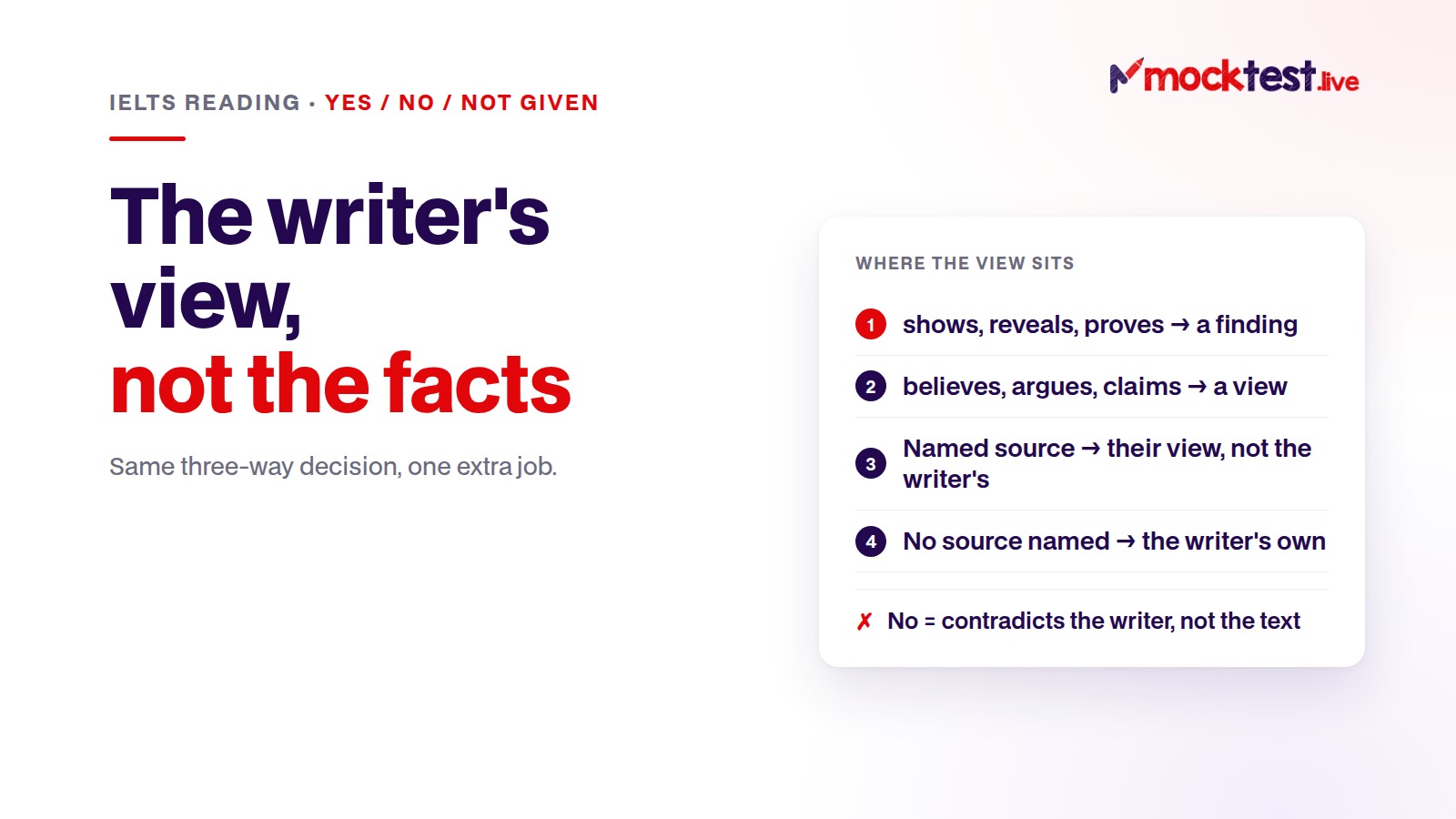
So when you land on a match: read that sentence and the one after it, and ask whether the passage actually states what the question asks. If the question is a True/False/Not Given item, that check is the entire task — and it has its own rules: False versus Not Given, and the evidence test that settles it.
The ten-minute drill
Paraphrase is a skill, not a fact, so it improves with repetition rather than with reading about it. Two directions, ten minutes a day.
- Passage to your own words. Take any sentence from a Reading passage and rewrite it, changing as many words and structures as you can while keeping the meaning exactly. Change nouns to verbs where you can — that is the word-family muscle.
- Question to possible passages. Read a question and write two or three ways the passage might have said the same thing, before you look. Then look, and see which shape it took.
Do it with a real passage rather than a vocabulary list. The point is not to collect synonyms; it is to stop expecting the text to repeat the question.
This one habit pays three times. Reading and Listening both ask you to recognise a paraphrase under time pressure, and Writing asks you to produce one — which is where developing an idea instead of restating it starts.
Practise where you can check yourself
Our Cambridge papers are free and run on a screen built to match the computer-delivered test — passage and questions side by side, with a highlighter for the line that proves your answer. Reading and Listening are marked the moment you submit, so you can go back to each wrong answer and find the paraphrase you missed. That is the feedback loop this skill needs. We are not affiliated with Cambridge, IDP or the British Council.
Quotations checked on 29 September 2026 against Cambridge English's IELTS Reading task-type activities and British Council's IELTS reading guidance.