
These two task types turn up less often than the rest, which is exactly why they cost marks. A candidate who has drilled True/False and matching headings for a month meets a diagram for the first time on test day, and spends four minutes working out how it is supposed to be read.
Neither is difficult. Both have a method, and both have one specific way of going wrong. The video above is the short version.
Short answer: what the task guarantees
ielts.org describes it in a block that is mostly rules, and two of them are gifts:
So you are transcribing, not composing, and you can work forwards without going back. Both halves matter.
The writing rules here are the same five that govern every task where you type an answer into a gap — the word limit, what counts as one word, copying exactly, grammar, and one answer per question. They are worth knowing properly, and they are set out in the five rules for summary and sentence completion. This piece is about the strategy on top of them.
The caution Cambridge adds to the order
ielts.org promises text order. Cambridge's teacher's notes for short-answer questions qualify it, using their own sample task where it does not hold:
In their sample, the answer to question 3 appears before the answer to question 2. So the guarantee is strong but not absolute, and the notes say what to do about it: if you do not find an answer quickly, "skim read around the relevant section of the text", and "keep the other questions in mind at all times".
That second instruction is the one that saves time. You are reading a passage that contains the answers to five questions, not one. Reading with all five in mind means an answer you were not looking for still gets caught as you pass it.
Diagram labelling: read the picture first
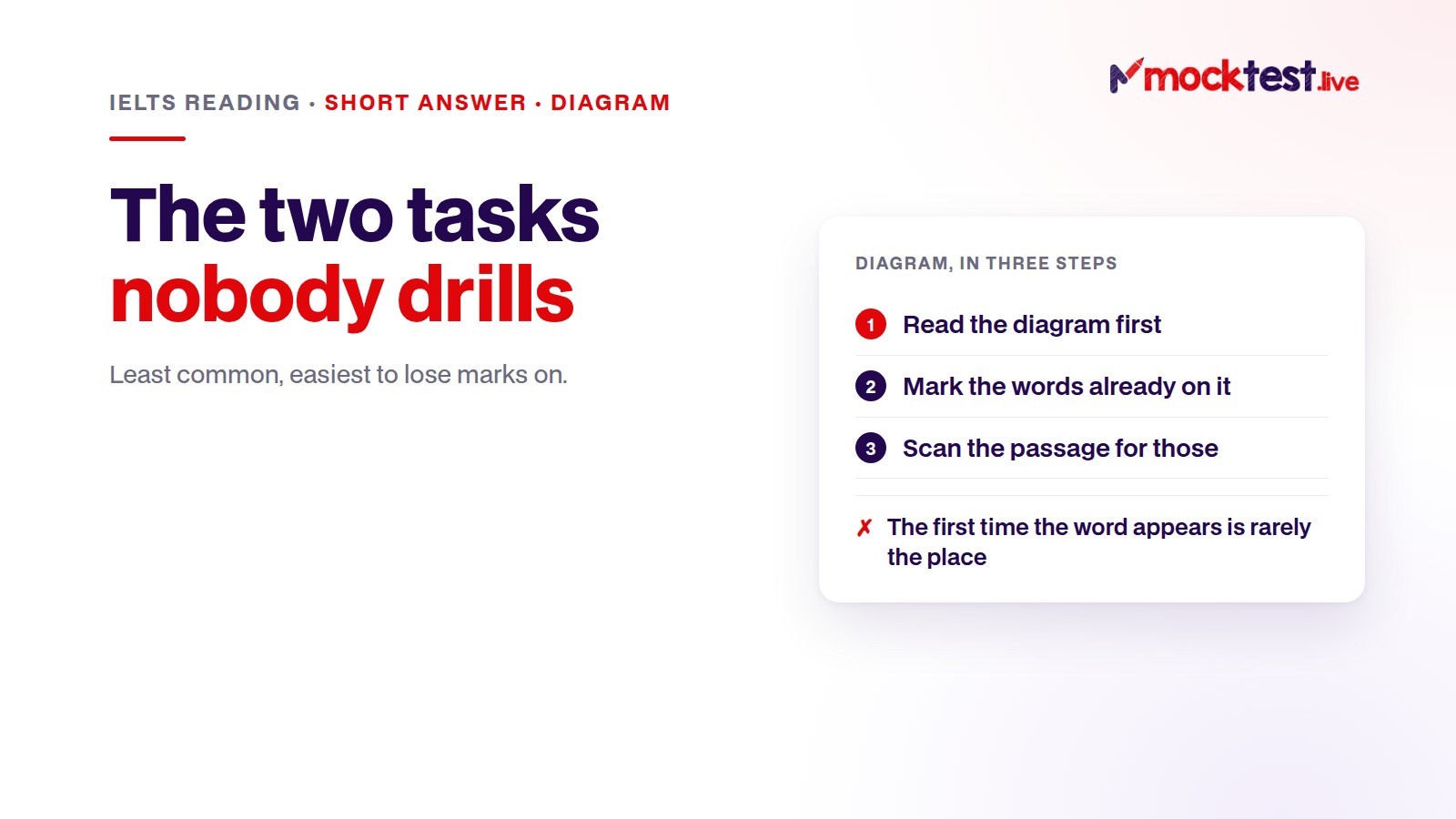
The instinct is to go to the passage and look for whatever the diagram is about. Cambridge's method does three things before that, and the order is the method:
| Step | What you do |
|---|---|
| 1 | Look at the diagram. Work out what kind of information each gap wants — a part, a material, a measurement? |
| 2 | Mark the words already printed on the diagram. Those are your key words. |
| 3 | Scan the passage for those words, skim the text around them to see whether it relates to the missing information, then read closely. |
Step 2 is the one candidates skip. The diagram arrives with labels already on it, and those labels are the vocabulary the passage will use at the point the answers live. You are given the search terms; most people never look at them.
And one thing to look for specifically. The notes tell teachers to have students pay "particular attention to expressions relating to location and position as these are likely to be the ones relating to the diagram". A diagram is a statement about where things are, so the passage's spatial language — above, beneath, at the far end, surrounding — is what the picture is drawn from.
The trap, in Cambridge's own sample
This is the part worth remembering, because it contradicts an instinct that works everywhere else:
The key word's first appearance is not the answer's location. In their example the real section is the later one, where the word recurs — because that is where the passage is actually describing the thing, rather than mentioning it in passing.
So treat a single occurrence with suspicion and a cluster as a promise. Where a passage describes something in detail, it says its name repeatedly; where it merely refers to it, once is enough.
ielts.org supports working this way: of diagram labelling it says "the answers may not come in the same order as in the text. However, they will usually come from one part of the text rather than the whole text." Find the part, and the labels are nearly all inside it.
What these two have in common
Both are tasks where the answer is a word you copy rather than a judgement you make — which means almost every lost mark is procedural rather than comprehension. You found the right place and wrote three words where two were allowed; you found the word and misspelled it; you answered from the first paragraph the word appeared in.
That is good news, because procedural marks come back faster than reading ability does. The rules are in the five completion rules, and if the finding rather than the writing is what costs you, start at why the question's words are not the passage's words.
Practise them deliberately, because the test will not
You will not meet these often enough to learn them by accident. When a paper gives you a diagram, do not skip it because it looks unfamiliar — that is the one worth sitting with.
Our Cambridge papers are free and run on a screen built to match the computer-delivered test, so a diagram task looks on the day exactly as it looks in practice. Reading and Listening are marked the moment you submit. We are not affiliated with Cambridge, IDP or the British Council.
The order guarantee, the words-from-the-text rule and the diagram ordering note are quoted from ielts.org's Academic Reading format page; the order caveat and the "keep the other questions in mind" advice from Cambridge English's short-answer teacher's notes; and the three-step method, the position-words guidance and the first-occurrence trap from its diagram-label-completion notes — all checked on 7 October 2026.