
You lost two marks on your last Reading paper writing False where the key said Not Given, and neither one was carelessness — you had a reason for both, and the reason was the problem.
That's the shape of this error. The difference between False and Not Given in IELTS Reading isn't a definition you're missing — you already know the definitions. It's a gap in what you're willing to count as proof, and it survives every article you read about it. You'll still get the next one wrong.
The difference between False and Not Given in IELTS Reading
False means the passage contradicts the statement. Not Given means the passage is silent on it — the topic may be all over the paragraph, but the specific claim isn't there to be confirmed or denied.
Now the rule that decides items:
For every False you write, you must be able to put your finger on the sentence that contradicts the claim. One sentence, occasionally two sitting next to each other. If you can quote it, it's False. If you can't quote it — if you're reaching for something that "obviously follows", or something you happen to know about solar panels or Antarctic ice or the history of the tea trade — the answer is Not Given, and you were reasoning from the world instead of from the page.
What you know is not evidence. Not even when you're right. The passage is the only witness in the room, and if it didn't testify, nothing was said.
Where the marks actually go
Nobody misses the clean contradictions. The passage says every nine years, the statement says annually, you write False, you move on. That item takes eleven seconds and you've never got it wrong.
The trap lives in partial overlap: the passage is clearly about the thing, discusses the thing, gives you three facts about the thing — and then the statement makes a claim one step to the side of everything stated. Almost always the step is one of six kinds.
| The statement says | For False, the passage must | The wrong answer you write |
|---|---|---|
| more than, faster, cheaper | compare those same two things, the other way round | False, from a comparison you assembled yourself out of two separate figures |
| because, due to, led to | state the causal link and deny it, or name a different cause as the cause | False, from two facts that merely sit near each other in time |
| most, half, only three | give a number or proportion that cannot both be true | False, from arithmetic the passage never performs |
| the first, the largest, the oldest | name a different holder of that title | Not Given, when the passage does name one and you skimmed past it |
| since 1990, before the war | date the same event differently | False, from a date you half-remember from school |
| all, never, always | show one case that breaks the rule | Not Given, when the passage hands you the exception |
Two of those six rows push the other way — towards writing Not Given when the evidence was there. This isn't an argument for choosing Not Given more often. It's an argument for choosing on evidence, which will move some of your answers in each direction.
There's a version of this that hits Bangla speakers harder than it hits, say, a Spanish speaker. If you're the kind of writer who drops articles — "he is teacher", "I read book" — and who writes informations and advices, then determiners and plural marking are a weak signal in your reading as well as your writing. Those are exactly the words that decide TFNG items. Some researchers is not researchers. A study is not the study. You aren't misreading the sentence; you're reading it accurately minus four small words, and those four words were the question.
Five items, with the deciding sentence
Read the passage, decide, then read the explanation. Don't read them together — you'll agree with everything and learn nothing.
Passage A
Cork oaks are stripped by hand every nine years. The first harvest from a young tree yields bark too coarse for bottle stoppers, and it is usually ground down for flooring instead.
1. Bark from a tree's first harvest is worth less than bark from later harvests.
Not Given. You want this to be True — surely coarse bark that can't make stoppers is worth less. Point at the sentence about worth. There isn't one. The passage tells you what the bark is unsuitable for and what it's used for; price never appears. You supplied the economics.
2. Cork bark is removed with machinery.
False. Deciding sentence: "Cork oaks are stripped by hand every nine years." By hand contradicts machinery, in the same clause, with no inference in between.
Passage B
Between 1968 and 1974 the island's goat population fell by roughly two-thirds. Over the same period a new road was cut across the plateau, and the number of visiting hunters rose sharply.
3. The new road caused the decline in the goat population.
Not Given. The writer has put two things side by side in a single time frame and left them there. "Over the same period" is a date, not a mechanism. To mark this False, the passage would have to say the road wasn't responsible, or name something else as the cause. It does neither. Notice how much the sentence feels like it's telling you something causal — that feeling is the error, and it costs a mark every time you obey it.
Passage C
Of the 40 samples tested, 31 contained traces of the dye. The remainder were inconclusive rather than clean; the laboratory could not rule out contamination.
4. Nine of the samples contained no trace of the dye.
False. Your arithmetic is right — 40 minus 31 is 9 — and the answer is still False, because of the second sentence: "The remainder were inconclusive rather than clean." The passage goes out of its way to deny that those nine were clean. A correct number attached to a wrong claim is still a wrong claim.
5. The laboratory's equipment was faulty.
Not Given. Contamination is mentioned; faulty equipment isn't. Two different explanations, one of them yours.
If you got 3 and 4 right for the right reason — the reason being a sentence you could quote — you're ahead of most candidates sitting at the British Council and IDP centres this month. If you got them right and can't say why, you'll lose them next time under a clock.
Yes/No/Not Given is not a different skill
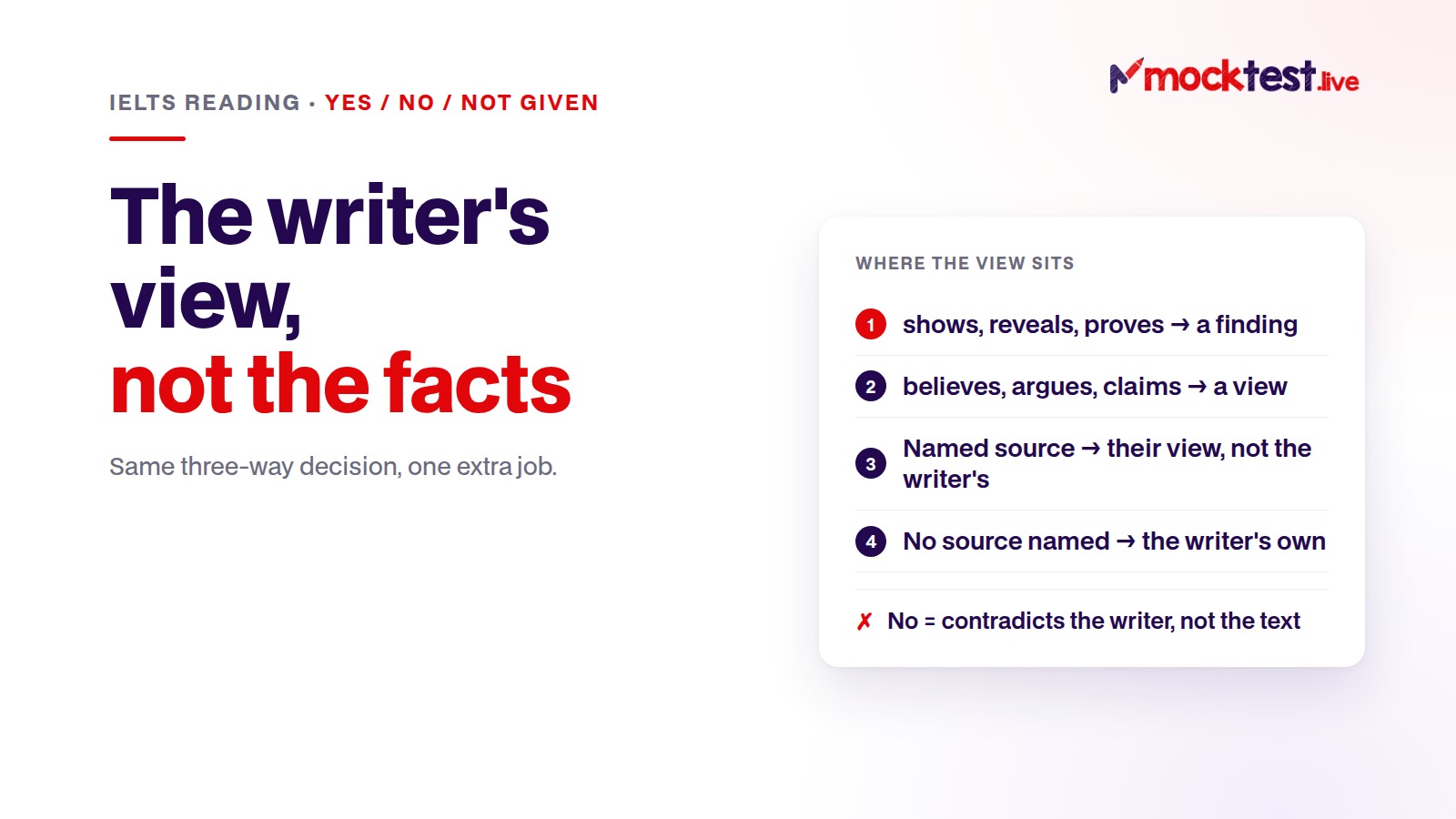
The wording changes because the passage changes. True/False/Not Given asks about stated facts. Yes/No/Not Given turns up when the passage carries an argument, and it asks whether the statement matches the writer's view — so a No means the writer says the opposite, and the evidence you point at is often a judgement rather than a figure: "the case for this has never been convincingly made", "such claims are difficult to sustain".
One extra trap, and it's why candidates who handle TFNG well still drop marks here. The writer reports other people's opinions. "Critics have argued that the scheme rewards the wealthy." That sentence is evidence of what critics think, not of what the writer thinks — and a Yes/No item about the writer's position is Not Given unless the writer takes a side somewhere on the page. Track whose voice each sentence belongs to. On the computer-delivered screen you can't underline with a pen, but you can select text and right-click to highlight it, and attach a note to the highlight — use that to tag whose voice a sentence carries: the writer's, or someone the writer is quoting. On paper, bracket the reported opinions and put the critic's name in the margin. The pointing test itself doesn't change — it's just pointing at a claim now rather than a fact.
Three heuristics to unlearn
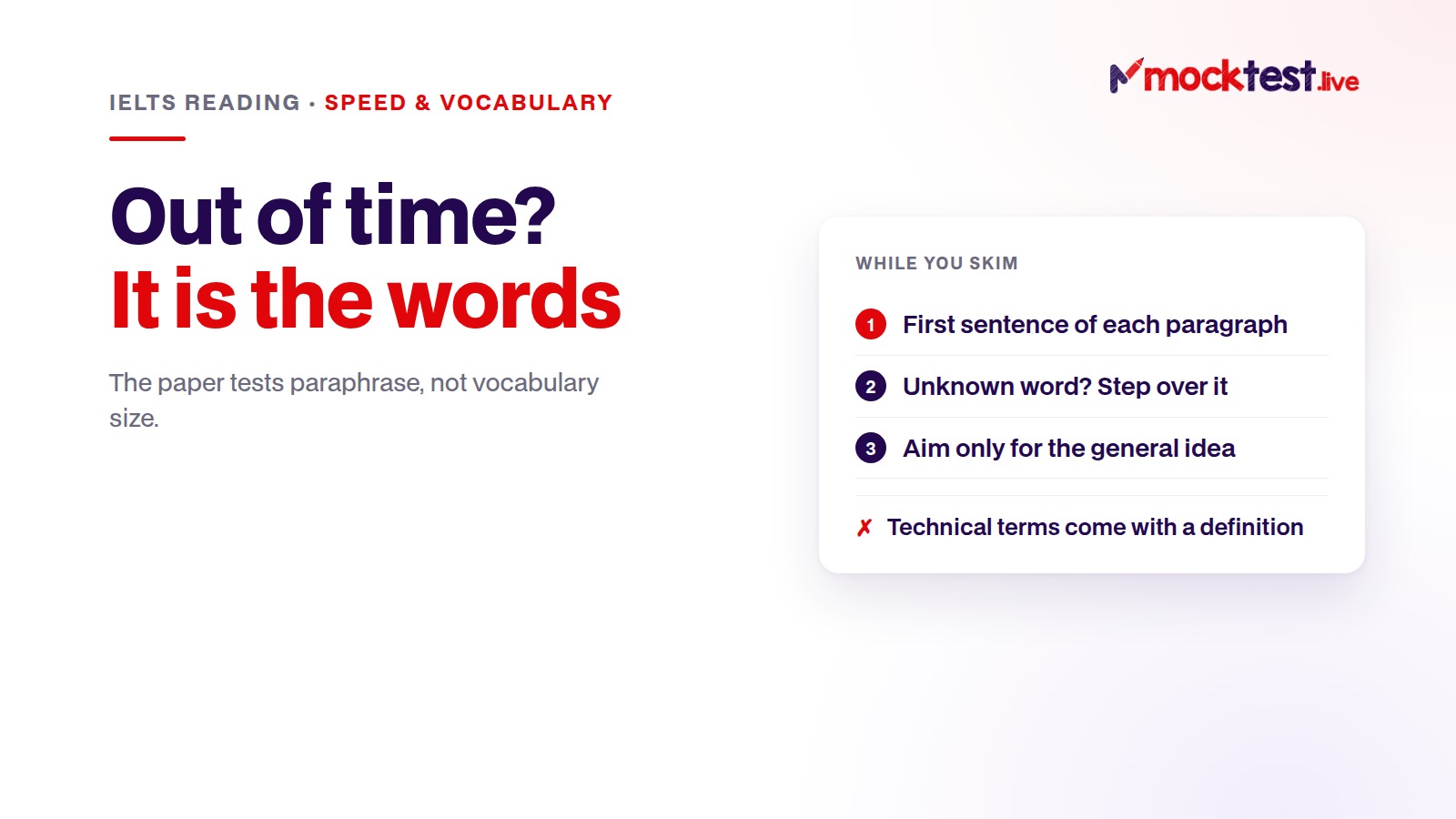
"It's not word-for-word, so it must be Not Given." Paraphrase is the entire examination. The passage will say dwindled, the statement will say decreased, and that is a match, not a gap. Nothing in this question type rewards you for spotting that the vocabulary differs.
"The answers alternate" and "you can't have Not Given twice in a row." The key isn't arranged for your comfort. The moment you change a considered answer because the pattern looks lopsided, you've stopped marking a passage and started marking a shape. Every mark you win that way you'd have won anyway; every mark you lose that way was one you had.
"When stuck, just write Not Given." Half right, and dangerous in the half that isn't. Not Given is where you land when the pointing test fails — that's a decision. Writing Not Given because the box feels safe, thirty seconds in, without having tried to locate the claim, is a coin flip.
For this question type, stop underlining keywords. I'll defend that. Keyword-matching is the most taught technique in every coaching centre in Dhaka, and it's the direct cause of the False/Not Given error. You underline the nouns — goats, road, plateau — you find those nouns in the passage, you find them close together, and your brain does the rest. But the deciding word in a TFNG item is almost never a noun. It's more, because, only, first, since, all, may. Nouns tell you where to look. They cannot tell you what the answer is, and treating a successful keyword hunt as a successful answer is precisely how a paragraph about a road turns into a False about causation. Mark the modals and quantifiers instead. The nouns you'll find anyway.
What the pattern costs on the band scale
Reading is 40 raw marks, and the raw score converts to a band. The conversion isn't the same for Academic and General Training — GT needs more correct answers for the same band — so any single table you've seen online is one of the two, or wrong. Bands come in whole and half steps only. Your overall band is the mean of the four skills rounded to the nearest half, and the rounding runs upward at the boundaries: 6.25 becomes 6.5, 6.75 becomes 7.0, while 6.125 falls back to 6.0.
Which is why four unsupported Falses is not a small thing. In the middle of the scale a handful of raw marks is often all that separates one Reading half-band from the next, and one skill moving half a band can turn an overall 6.5 into a 7.0 when the rounding is on your side.
The clock, and the blank you never leave
| Reading | |
|---|---|
| Time | 60 minutes |
| Questions | 40 |
| Passages | 3 |
| Transfer time | none — on paper or computer |
| Average per question | 90 seconds |
| What a TFNG item should cost you | 45 to 75 seconds |
The no-transfer-time line surprises people who move from paper to computer, which in Bangladesh is the newer of the two options and still the less familiar one. In Listening, paper gives you 10 minutes at the end to copy answers onto the answer sheet and the computer gives you 2 minutes to check. Reading gives you nothing on either format. Sixty minutes is sixty minutes, and whatever is in the box at the end is your answer.
TFNG items run in passage order. You never hunt the whole text; the next answer is below the last one. If you're past 75 seconds and still can't point at a sentence, write Not Given, flag it, and go. On the computer-delivered screen there's a review checkbox on each question and a review screen at the end listing every flagged and unanswered item. Use it in the last four minutes.
Never leave a blank. Nothing is deducted for a wrong answer — a blank is a guaranteed zero and a guess is not.
This won't help you if your real problem is that you can't finish passage three. No amount of care over False versus Not Given will rescue a paper you didn't reach the end of.
The drill, which is the only part that works
After you mark a paper, take every TFNG and YNNG item you got wrong and write out, by hand, the sentence in the passage that decided it. Not a summary. The sentence.
Then do the part nobody does. Go back through the items you got right, look only at your Falses, and count how many you can support with a quotable sentence. If a third or more of your Falses have no sentence behind them, you have your diagnosis: you're answering from what you know, and some of those guesses happened to land. They won't land on test day.
Ten items a day, honestly reviewed, moves this faster than anything else you could do with the same twenty minutes. What it needs is items — real ones, from full papers, marked against the key while the passage is still in front of you.
This piece is the deep dive on the one distinction. If you want the task as a whole first — the three-way decision, Cambridge's own procedure and its worked items — start with the three questions that decide a True/False/Not Given item. And when the item is hard to locate rather than hard to judge, the problem is usually that the question's words are not the passage's words.
That's what we built. Full-length Reading papers from the Cambridge IELTS books, Academic and General Training, sat on a screen built to match the computer-delivered exam interface — same review checkbox, same navigation — so the interface is never the thing you're learning on the day. Submit and it's marked instantly against the key. Sixty minutes, three passages, 40 questions, no transfer time. Every Cambridge paper is free.