
In this guide7 sections
"I ran out of time" is the most common thing candidates tell me about Reading, and it is almost never a complaint about reading speed. It is a complaint about how long they spent stuck.
Being stuck is a vocabulary event, not a speed event. You meet a sentence, do not understand two words in it, read it again, read it a third time, and ninety seconds are gone — on a sentence that may not have contained the answer anyway. The video above is the short version.
What this paper is actually testing
Cambridge English's teacher's notes say it in one line, and it reframes the whole problem:
Not vocabulary size. Vocabulary flexibility — the ability to see that the decline in numbers and the population fell are the same event. A candidate with a smaller word list who recognises paraphrase will beat a candidate with a bigger one who does not, because the paper never uses the question's words in the passage.
So the useful question is not "how many words do I know" but "how quickly do I recognise a word I know, wearing something else".
Two things that remove most of the panic
You are not required to understand everything. Cambridge's IELTS FAQs:
Read that as permission, because that is what it is. The answer to an item usually turns on one sentence. The other forty sentences in the paragraph can contain words you have never met and it changes nothing.
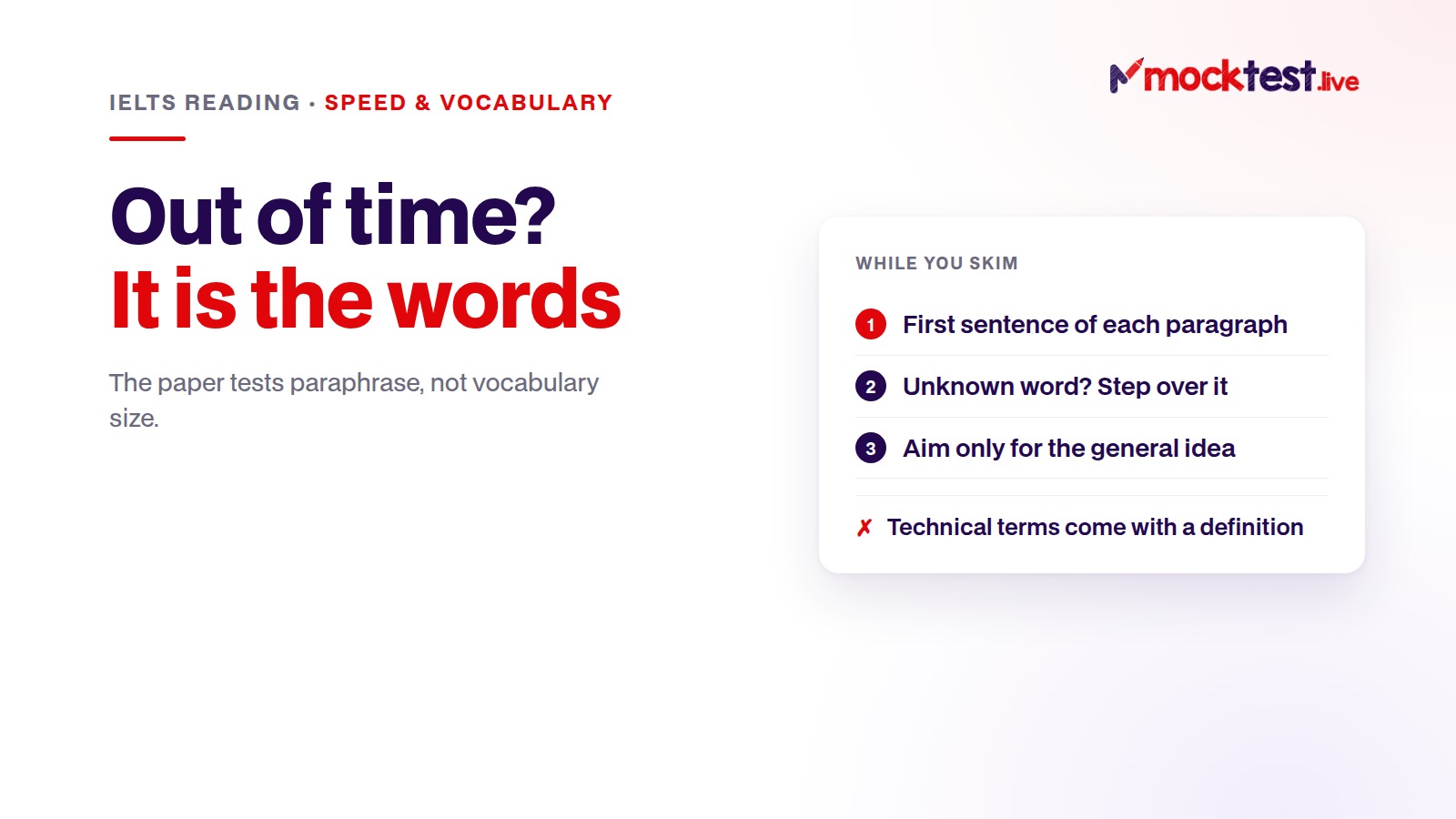
Technical words come with their meaning attached. ielts.org, on Academic Reading texts:
And Cambridge's FAQs tell you to use it: "Look at the dictionary definition, if one is provided, to help you understand unfamiliar words." If a passage about marine biology throws a term at you, the test has already decided that term is not what it is measuring.
Between them, these two mean the frightening-looking passage is usually not the hard one. The hard one is the ordinary-looking passage where every word is familiar and the questions are all paraphrase.
What skimming actually is, in Cambridge's words
"Skim the passage" is advice everyone has heard and few have had defined. Cambridge's notes define it by asking students four questions and giving the answers:
| Question | Cambridge's answer |
|---|---|
| Do you read quickly or slowly? | Quickly. |
| Do you need to read every word and every sentence? | "No, you don't need to read every word or even every sentence — you could read just the first sentence of each paragraph or the first and last sentences." |
| What should you do with an unknown word? | "Ignore it or skip it — you shouldn't even try to work out the meaning when you are skim reading." |
| What is the purpose? | "To get a general idea of the text and overview of the content." |
The third one is the discipline most people lack. While skimming, an unknown word is not a problem to solve — it is a word to step over. You will come back to that part of the passage if a question sends you there, and most of the time no question will.
There is more on the difference between this and scanning in skimming and scanning, and what each is actually for.
The speed drill Cambridge actually runs
This is from the same notes, and it is the simplest useful exercise I know:
Ask students how long they will need to skim read the text. Halve the time they suggest. Students skim it in that time, then share what they understood.
Do it to yourself. Look at a passage, decide it needs four minutes, give yourself two. The point of the exercise is in what Cambridge says comes next — students "realise that they can take in a lot of information from just a quick reading". Most people's estimate of how long they need is a measure of their anxiety, not of the text.
The vocabulary drill that actually moves the needle
Word lists are a slow way to prepare for a paper that tests paraphrase. The faster exercise, also from Cambridge's classroom:
Take one sentence from a passage. Rewrite it in your own words, changing as many words and structures as you can while keeping the meaning.
That is the test's own mechanism, run backwards. Every time you do it you are practising the exact operation the question writer performed when they turned the passage's sentence into the question's sentence. Five minutes a day on this will do more than an hour of flashcards. It is the same skill described from the other side in why the question's words are not the passage's words.
And one habit for while you read, from IDP's examiner-approved tips: "Circle or underline key words as you read. For example, if a reading passage contains many place names or dates, circle them as you go along. This will make it easier to find these details later if they come up in any of the questions."
And the clock, briefly
Cambridge's FAQs give the budget: "You have 60 minutes to read three texts and answer 40 questions. You should spend about 20 minutes on each text." Plus the instruction most candidates need more than the arithmetic — do not waste time worrying about questions you cannot answer.
If the hour itself is where things fall apart rather than the vocabulary, that is a different fix: a section-by-section plan for the hour.
Practise with the passage still in front of you
Here is the review that turns a practice paper into progress. For every wrong answer, find the sentence that held the answer and ask one question: did I not understand it, or did I not find it? Those are different problems with different fixes, and almost nobody separates them.
Our Cambridge papers are free and run on a screen built to match the computer-delivered test, with a highlighter and a timer that behaves like the real one. Reading and Listening are marked the moment you submit, so you can do that review while the passage is still fresh. We are not affiliated with Cambridge, IDP or the British Council.
The synonyms-and-paraphrase line, the skim-reading definition and the halve-the-time drill are quoted from Cambridge English's matching-features teacher's notes; the "don't understand every word", dictionary-definition and twenty-minute points from its IELTS Academic FAQs; the technical-vocabulary rule from ielts.org's Academic Reading format page; and the circling habit from IDP's examiner-approved tips — all checked on 7 October 2026.