
Here is the pattern I see most often on a wrong matching-information answer: the candidate found the word. It was right there in paragraph C, exactly the word the question used, and paragraph C was the answer they wrote. The information was in paragraph F.
That is not carelessness. It is what happens when you search a passage the way this task punishes. The video above is the short version.
What this task is actually asking for
ielts.org separates it from its nearest neighbour in one line:
That list at the end is the useful part. You are not looking for what a paragraph is about — you are looking for whether a particular thing is in it. A paragraph mainly about transport policy can contain the one example of a successful cycling scheme, and that example is the answer even though the paragraph is not "about" it.
Which is exactly backwards from matching headings, where the main idea is the whole job. Two tasks that look alike on the page and want opposite things from the same paragraph.
Two rules that decide how you work
Both from the same ielts.org description:
Read what follows from that. If a paragraph can be used twice and another not at all, then the questions cannot run in the order of the passage. ielts.org promises the order for multiple choice and for sentence completion; for this task it says nothing, and the structure makes it impossible. Plan for a task where every item is its own search — the point of knowing which question types follow the text and which do not.
Cambridge turns the search around
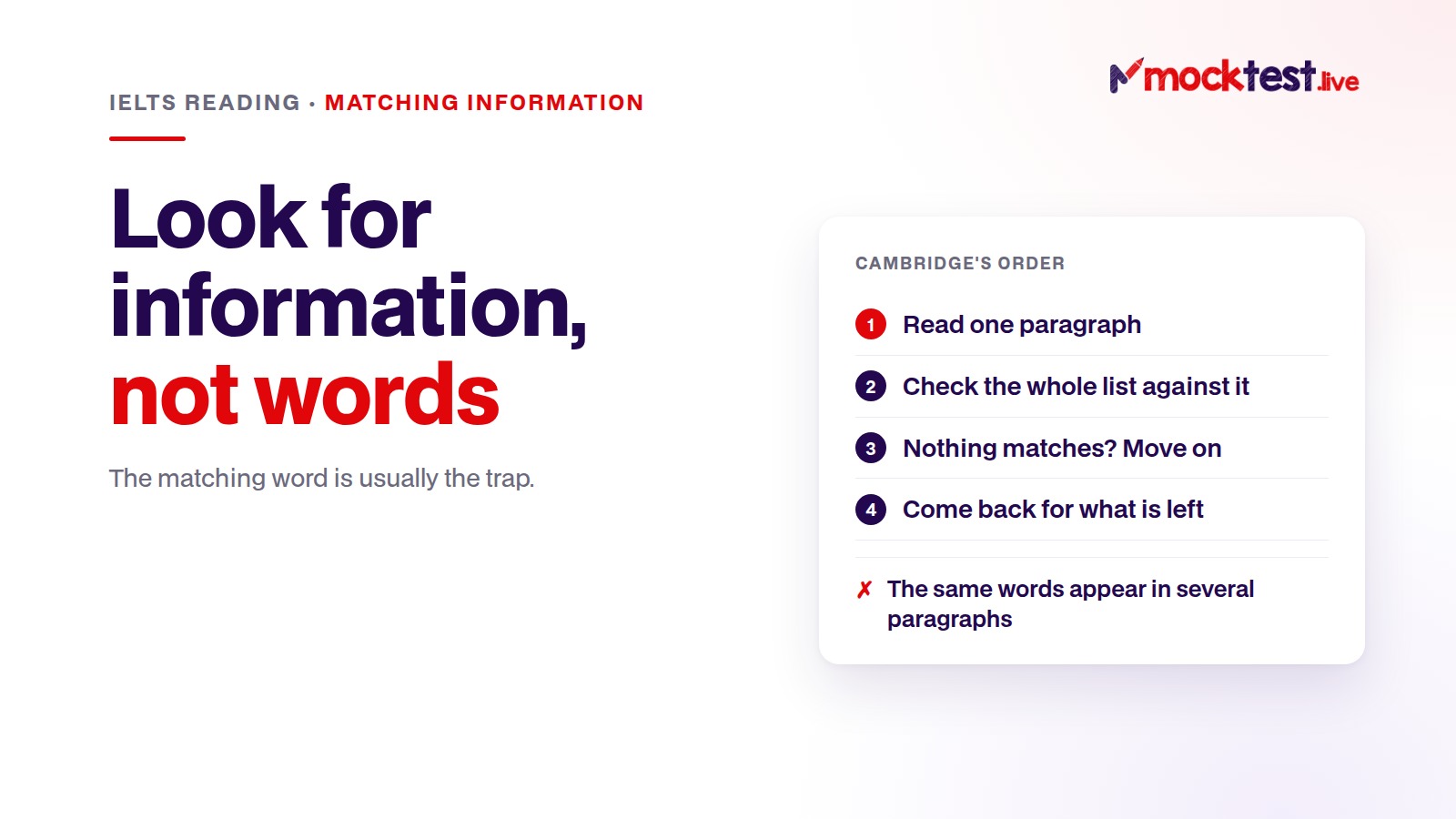
Most candidates work question-first: take statement 1, scan the passage for it, write a letter, take statement 2, scan again. Cambridge English's teacher's notes for this task reverse it — read a paragraph, then look at the list and see which statement it answers.
The reason is in the notes, as a point students are asked to disagree with:
That is the whole argument. Some paragraphs hold no answer. Question-first searching makes you read those paragraphs once per question — six questions, six passes through a paragraph that was never going to help. Paragraph-first reads each one once, against the whole list.
The practical loop:
- Read paragraph A with the list of statements in mind.
- If something matches, write it and cross that statement off.
- If nothing matches, move on — do not read it again hoping.
- Come back at the end for whatever is unplaced, now with a much shorter list.
The trap, named by Cambridge
This is the one that produces confident wrong answers, and the notes state it directly:
A shared word tells you a paragraph is on the right topic. The question asks which paragraph contains the specific fact. In a passage about urban transport, four paragraphs will say "congestion"; one of them contains the comparison the question wants.
So when you find the word, do not stop. Read the sentence it sits in and ask whether it does what the statement describes — is this an example, a reason, a comparison? If the statement promises a reason and the sentence only mentions the subject, keep going.
This is the same muscle as recognising a paraphrase instead of hunting the exact word, pointed at paragraphs rather than sentences.
Matching features, which is a different task
These two are often taught together and are not the same thing. Matching features gives you a list of options — people, studies, places — and asks you to match statements to them. ielts.org:
Same two structural rules apply: some options may go unused, some may be used more than once, and the instruction tells you which.
Cambridge's method here is to locate the options first. Find where each named feature appears in the passage and mark those places, then match the statements against them. Once you know the study is discussed in paragraphs two and five, a statement about that study has only two places it can come from.
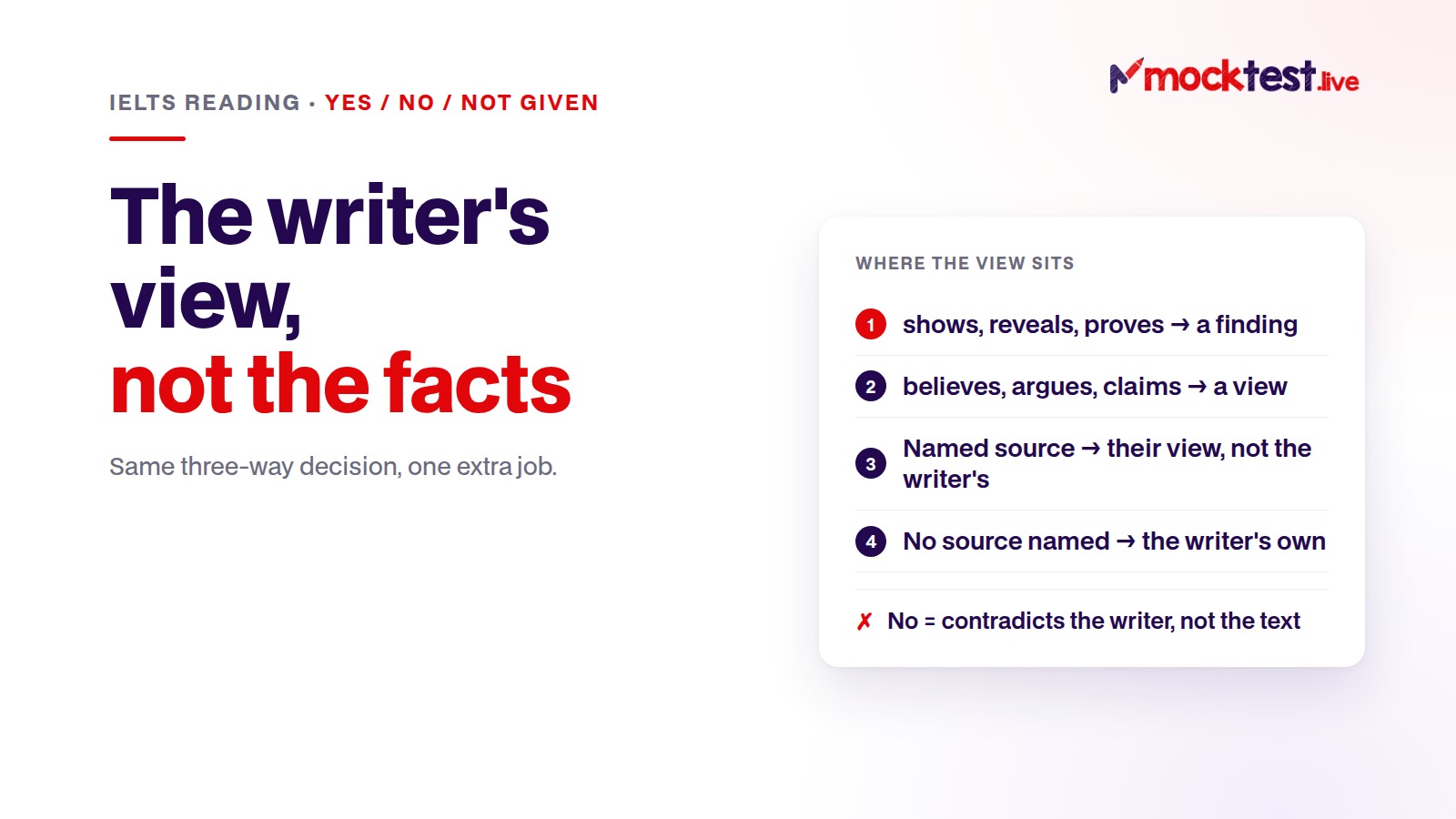
One extra thing this task tends to test, which is worth knowing before you meet it: whether a claim is a finding or an opinion. Cambridge's notes for it draw that line by verb — "the study shows, reveals, proves" against "the researchers believe, argue, claim" — and the same distinction decides Yes/No/Not Given.
Practise with the key beside you
For every wrong answer, find both paragraphs: the one you chose and the one that was right. The word that misled you will usually be in both. Seeing that twice is what retrains the search.
Our Cambridge papers are free and run on a screen built to match the computer-delivered test, with a highlighter for the sentence you matched on. Reading and Listening are marked the moment you submit. We are not affiliated with Cambridge, IDP or the British Council.
The task descriptions, the reuse rule and the skills lines are quoted from ielts.org's Academic Reading format page; the paragraph-first method, the wasted-time warning and the shared-words trap from Cambridge English's own matching-information teacher's notes, and the findings-versus-opinions verbs from its matching-features notes — all checked on 7 October 2026.