
In this guide9 sections
- Which questions these rules cover
- Rule 1 — the word limit, and which direction it punishes
- Rule 2 — what the test counts as one word
- Rule 3 — the words are already on the page
- Rule 4 — it has to fit the grammar of the gap
- Rule 5 — one answer when one is asked for
- The ordering trap nobody mentions
- Where these marks actually go
- Practise where you can see the key
There is a particular kind of lost mark that I see on scripts every week, and it is the one candidates never see coming: the answer is right, the candidate found the correct word in the correct place, and the box still scores zero.
It happens in summary, note, table and sentence completion — the tasks where you write the answer yourself instead of choosing a letter. Five rules decide those marks. All five are published, none of them are secret, and almost nobody reads them before the test. The video above is the short version.
Which questions these rules cover
The rules below apply wherever you type words into a gap rather than pick an option. On ielts.org that is five of the eleven Reading question types:
- sentence completion
- summary, note, table and flow-chart completion
- diagram label completion
- short-answer questions
Summary completion has two variations, and the difference matters. In the first, ielts.org says, "you need to select words from the text which fit into the gaps." In the second, "you have to choose from a list of words to fill the gaps." The word limit belongs to the first. If there is a box of words above the summary, you are picking, not writing, and most of what follows does not apply.
Rule 1 — the word limit, and which direction it punishes
ielts.org repeats one block of text under every completion type. This is the whole of it:
Cambridge English's IELTS Academic FAQs answer the same question from the marking side, and the wording leaves no room:
Two things follow from that, and the second is the one worth keeping.
The limit is a ceiling, not a target. Nothing in either source penalises a shorter answer. If the instruction allows three words and the right answer is one word, write the one word. Candidates pad answers towards the limit as though a two-word gap wants two words, and padding is how a correct noun acquires an adjective that breaks it.
And read "AND/OR A NUMBER" as it is written. "NO MORE THAN TWO WORDS AND/OR A NUMBER" allows up to two words, or a number, or up to two words together with a number. The phrase is not decoration — it is there because some answers in that set are numeric.
The sentence most people skip is the first one: the limit "can change". It is set per set of questions, not per paper. A passage can carry a three-word limit in one task and a one-word limit in the next, and the instruction line is the only place that says so.
Rule 2 — what the test counts as one word
The same block settles the three arguments candidates have with themselves in the exam hall.
| The case | What ielts.org says |
|---|---|
check-in, well-being, self-esteem | "Hyphenated words such as 'check-in' count as single words." One word, whatever the limit is. |
they're, don't, it's | "Contracted words such as 'they're' will not be tested." They are never the answer. |
15 or fifteen | "Numbers can be entered using figures (1, 2, etc.) or words (one, two, etc.)." Either is accepted. |
The contraction rule is more useful than it looks. It is not advice about style — it is a statement that no correct answer in Reading is ever a contracted form. So if the only way to make your answer fit the limit is to contract it, you have the wrong words and you should go back to the passage rather than compress what you have.
The numbers line comes from the short-answer section specifically, where ielts.org spells it out. On the computer-delivered test, figures are the safer habit: fewer keystrokes, nothing to misspell.
Rule 3 — the words are already on the page
This is the rule that separates Reading from Writing, and candidates who are strong writers break it most often.
Under short-answer questions ielts.org is explicit: "Answers must be taken from words in the text." Cambridge says the same thing as reassurance, which is how it should be read:
So there is no vocabulary to produce here. Finding the place in the passage is the hard half; the writing half is transcription. Paraphrasing a correct answer into your own words is how a correct answer becomes a wrong one.
Which makes the spelling rule less frightening than it sounds:
In Listening you spell from sound and a weak speller is genuinely exposed. In Reading the word is printed thirty centimetres from your eye. Every spelling mark lost in Reading is a copying error, not a vocabulary gap — which means it is the most recoverable mark on the paper. Check the word against the passage before you move on, letter by letter if it is a name or a technical term.
Rule 4 — it has to fit the grammar of the gap
Cambridge lists this under the Reading do's, and names the tasks it applies to:
ielts.org says the same from the skills side, describing what summary completion tests: "you will need to think about the type of word(s) that will fit into a gap (for example, whether a noun is needed, or a verb, etc.)."
Read the words either side of the gap before you go looking. An a or an in front of it wants a singular countable noun. A the wants a noun. A to usually wants a verb. A plural verb after the gap wants a plural subject.
Then use it the other way round, which is the part that earns marks: grammar is your check, not just your constraint. If the word you found makes the sentence ungrammatical, the usual reason is not that the test is being awkward — it is that you took the word from the wrong place. A singular where the sentence needs a plural very often means you landed on the wrong sentence in the passage. Treat the misfit as a signal to search again.
One caution: do not change the word to make it fit. Adding an -s to a word the passage gives in the singular breaks Rule 3 while it fixes Rule 4. If the correct answer needs to be plural, the passage contains it in the plural somewhere.
Rule 5 — one answer when one is asked for
This is the rule candidates are most surprised by, and it costs the most to break:
Writing both candidates feels like insurance. It is the opposite. One answer gives you a chance of a mark; two answers guarantee none. When you are torn between two words, pick the one that fits the grammar of the gap — Rule 4 is a tiebreaker as well as a check — and leave the other.
The same goes for the hedge of writing an answer and a bracketed alternative, or an answer with a question mark after it. Write the word you are choosing, and nothing else in the box.
The ordering trap nobody mentions
Most online guides to summary completion say the answers run in the order of the text. For summary completion that is not what ielts.org says:
Two completion tasks, two different behaviours. In sentence completion you can work downwards and never go back. In summary completion you cannot — but you get something better in exchange, because the answers are concentrated in one part of the passage rather than scattered across it. Find that part first and the rest is a close read of a few paragraphs.
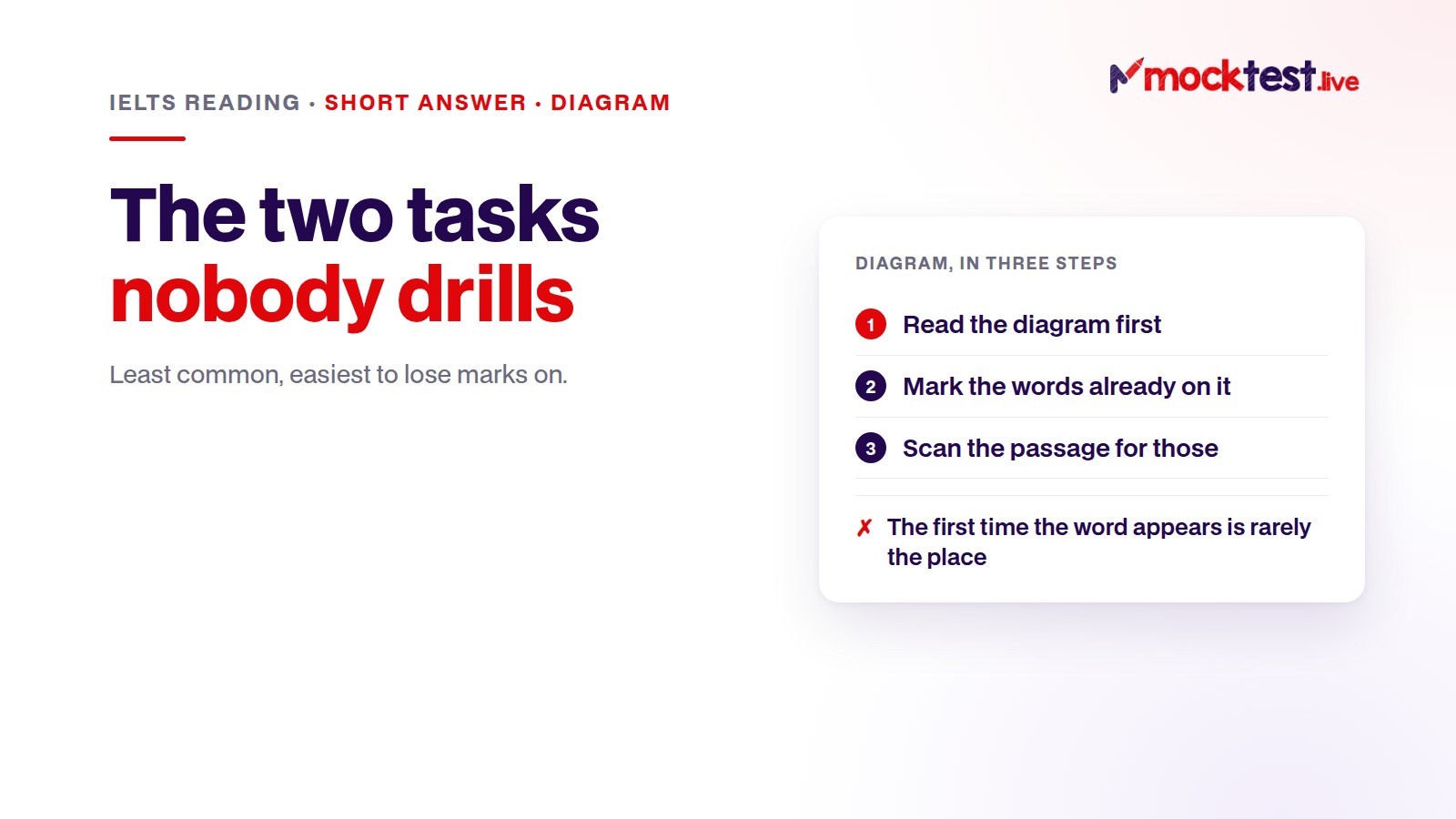
That distinction is worth knowing per task type rather than per passage, which is the subject of which question types follow the order of the text, and which do not. Two of the tasks these rules govern have strategies of their own: short answer and diagram labelling.
Where these marks actually go
Two of these five rules — the limit and the single answer — cost you marks you had already earned. That is a different problem from not understanding the passage, and it is fixed in an afternoon rather than a month.
If the harder half is the finding rather than the writing, start with why the question's words are not the passage's words. And if you run out of time before you run out of questions, the 60-minute plan is the place to look.
Practise where you can see the key
The only way to know whether these rules are costing you anything is to do a set and compare your answers with the key word for word — not meaning for meaning. A mark lost to an extra word looks exactly like a mark lost to a misread sentence until you check the spelling and the count.
Our Cambridge papers are free and run on a screen built to match the computer-delivered test, with the instruction line where the real one sits and a highlighter for the words you copied. Reading and Listening are marked the moment you submit, so you can see at once whether a zero was a reading problem or a rule you did not know. We are not affiliated with Cambridge, IDP or the British Council.
The word limit, contraction, hyphen and number rules are quoted from ielts.org's Academic Reading format page; the marking, spelling, grammar and single-answer rules from the Reading section of Cambridge English's IELTS Academic FAQs — all checked on 1 October 2026. Nothing here is taken from that document's Listening section, which carries some rules that do not apply to Reading.