
Sixty minutes, forty questions, three sections. Most candidates know those numbers and still arrive at Section 3 with eleven minutes left, because nobody ever told them what the hour is supposed to look like from the inside.
The video above is the short version, in Bangla. This is the same plan written down, with what is official separated from what is convention.
What is actually published
The shape of the test comes from ielts.org: Academic Reading is 60 minutes, 40 questions, 3 sections, and "the total text length is 2150–2750 words". General Training Reading is the same hour and the same 40 questions, with 2,150 to 2,375 words of text.
That is all. No official IELTS page tells you how to divide the hour between the sections — not one. So when a coaching page calls a split "the golden rule of IELTS Reading", what it means is that somebody wrote it down and everybody copied it.
The plan: about 15, 20 and 25 minutes
The split in the video is the one I use when I watch someone practise:
| Section | Time | Why |
|---|---|---|
| Section 1 | about 15 minutes | Usually the most straightforward text and the most literal questions |
| Section 2 | about 20 minutes | Denser text, more paraphrase between question and passage |
| Section 3 | about 25 minutes | Usually the hardest passage, and often the heaviest question types |
Fifteen, twenty and twenty-five is exactly sixty, which is the point: the plan spends the whole hour and leaves the largest share where the difficulty usually is.
The rule that matters more than the split
Do not sit on one question.
Almost every ruined Reading paper I look at has the same shape. It is not that the candidate read slowly throughout; it is that somewhere around minute twenty-two they met one item they would not let go of, spent six minutes on it, and then spent the rest of the hour trying to make up time they had already spent.
When a question will not come: flag it, put down your best guess if you have one, and move. Three reasons this is always right.
- There is no penalty for a wrong answer. A blank field and a wrong answer score the same, so a guess is free.
- The next question is worth exactly as much as this one. One mark. A question you have not read yet is a mark you are choosing to give away.
- Coming back works. After the rest of the section, the paraphrase you were looking past is often obvious. Sitting still rarely produces that.
There is no transfer time in Reading
This one costs people whole bands, and it comes from advice written for a test most Bangladeshi candidates no longer sit.
IDP's guidance is blunt: in IELTS Reading no extra time is given to transfer answers. The ten minutes people remember belonged to Listening on paper, where answers had to be copied from the question booklet onto an answer sheet. Reading never had that window, on paper or on computer.
So do not collect answers in your head, or in the margin, or in a list to be typed "at the end". Enter each one the moment you have it. On the computer-delivered test there is no answer sheet at all — you type into the field beside the question — and when the hour ends, the screen saves what is there and closes.
You do not have to read every word
Passage length is fixed and your hour is fixed, so the only variable you control is how many times you cross the text.
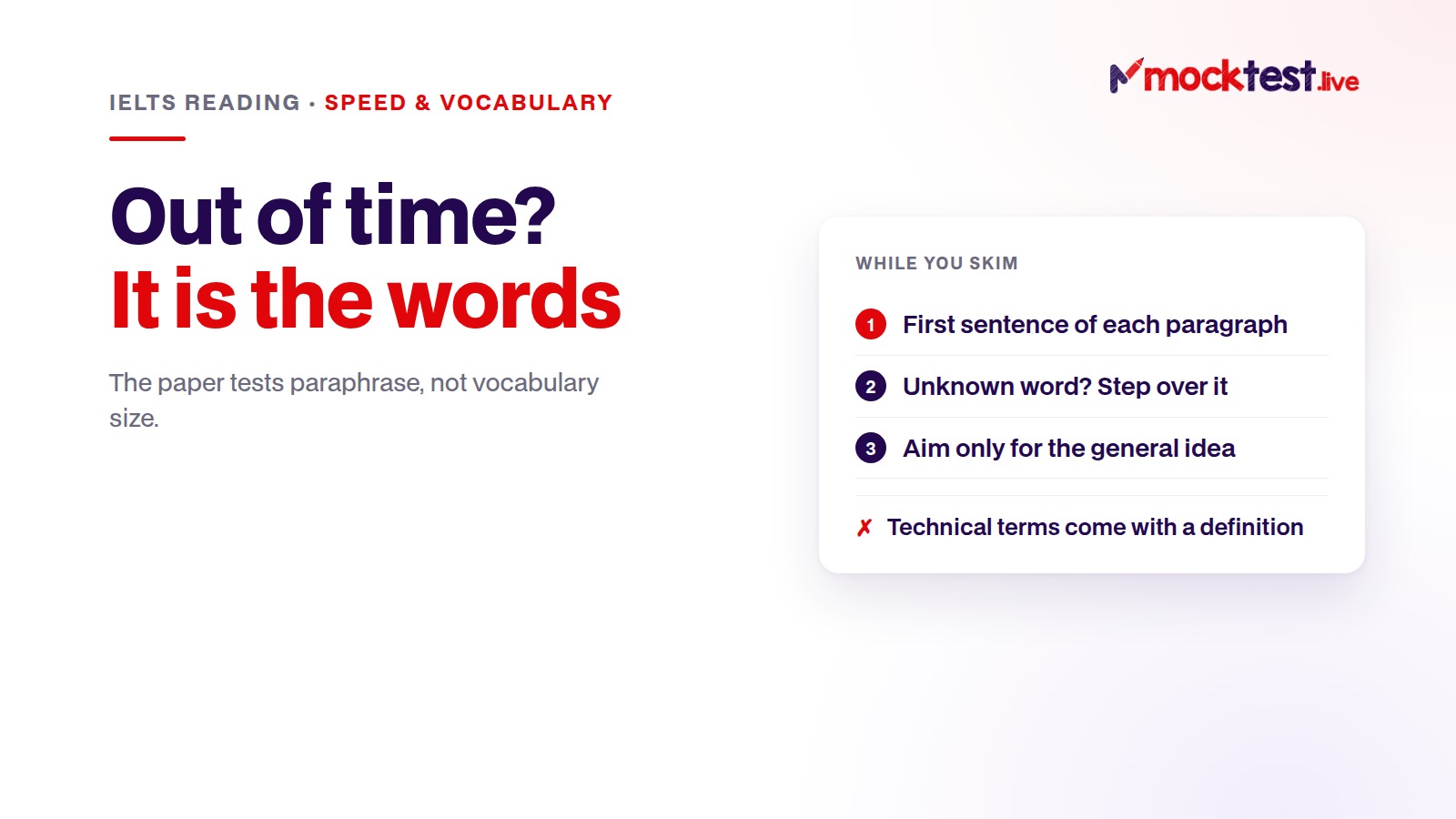
Read the question first, work out what information it actually wants, then go looking for that — the names, dates, numbers and terms that survive rephrasing — and read closely only around what you find. The full technique, with the arithmetic behind it and where it stops working, is here: skimming and scanning in IELTS Reading.
The last five minutes
The final stretch is not for re-reading a passage. It is for three things, in this order:
- Fill every blank field. No penalty for wrong answers means an empty box is a mark you have given away on purpose.
- Check the word limit on every answer you wrote. "No more than three words" means exactly that; a fourth word makes a correct idea score zero.
- Check spelling and plurals. A misspelled answer is a wrong answer, and singular/plural is the error I mark most often in completion tasks.
If your minutes disappear inside one particular task type rather than across the paper, the fix is not a better clock — it is knowing what a mark costs you in minutes on each type. That is measured, not guessed: what ten blank answers cost in bands, and how to budget by question type.
Practise the plan, not the theory
A time plan is a habit, and a habit only exists once it has survived an hour with no pausing.
Sit a full Reading paper, all three sections, 60 minutes, no stopping. Note the clock when you start each section — that is your whole measurement. If Section 3 begins with fewer than 20 minutes on the clock, the problem happened earlier, and you now know roughly where.
Our Cambridge papers are free and run on a screen built to match the computer-delivered test: passage and questions side by side, a highlighter, a flag for the questions you left, and the same timer. Reading and Listening are marked the moment you submit, so the two numbers you need — marks and minutes — are both there when you finish. We are not affiliated with Cambridge, IDP or the British Council.
Format details checked against ielts.org and IDP's guidance on 24 September 2026.