
Multiple choice is the question type candidates assume they already understand, because they have met it in every exam they have ever sat. It is also the type I see careful readers lose marks on — not because they misread the passage, but because they read the options first.
The fix is a sequence, and it is the one Cambridge teaches in its own classroom notes for this task. The video above is the short version.
The options are not neutral
Start here, because everything else follows from it. Cambridge English's teacher's notes for multiple choice say what the options are for:
A distractor is an option written to look right. It usually borrows a word the passage genuinely uses, and attaches it to a claim the passage does not make. So the search that feels natural — take the words from option B, find them in the text — is a search that leads you to a trap by design.
The question stem is the part nobody built to mislead you. Search with that.
The order Cambridge actually teaches
The notes do not suggest this as a tip. They structure the whole lesson around it, and step 3 has students physically hide the options:
"Students should cover the answer options (A – D)."
"Still keeping the answer choices A-D covered up, try to complete the question stem using all the relevant information in the text. Use your own words to summarise and paraphrase in your mind what is said in the text."
Then, and only then: "Students now uncover the answer options (A – D) and select the best answer."
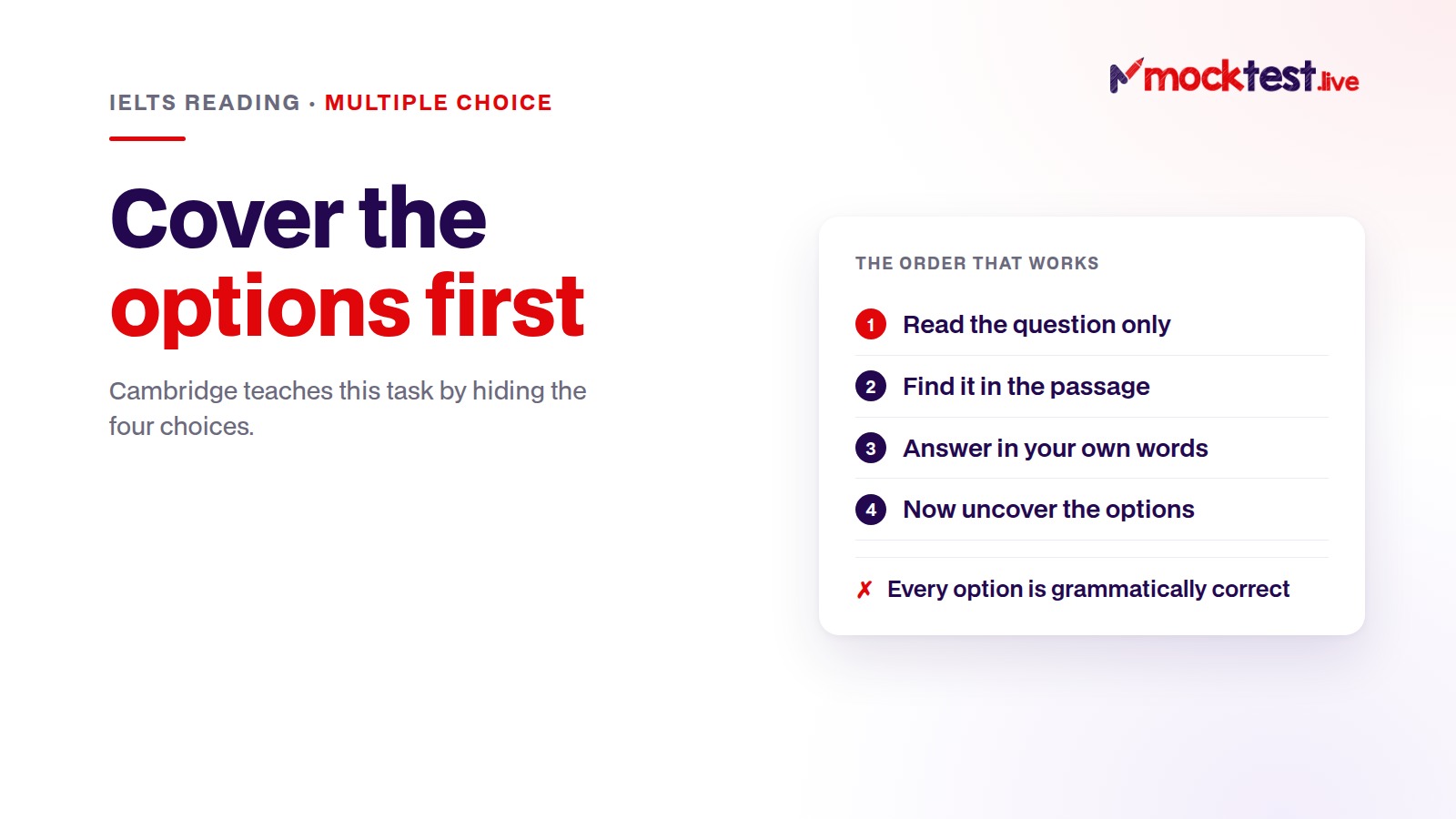
So the working order is four steps:
- Read the question only. Cover the options with your hand, or on screen, with the edge of a piece of paper.
- Find the place in the passage using the question's words.
- Answer it in your own words, in your head, before you look.
- Uncover the options and find the one that matches what you already decided.
Step 3 is the whole method. Once you have an answer of your own, a distractor has nothing to grip: you are no longer choosing between four plausible sentences, you are checking four sentences against something you already know.
Grammar will not pick the answer for you
This is the habit I most often have to argue someone out of, usually a candidate who is strong at Writing. Cambridge closes its lesson by testing exactly that instinct:
Every option fits the sentence. That is a design requirement, not an accident. If you find yourself thinking "C sounds right there", you have stopped reading the passage and started reading the question paper.
The useful version of that instinct is the opposite one: for every option you reject, you should be able to name the line in the passage that rejects it. If you cannot, you have not eliminated it — you have just preferred the others.
The one promise this task makes
Multiple choice is the task type where ielts.org commits to the order, in as many words:
Use it. Once question 3 is answered, the answer to question 4 is below that point, and everything above it can be left alone. Candidates who re-scan the whole passage for every question are throwing away a guarantee the test has given them in writing — which is the subject of which question types follow the order of the text, and which do not.
When it asks for more than one
ielts.org describes two shapes of this task: a question with four options, and "a longer list of possible answers" where "you have to choose more than one answer". Its advice between them is to read the instruction, because the number changes.
Two things about the multi-answer form:
- Order does not matter. The answer key in ielts.org's own published Academic Reading sample task marks the pair as "1&2 IN EITHER ORDER".
- Write letters. The rubric says "Choose TWO letters, A-G" — so the box takes
B, not the phrase B stands for.
And one habit from the same Cambridge notes, for the start of the set rather than the questions: "Ask students to look at it for 30 seconds in order to find out in general what the text is about." Half a minute, before the first question, so that you are placing answers inside something you already have the shape of.
Where this fits
Multiple choice rewards the same underlying skill as everything else on this paper: recognising the passage's idea in the question's words. If that is where you come unstuck, start with why the question's words are not the passage's words.
And if the clock is the problem rather than the choosing, the 60-minute plan is the place to look.
Practise with the key in front of you
This task improves by reviewing the distractors, not the answers. For every question you got wrong, find the option you chose and the line that makes it wrong. That line is the lesson; the correct answer rarely teaches you anything.
Our Cambridge papers are free and run on a screen built to match the computer-delivered test, with the passage and questions side by side. Reading and Listening are marked the moment you submit, so the option you fell for is still in front of you while you can remember why. We are not affiliated with Cambridge, IDP or the British Council.
The order guarantee and the two task shapes are quoted from ielts.org's Academic Reading format page and its published Academic Reading sample tasks; the covered-options method, the distractor warning and the grammar point from Cambridge English's own multiple-choice teacher's notes — all checked on 7 October 2026.