
If you are losing marks in IELTS Reading and cannot see where, this is the first place to look. True/False/Not Given takes more marks off scripts than any other task type I mark, and almost all of the loss comes from one confusion: False versus Not Given.
The video above is the two-minute version. Below is the same decision, with the official wording behind it.
What the three answers actually mean
ielts.org defines two of them in the instructions for the task itself:
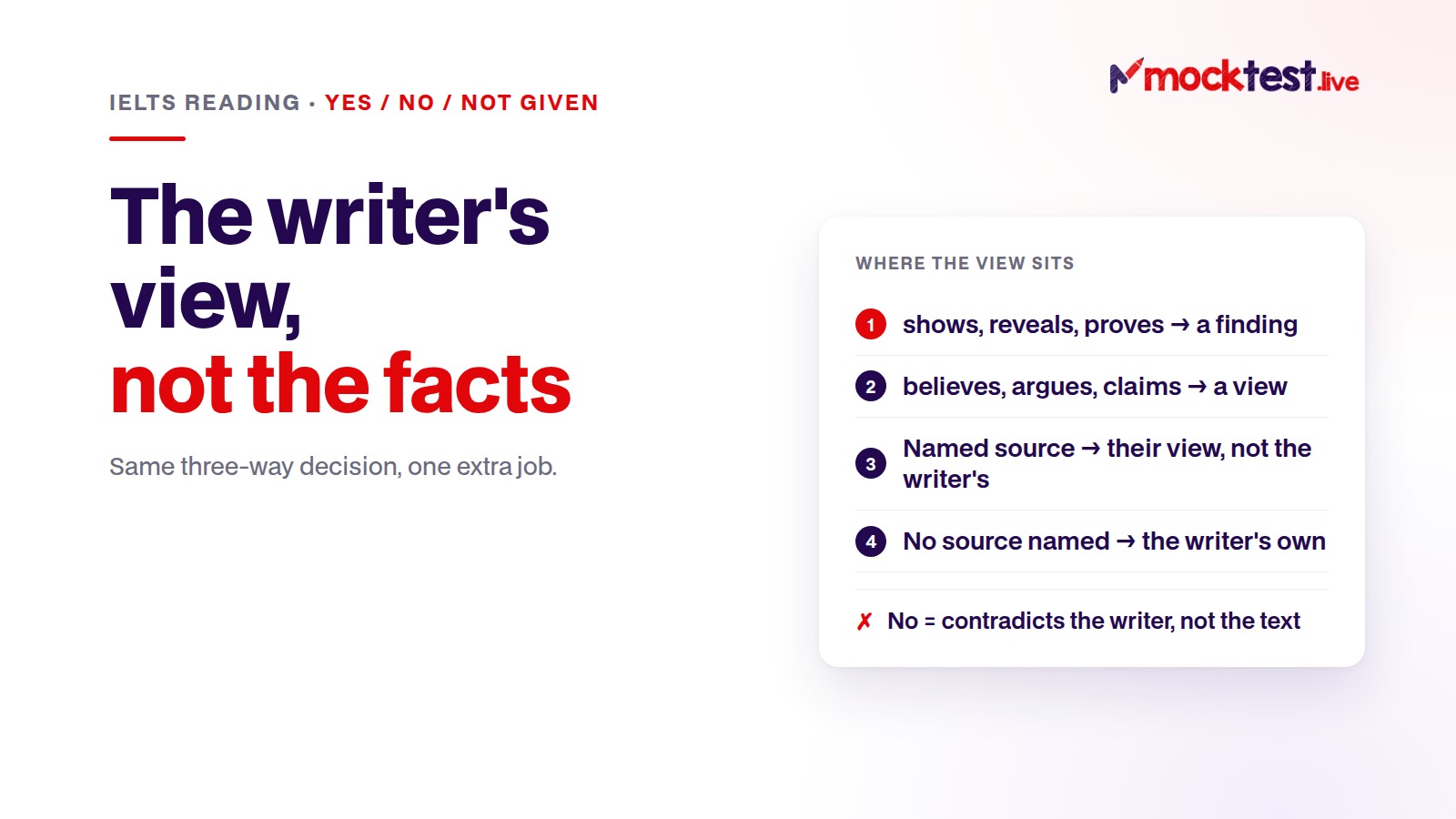
True, by the same logic, is the statement agreeing with the text. And when the statements are about what the writer thinks rather than about facts, the same three-way choice appears as Yes/No/Not Given — same skill, different label.
Read the definitions once more and notice what False requires: a contradiction. Something in the passage has to clash with the statement. If nothing clashes and nothing agrees, you are in Not Given, however strongly the statement feels wrong.
Cambridge turns it into three questions
Cambridge English publishes a worksheet for this task type, and its procedure is three questions asked in order. This is the clearest version of the decision I have seen anywhere:
| Ask this | If yes |
|---|---|
| Does the statement have the same meaning as the text? | True |
| Does the statement have some information that is different from the text? | False |
| Do the two talk about different things? | Not Given |
The third question is the one that rescues people. You are not asking "can I find it?" — you are asking "are these two sentences even about the same thing?" If the statement introduces a subject the passage never touches, the answer is Not Given, and you can move on in seconds rather than searching for a minute.
Two items from Cambridge's own material
Both of these come from the same Cambridge worksheet, with its answers.
Notice that in both items the keyword is present in the passage. Finding the word is not the task — deciding what the passage does with it is. That is the same skill as recognising a paraphrase instead of hunting for the exact word.
Three habits that cost the marks
Answering from what you know. ielts.org puts this in the instructions: "You must be careful not to use any information you already know about the topic of the text when choosing your answer." A statement can be perfectly true in the world and still be Not Given here, because the only evidence that counts is the passage in front of you.
Treating "all" or "never" as a signal. There is no rule that a strong word makes a statement False. What makes it False is the passage saying something different — "most" where the statement says "all" is a real clash; "all" by itself proves nothing at all.
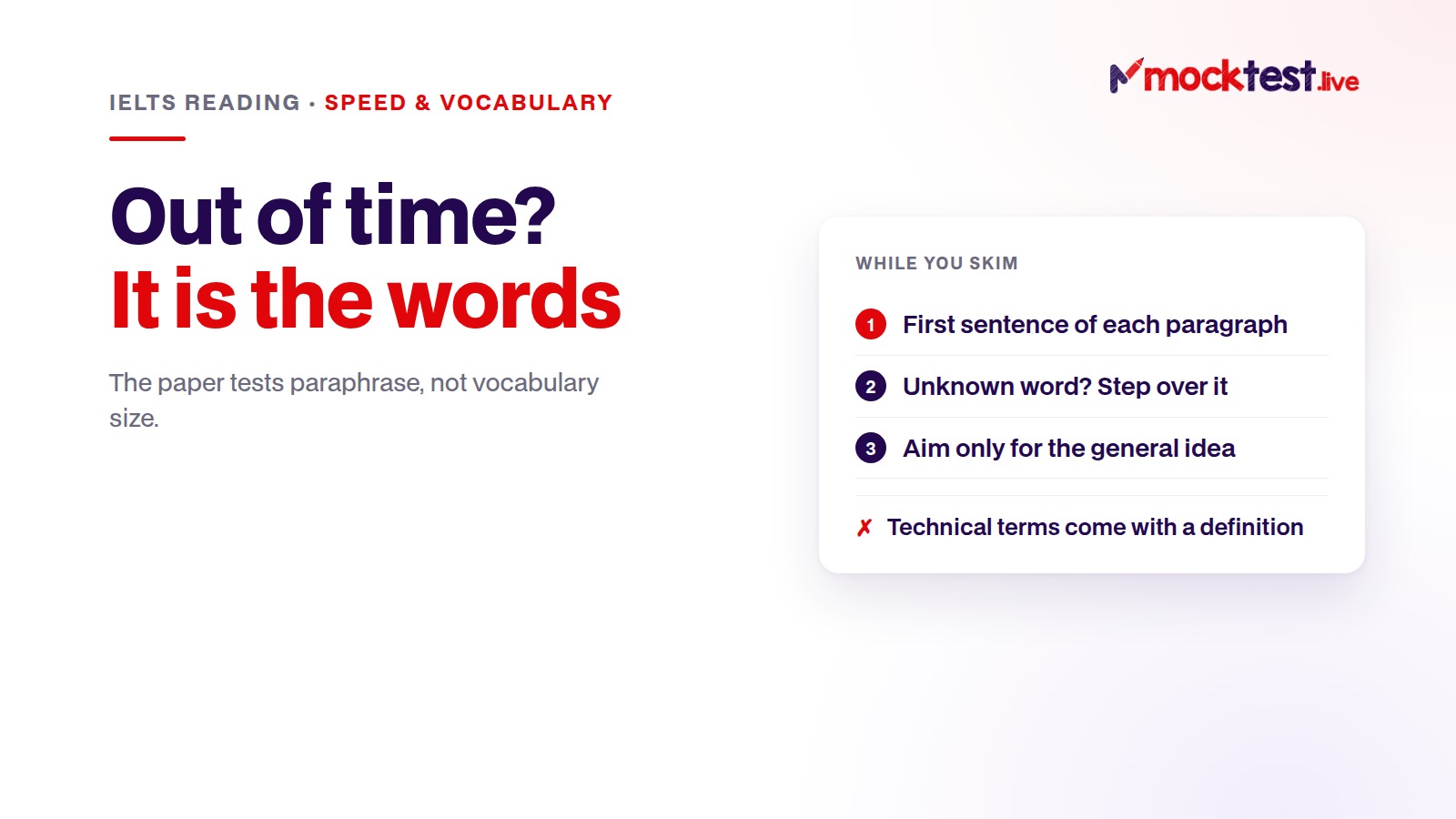
Writing Not Given because you could not find it. Not finding something and the passage not containing it are different events. Before you settle on Not Given, search once more with the paraphrase in mind: the information may be sitting there in words you were not expecting.
And one more, which is not a habit so much as a superstition: do not read the pattern of your answers. The official General Training sample task on ielts.org has an answer key reading True, True, True, True, Not Given, False. Four Trues in a row, on a published task. If your instinct says "too many Trues, change one", overrule it.
Writing the answer down
Write the word in full — TRUE, FALSE, NOT GIVEN. On the computer-delivered test you type it into the box, and an abbreviation is a risk with no upside. Use the labels the task gives you: if the instructions say YES/NO/NOT GIVEN, do not answer TRUE.
Where to go deeper
This piece is the decision procedure. If the False/Not Given line is still where your marks go, the long version works through five items one at a time, with the deciding sentence marked in each: False versus Not Given, without guessing.
The task that makes the opposite promise — where ielts.org guarantees the answers run in text order — is multiple choice.
And if the problem is that these items eat your clock rather than your accuracy, the fix is elsewhere — knowing which question types run in the order of the text saves more minutes than reading faster does.
Practise where the answer key is one click away
This task type improves in one way only: doing items, then reading the deciding sentence for each one you got wrong.
Our Cambridge papers are free and run on a screen built to match the computer-delivered test, with a highlighter for the line that decides the answer. Reading and Listening are marked the moment you submit, so every False you wrote where the key says Not Given is in front of you while the reasoning is still fresh. We are not affiliated with Cambridge, IDP or the British Council.
Definitions and the answer key were checked against ielts.org, and the decision questions and worked items against Cambridge English's own worksheet, on 29 September 2026.