
In this guide8 sections
- IELTS Academic vs General Training is two decisions, not one
- Ask the organisation, not the test
- What actually differs between the two papers
- The General Training scale is set a band harder
- IELTS General or Academic for immigration: three worked examples
- IELTS Academic or General for nursing: when the visa and the regulator disagree
- The booking is less locked than you have been told
- What it costs in Bangladesh, and what One Skill Retake will not fix
Thirty correct answers out of forty on the Reading paper is, on ielts.org's published anchors, a band 7 if you sat Academic. The same thirty is a band 6 if you sat General Training. Nothing in a side-by-side format table tells you that.
The choice usually gets presented as a single question with an obvious answer. Academic for study, General Training for migration. That is roughly true, and it is also the sentence you already knew before you opened this page.
What it leaves out is where the money goes. IELTS on Computer costs BDT 29,600 at IDP Bangladesh — read off IDP's Bangladesh fee page on 11 September 2026, and the same price for both modules — so there is no cheaper option to be tempted by, only a correct booking and a wasted one.
IELTS Academic vs General Training is two decisions, not one
The booking form asks you two things. The first one gets all the attention. The second is the one that quietly wastes a fee.
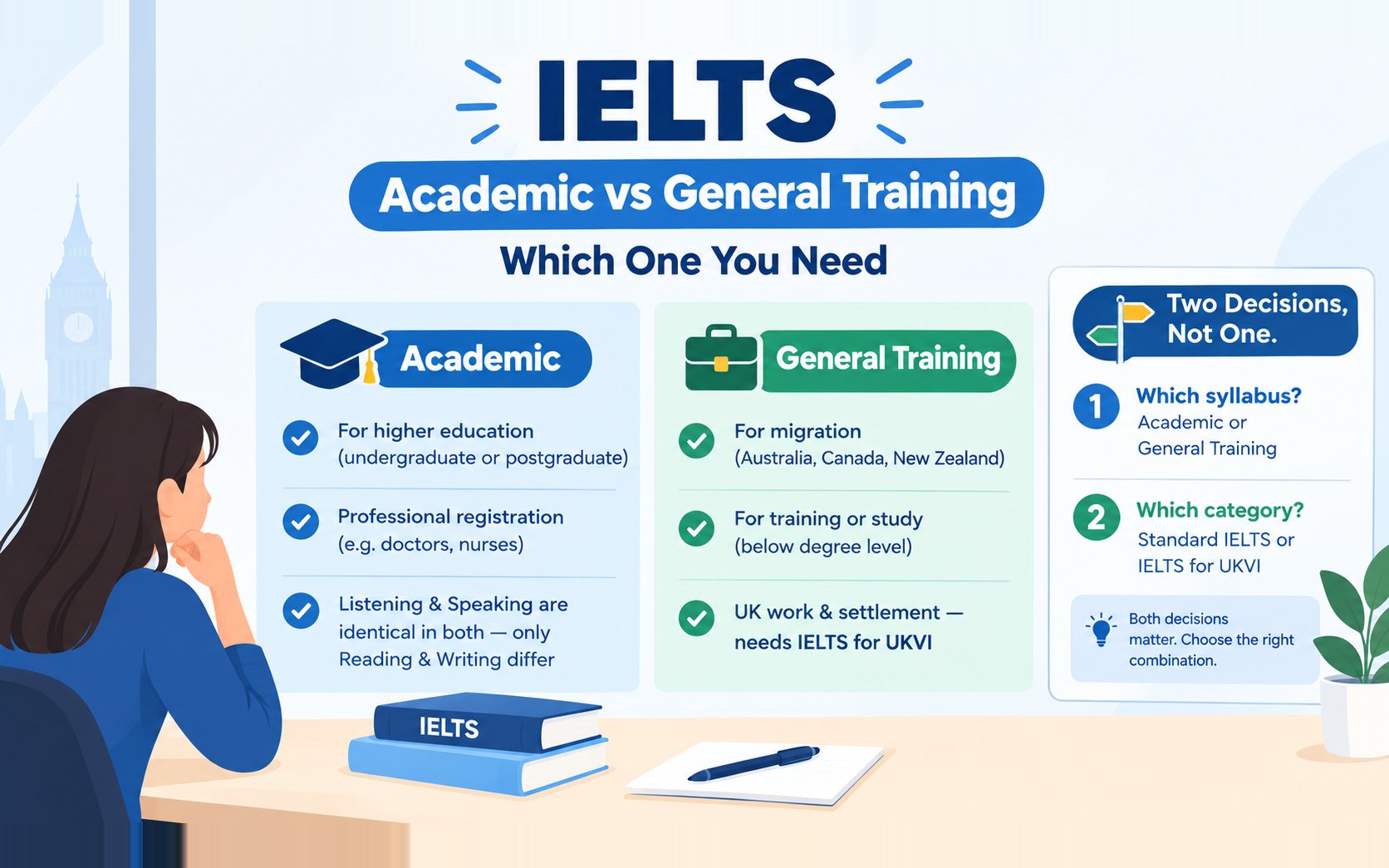
The first axis is the syllabus: Academic or General Training. The second is the category: standard IELTS or IELTS for UKVI. Those multiply into four different bookings.
| Standard IELTS | IELTS for UKVI | |
|---|---|---|
| Academic | Study at undergraduate or postgraduate level; professional registration, e.g. doctors and nurses | UK routes where a Secure English Language Test is required and the receiving body names the Academic module |
| General Training | Migration to Australia, Canada, New Zealand; training or study below degree level | UK work, settlement and vocational training routes requiring a SELT |
A reader who correctly works out "General Training for a UK work visa" and then books standard General Training has bought the right syllabus in the wrong category. Same questions, same marking, wrong Test Report Form. UK Visas and Immigration requires a SELT on those routes and a standard Test Report Form is not one, which makes this a booking error rather than a scoring one. There is nothing to re-mark or appeal.
Ask the organisation, not the test
IELTS does not decide this. A named university, a named regulator or a named visa office decides it, and each of them publishes the rule.
So the lookup runs in this order, and what I tell candidates is to do it with the page open, not from memory of a Facebook group:
- Name the body. Not "Canada" but Immigration, Refugees and Citizenship Canada. Not "a UK university" but the specific university and the specific course.
- Find its published English language requirement. Its own page, on its own domain.
- Read three things off it: which module it names, whether it demands a Secure English Language Test, and how old a result it will still accept.
The third one is the item people skip, and a band you earned two years and one month ago is not a band to IRCC. The two-year figure everyone quotes is a recommendation from the IELTS partners, based on documented second-language attrition, and organisations that accept IELTS may choose to accept results for longer. IRCC enforces two years strictly for Express Entry. Australia's Competent English standard works on a three-year window. The deadline belongs to whoever is reading your score, never to the test.
If you are still deciding whether you are close enough to book anything, the five checks in this guide come before this one.
What actually differs between the two papers
Listening is the same test in both modules, and so is Speaking. Total test time is 2 hours 45 minutes either way: Listening around 30 minutes, Reading 60, Writing 60, Speaking 11 to 14.
Reading and Writing are where the two diverge, and the split is about setting rather than difficulty: one paper assumes you are reading a journal, the other assumes you are reading a staff handbook. The format detail below is off ielts.org's test-type pages, read on 11 September 2026. Whichever you sit, the hour and the forty marks work the same way — the Reading format, section by section covers the part both modules share, and the General Training paper has its own piece with the conversion table in full.
Reading
| Academic Reading | General Training Reading | |
|---|---|---|
| Structure | 3 passages | 3 sections of increasing difficulty |
| Questions | 40, in 60 minutes | 40, in 60 minutes |
| Reading load | 2,150–2,750 words | 2,150–2,375 words |
| Sources | Books, journals, magazines, newspapers and online resources, written for a non-specialist audience | Section 1: notices, advertisements, timetables. Section 2: job descriptions, contracts, staff development and training materials. Section 3: one long text from newspapers, magazines, books and online resources |
| Subject matter | Topics of general interest to students at undergraduate or postgraduate level | Section 1 social survival, Section 2 workplace survival, Section 3 general interest |
General Training Section 1 may be two or three short texts or several shorter ones, which is why it feels fragmented next to an Academic passage. Section 3 is the one that looks most familiar: a single long text, longer and more complex than the two sections before it.
Whatever module you sit, the marks lost to True/False/Not Given are lost the same way. If that is where yours are going, this is the fix.
Writing
Task 1 is the real split.
Academic Task 1 asks you to describe some visual information in your own words: a graph, table, chart or diagram. Minimum 150 words, about 20 minutes, in an academic or semi-formal neutral style. The response has to be written as a whole piece of connected text, so notes and bullet points are not acceptable.
General Training Task 1 asks you to respond to a situation by writing a letter — asking for information, say, or explaining a situation. Same 150 words, same 20 minutes. The style may be personal, semi-formal or formal, and which one you choose depends on who you are writing to and why.
Task 2 is essentially the same shape in both: a point of view, argument or problem which you need to discuss, minimum 250 words, about 40 minutes, semi-formal neutral discursive prose. It contributes twice as much as Task 1 to your Writing band.
The four Writing criteria do not change between modules: Task achievement (Task 1) or task response (Task 2), Coherence and cohesion, Lexical resource, Grammatical range and accuracy. So the work of getting from a 6 to a 7 in Writing is the same work on either module, and the criterion-by-criterion breakdown applies to both.
The General Training scale is set a band harder
Half the exam has no difficulty difference at all, because half the exam is literally the same test.
For the other half, the honest answer has two parts. General Training's Reading texts are shorter and more everyday. And the raw-to-band conversion is set harder to compensate.
ielts.org puts it plainly: the two Reading tests are graded on the same scale, "however, it is usual that a greater number of questions must be answered correctly on a General Training Reading test to secure a given band score."
Here is what that means in marks. These are the four anchor points ielts.org publishes for each module, out of 40:
| Correct answers | Academic Reading | General Training Reading |
|---|---|---|
| 15 | Band 5 | Band 4 |
| 23 | Band 6 | Band 5 |
| 30 | Band 7 | Band 6 |
| 35 | Band 8 | Band 7 |
A whole band, at every anchor they publish. The shorter texts do not buy you anything; the scale takes it straight back off you. The same table, with Listening beside it, sits on the band score calculator if you want to work an overall band out from four module scores.
One argument to refuse outright: the cohort average bands, where General Training sits above Academic, are not evidence that it is easier. Different populations sit the two, for different reasons, so the gap between those averages is telling you who books General Training, not how hard it is.
IELTS General or Academic for immigration: three worked examples
Three routes, run through that lookup.
Canada
canada.ca approves three English tests for Express Entry, and IELTS appears on that list only with the General Training option; the other two are CELPIP-General and PTE Core. Academic is not on it at all. A candidate who books Academic "to be safe" has not bought a stronger result, they have bought an unusable one.
Two more lines from the same page, because both cost people applications. Your results must be less than two years old when you complete your Express Entry profile and again when you submit the permanent residence application. And, verbatim: "We don't accept IELTS One Skill Retake for Express Entry."
Australia
The Department of Home Affairs accepts both IELTS Academic and IELTS General Training. Competent English requires at least 6 in each of the four components, from a test taken in the three years immediately prior to lodging the visa application.
The complication is not the visa, it is the skills assessment. IDP notes that only certain skills assessment bodies — the Australian Nursing and Midwifery Accreditation Council, CPA Australia, the Australian Institute for Teaching and School Leadership — require an IELTS Academic score, and that if you are simply migrating, General Training would be enough. You pay once and have to satisfy both of them.
The list of English tests approved for Australian visa purposes also changed on 7 August 2025, with results from earlier tests still valid for up to three years depending on the subclass. Check the date on anything you read about which tests Australia approves; the list is younger than most of the pages describing it.
The United Kingdom
For work, settlement and vocational training, IDP's guidance is that General Training for UKVI is the option to look at, and the UKVI category is required rather than optional.
Student visas are less uniform than the internet believes. gov.uk sets the Student visa English requirement at CEFR B2 for degree level or above and B1 below degree level, and a Secure English Language Test is not always required: "If you're studying at degree level or above, your Higher Education Provider (HEP) can assess your level of English themselves. This means they may ask you to do a different test." Which means a degree-level provider can accept a test other than a SELT, standard IELTS Academic included. Whether yours does is on its admissions page, not here. Below degree level, the SELT rule bites.
IELTS Academic or General for nursing: when the visa and the regulator disagree
Here the two organisations you have to satisfy do not read the same rulebook.
A nurse moving to the UK deals with two organisations that do not have to agree with each other. The visa route may be satisfied by IELTS for UKVI General Training. The Nursing and Midwifery Council, on the IELTS route, accepts IELTS Academic only.
The NMC's published requirement is at least 7.0 in reading, listening and speaking and at least 6.5 in writing. Those scores may be reached across up to two sittings, provided no score in listening, reading or speaking falls below 6.5 and no writing score falls below 6.0 in either sitting. Be careful with this one: we could not load the NMC's own guidance page when this was written, and the source document we could reach is dated June 2023, with the two-sitting rule the part most likely to have moved since. Treat the figures here as indicative and confirm them on nmc.org.uk before you book anything.
The shape of the mistake is what matters. "Doctors and nurses take Academic because immigration requires it" has the reasoning backwards. The visa frequently accepts General Training; it is the regulator that requires Academic, and a candidate whose regulator has no such rule is being sold the wrong paper.
If you are not sure whether your route has a regulator as well as a visa office, email the regulator's registration team and keep the reply in writing.
The booking is less locked than you have been told
Phone your test centre. Today, not after the weekend.
The advice you will find repeated everywhere is that the module cannot be changed once you have registered, and that is not what the policy says. ielts.org's transfer terms: "You may change your test date at any time before the test. However, your transfer request may be treated as a cancellation dependent on how near to the test day it is made." The new date must be within three months of the original, and you can transfer the same booking only once.
Three qualifications, all real. Detailed policy terms vary according to test centre location. More favourable local consumer protection law overrides the published terms. And a transfer is not free. Ask the centre what it charges before you agree to anything — whatever it is, it will be a fraction of rebooking at BDT 29,600.
The worst outcome is silence. Assume the booking is locked and you either sit the wrong module or pay the 29,600 twice.
What it costs in Bangladesh, and what One Skill Retake will not fix
Read off IDP Bangladesh's own fee page on 11 September 2026:
| Fee (BDT) | |
|---|---|
| IELTS on Computer (Academic or General Training) | 29,600 |
| IELTS for UK Visas and Immigration | 33,200 |
| IELTS Life Skills (A1 and B1) | 24,750 |
| One Skill Retake | 18,600 |
| IELTS for UKVI One Skill Retake | 20,900 |
| Enquiry on Results (re-mark) | 10,500 |
| Additional Test Report Forms beyond five | 2,400 per institution |
| Speaking reschedule | 1,500 |
IDP lists seven test cities, from Dhaka and Chittagong to Barisal Sadar and Cumilla, and states that fees are the same for all of them. Taka fees move with the exchange rate and the page carries no revision date, so treat every figure above as correct on the day it was read. Numbers in the BDT 24,000 range circulate on Bangladeshi coaching and aggregator sites; they do not match what IDP publishes.
One Skill Retake is worth understanding before you need it, because it has three conditions and one large exception. You qualify only if you completed a full test at a centre that offers One Skill Retake, your full test was an IELTS on computer test, and you sit the retake within 60 days of the full test. It can be used once per original test, and it applies to both Academic and General Training. The first two conditions are the ones to check before you count on a retake: not every centre offers it, and the full test itself has to have been computer-delivered. This guide to the format change covers what is available in Bangladesh.
The exception is acceptance, and it is the fastest-moving thing on this page. As of 11 September 2026: UKVI accepts One Skill Retake for Academic and General Training tests on computer in selected locations — ielts.org does not say which, so confirm your centre is one before you plan around it. canada.ca states flatly that it is not accepted for Express Entry. ielts.org publishes no definitive list of organisations that accept it and recommends you check with the organisation directly, which is an unusually honest thing for a test provider to admit, and worth reading as a warning that nobody downstream has settled on a rule yet.
The receiving body decides the module, the category, whether a retake counts, and how old the result can be.
Mock Test is the computer-delivered IELTS screen rebuilt as closely as we could manage, in a browser, with past IELTS papers in both Academic and General Training. We are not affiliated with the British Council, IDP or Cambridge. Listening and Reading are marked the instant you submit, against the key, and converted on the raw-to-band scale for the module you actually sat. That last part matters more here than anywhere: a platform that runs your General Training Reading through the Academic table hands you a band you have not earned. Writing and Speaking go to a human instructor who marks all four criteria.
Every Cambridge paper is free. Sit one on the module your university, regulator or visa office named — and if you have not found that page yet, find it before you find a practice test.
Published 18 Sept 2026 · Last checked 10 Oct 2026