
"General Training Reading is the easier one." I hear it from almost every candidate who has been told they can sit GT, and it is half true in a way that costs people half a band.
The texts genuinely are easier. The scale is genuinely harder. Those two facts cancel out less neatly than people expect, and the arithmetic is published. The video above is the short version.
First, what is actually the same
Sixty minutes. Forty questions. Three sections. One mark per correct answer, converted to a band from 1 to 9 in whole and half bands. No extra time to transfer answers.
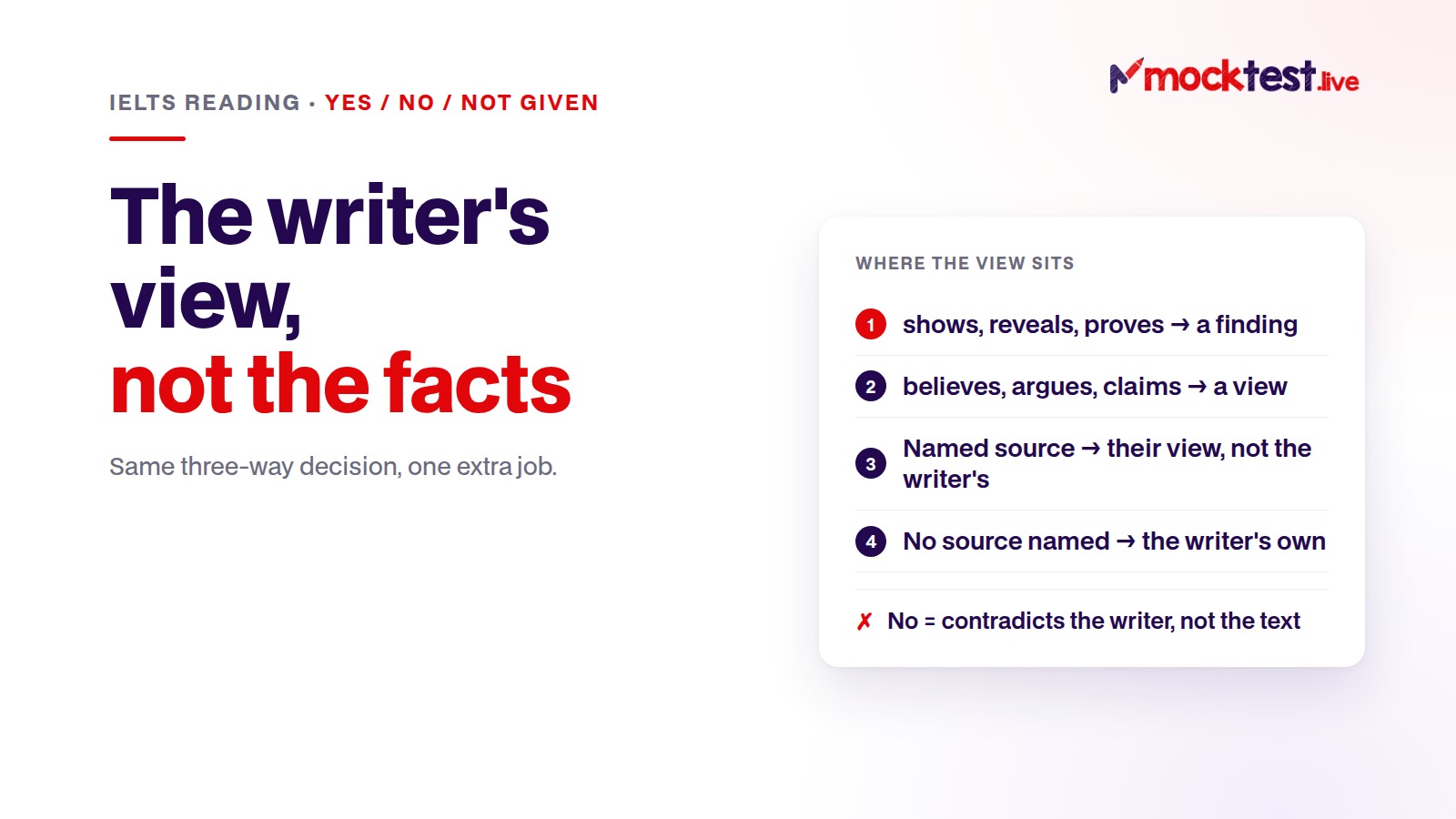
And — this is the part that matters for your preparation — the question types are the same. Multiple choice, True/False/Not Given, matching headings, matching information, sentence and summary completion, short answer, diagram labelling. GT does not get an easier set of tasks; it gets the same tasks on different texts.
Which means everything in this series applies to you unchanged. The reason to read a GT-specific article is not technique. It is the scale.
The three sections, and how they climb
ielts.org describes GT Reading as getting harder as you go, and names what each section holds:
| Section | What is in it |
|---|---|
| 1 | Everyday texts — "notices, advertisements and timetables". ielts.org calls these "the sort of texts that a person would need to be able to understand when living in an English-speaking country". Often several short texts rather than one. |
| 2 | Work. "Job descriptions, contracts, staff development and training materials." |
| 3 | One longer text on a topic of general interest, "generally descriptive and narrative", taken from "newspapers, magazines, books and online resources". |
And ielts.org is explicit about section 3: it is "longer and more complex than the texts in Sections 1 and 2".
The total across all three is 2150–2375 words — shorter than an Academic paper. That is the easier half, and it is real: less to read in the same hour.
Now the part nobody mentions
Both Reading papers are marked on one scale. ielts.org is direct about what that costs you:
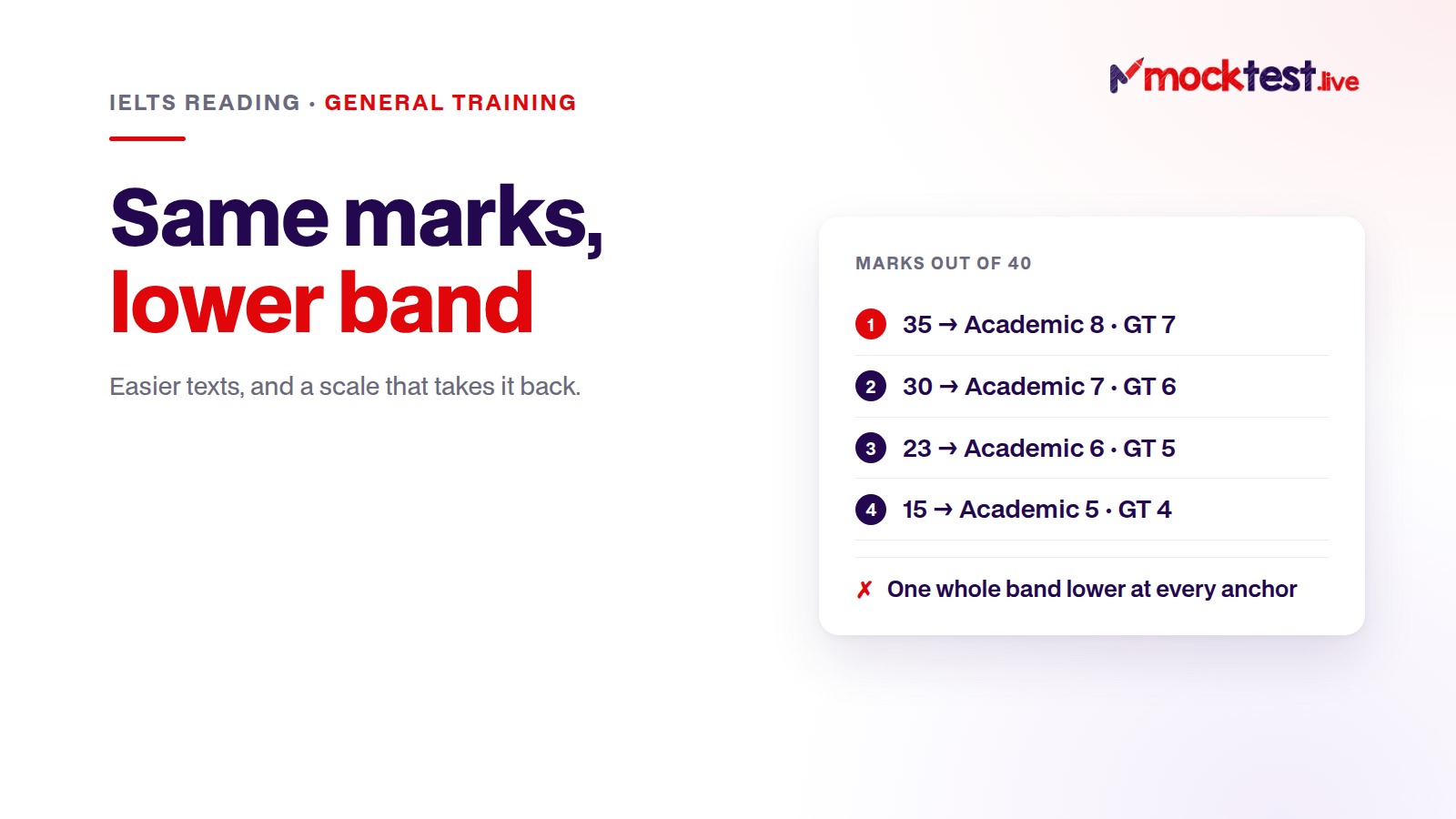
And then it publishes the numbers. These are the four anchor points, out of 40:
| Marks out of 40 | Academic | General Training |
|---|---|---|
| 15 | Band 5 | Band 4 |
| 23 | Band 6 | Band 5 |
| 30 | Band 7 | Band 6 |
| 35 | Band 8 | Band 7 |
One whole band lower, at every single anchor they publish.
Thirty correct answers is a band 7 if you sat Academic and a band 6 if you sat General Training. The shorter texts do not buy you anything — the scale takes it straight back, and then some.
ielts.org attaches a caveat worth keeping: "The precise number of marks needed to achieve these band scores will vary slightly from test version to test version." So these are the shape of the conversion, not a guaranteed pass mark. Do not plan to land on 30 exactly.
What that means for your target
If your requirement is band 6 in Reading, Academic asks for roughly 23 marks and GT asks for roughly 30. That is seven more questions, out of forty — a very different paper to prepare for, even though the tasks are identical.
So the practical conclusion is the opposite of the reassuring one. Because the texts are easier, your target has to be higher. A GT candidate aiming for band 7 is aiming at 35 out of 40, which leaves room for five mistakes across the whole hour.
That makes the cheap marks much more valuable than they are on Academic — the ones lost to a word-limit violation or a misspelling rather than to misreading. The GT Reading page says so itself: "You should be careful when typing your answers because you will lose marks for incorrect spelling and grammar." In a paper where you can afford five errors, a correct answer written wrongly is an expensive way to lose one. The rules are in the five rules for summary and sentence completion.
Where to go from here
The sections climb, so the hour should not be split into three equal parts — section 3 deserves more than twenty minutes and section 1 less. The 60-minute plan is written for Academic but the logic transfers: budget by difficulty, not by section number.
And if you are not yet sure which module you should be sitting at all, that is a different question with a more expensive wrong answer: which of the two tests you actually need.
For the task types, everything in the series applies. The Reading format, section by section lists them with the piece on each.
Practise on the right module
This is the one thing you should not improvise. A GT candidate practising on Academic papers is reading harder texts and converting them on the wrong table — the score they see is not the score they would get.
Our Cambridge papers run in both modules, Academic and General Training, from books 1 to 21, and Reading is converted on the module you actually sat rather than on a single table pretending to cover both. Every paper is free. We are not affiliated with Cambridge, IDP or the British Council.
The section descriptions and the 2150–2375 word range are quoted from ielts.org's General Training Reading format page; the same-scale statement and the four band anchors for each module from ielts.org's scoring-in-detail page — all checked on 7 October 2026.