
Most preparation advice assumes you already know what the paper looks like. Plenty of candidates do not, and it shows up in odd places: leaving boxes empty because they think a wrong answer costs marks, or chasing a band chart that IELTS never published.
The video above covers the whole format in a little over two minutes. Here it is written down, with the official figures separated from what people repeat.
The shape of the test
Sixty minutes. Forty questions. Three sections. That is true of Academic and General Training alike, and the time is the whole hour — nothing is added at the end.
| Academic Reading | General Training Reading | |
|---|---|---|
| Time | 60 minutes | 60 minutes |
| Questions | 40 | 40 |
| Sections | 3 | 3 |
| Total text length | 2,150–2,750 words | 2,150–2,375 words |
What sits inside those sections is where the two tests part company.
Academic takes its passages from books, journals, magazines, newspapers and online resources — written for a non-specialist audience on topics of general interest. At least one passage contains detailed logical argument, and where a technical term matters, a short glossary is provided.
General Training is organised by purpose rather than by difficulty of subject. Section 1 is everyday material: notices, advertisements, timetables. Section 2 is work-related: job descriptions, contracts, training material. Section 3 is one longer text on a topic of general interest.
The marking is simpler than people expect
Each correct answer is worth one mark. Forty questions, forty marks. Nothing is weighted, and a hard question earns exactly what an easy one earns.
And there is no negative marking. A wrong answer scores what a blank box scores: nothing. That single fact should change how you finish a paper — every empty field at minute fifty-nine is a mark you have decided to give away.
What IELTS actually publishes about bands
This is where most of the confusion lives, so it is worth being exact.
IELTS does not publish a full conversion table. What ielts.org publishes is a handful of indicative points:
| Correct out of 40 | Academic Reading | General Training Reading |
|---|---|---|
| 15 | Band 5 | Band 4 |
| 23 | Band 6 | Band 5 |
| 30 | Band 7 | Band 6 |
| 35 | Band 8 | Band 7 |
Two things follow, and both matter more than the numbers themselves.
So when you meet a chart that maps every score from 0 to 40 — 39 is band 9, 37 is band 8.5, and so on — you are looking at somebody's reconstruction. It may be close. It is not official, and it cannot be, because the conversion is not fixed.
If you want to know what your four module bands add up to, that arithmetic is published and exact: how the overall band is worked out, and the rounding rule that surprises people.
Two details that cost marks quietly
There is no extra time to transfer answers in Reading. The ten minutes people remember belonged to Listening on the paper test, where answers had to be copied onto a separate answer sheet. Reading never had that window. On the computer-delivered test there is no answer sheet at all — you type into the field beside the question — so the hour is the hour.
The paper test is going. IELTS has said that from the middle of 2026 the test is delivered on computer, and IDP's Bangladesh pages already list computer-delivered sittings only. That changes the practical advice more than it changes the format: you type instead of writing, the timer is on screen, and the highlight and note tools are part of the interface. Everything in this series assumes the computer test — what actually changes when paper ends.
Where the hour usually goes wrong
Knowing the format does not by itself buy you time, but it tells you where to look when time runs out.
- If you are finishing section 1 at minute twenty-five, the problem is pacing: a section-by-section plan for the hour.
- If you are reading every passage twice, the problem is method: skimming and scanning, and what each is actually for.
- If you find the answer and still get it wrong, the problem is evidence: False versus Not Given.
And three question types take more marks off scripts than the rest put together, each for its own reason:
- True / False / Not Given — the three-way decision, and why False needs a clash you can point at.
- Matching headings — read the paragraph first, because hunting a heading's keyword finds detail rather than the main idea.
- Summary and sentence completion — the five rules that turn a correct answer into a zero, starting with the word limit.
- Multiple choice — cover the options, because they are written to mislead you.
- Matching information — the matching word is usually in the wrong paragraph.
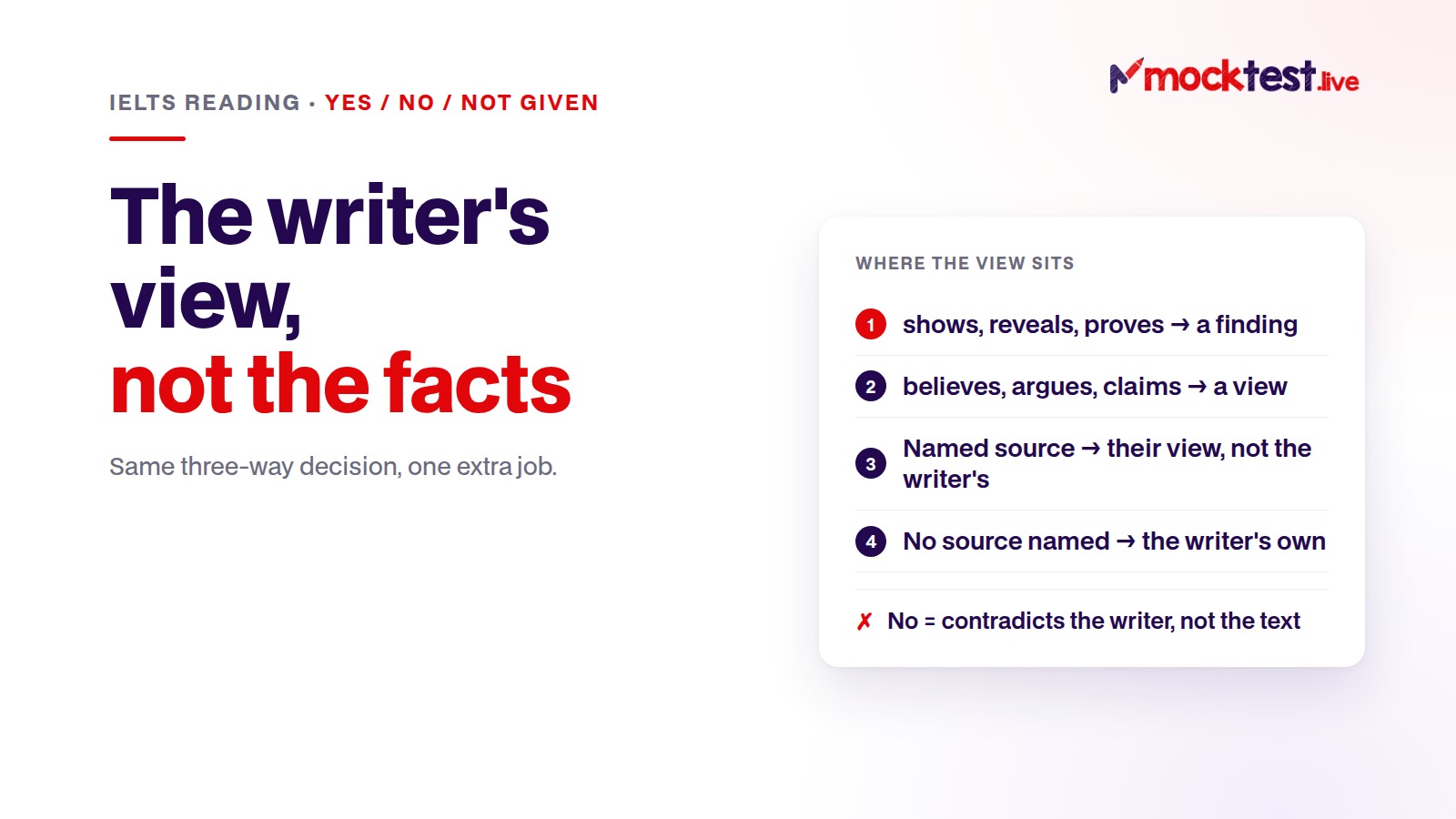
- Yes / No / Not Given — the same decision, tested against the writer's view rather than the facts.
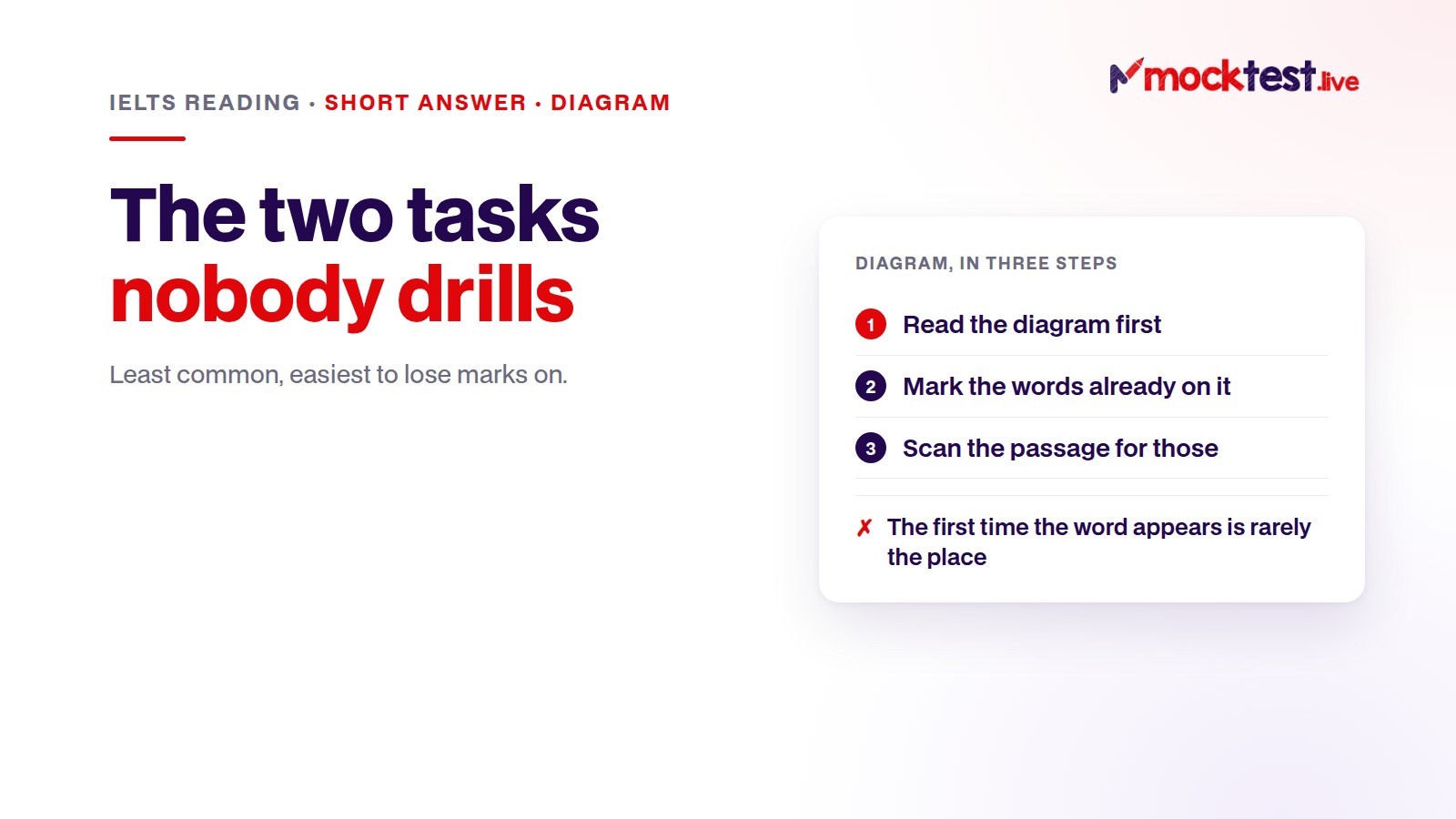
- Short answer and diagram labelling — the two you will not meet often enough to learn by accident.
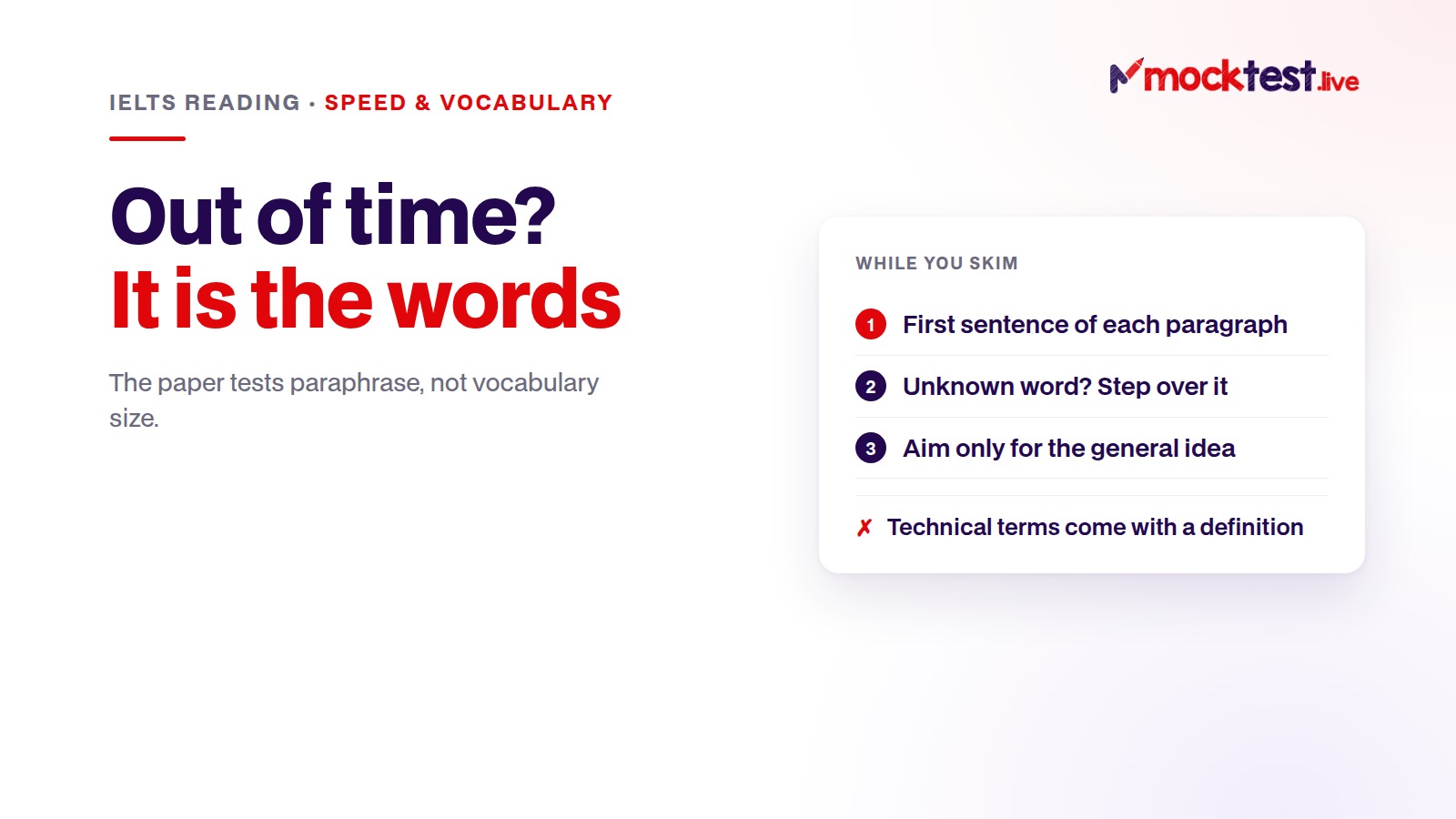
Two more, either side of the task types: why running out of time is usually a vocabulary problem, and, if you are sitting the other module, General Training Reading, where the same marks give a lower band.
Sit one and see the numbers
The format becomes real the first time you sit a full paper under the clock and look at your own raw score beside the indicative table.
Our Cambridge papers are free, and they run on a screen built to match the computer-delivered test: passage and questions side by side, a highlighter, a flag for the questions you left, and the same timer. Reading and Listening are marked the moment you submit, and the raw score is converted with the indicative table above — with IELTS's caveat carried through, so you read it as a guide rather than a promise. We are not affiliated with Cambridge, IDP or the British Council.
Format, marking and the indicative band figures were checked against ielts.org on 29 September 2026.