
The most common reason a candidate runs out of time in IELTS Reading has nothing to do with how fast they read. It is that they read the passage the way they would read a chapter of a book — first line to last, every word weighted the same — and then go back and do it again for each question.
I mark Listening and Reading. When someone shows me a practice paper with the last ten questions blank, we almost always find the same thing: they crossed the same passage six or seven times.
The arithmetic nobody does before the test
The shape of the test is published. For Academic Reading, ielts.org gives the time as 60 minutes, the number of questions as 40, the number of sections as 3, and says "the total text length is 2150–2750 words". General Training is the same hour and the same 40 questions, with a slightly shorter total: 2,150 to 2,375 words.
Now put your own reading against that. Read a page of a broadsheet newspaper at a pace where you actually take in the argument, and time yourself: most people land somewhere between 180 and 250 words a minute in a second language, and slower when the topic is unfamiliar and the clock is visible. At 200 words a minute, 2,750 words is about fourteen minutes — for one careful pass, having answered nothing.
That leaves roughly forty-five minutes for forty questions, which is fine. It is the second, third and fourth passes that are fatal. Each one is another fourteen minutes you do not have, so what actually happens is that the first passage is read properly, the second is read half-properly, and the third is skimmed in panic — the opposite of the order that would serve you, because the passages get no easier.
What skimming and scanning actually mean
IDP, one of the three owners of IELTS, defines both in a sentence each, and the definitions are narrower than the way the words are usually thrown around:
So skimming is not fast reading, and it is not the reading that answers anything. It is a structural pass: the title, any headings, the first sentence of each paragraph, the names and numbers that stand out. What you are building is a map — paragraph three is the objection, paragraph five is the study from Denmark — so that when a question arrives you know which part of the passage it belongs to.
Scanning is not reading at all in the ordinary sense. Your eyes are looking for a shape: a capital letter, a year, a number, a term you noticed in the skim. You are not trying to understand the sentences you pass over, and if you find yourself understanding them, you have stopped scanning.
The reading that earns the mark is the third thing, and it is slow on purpose: two or three sentences around the place you located, read properly, including the sentence after the one that matched.
The order that survives a 60-minute paper
This is the sequence in the video above, and it is the one I watch work in practice papers:
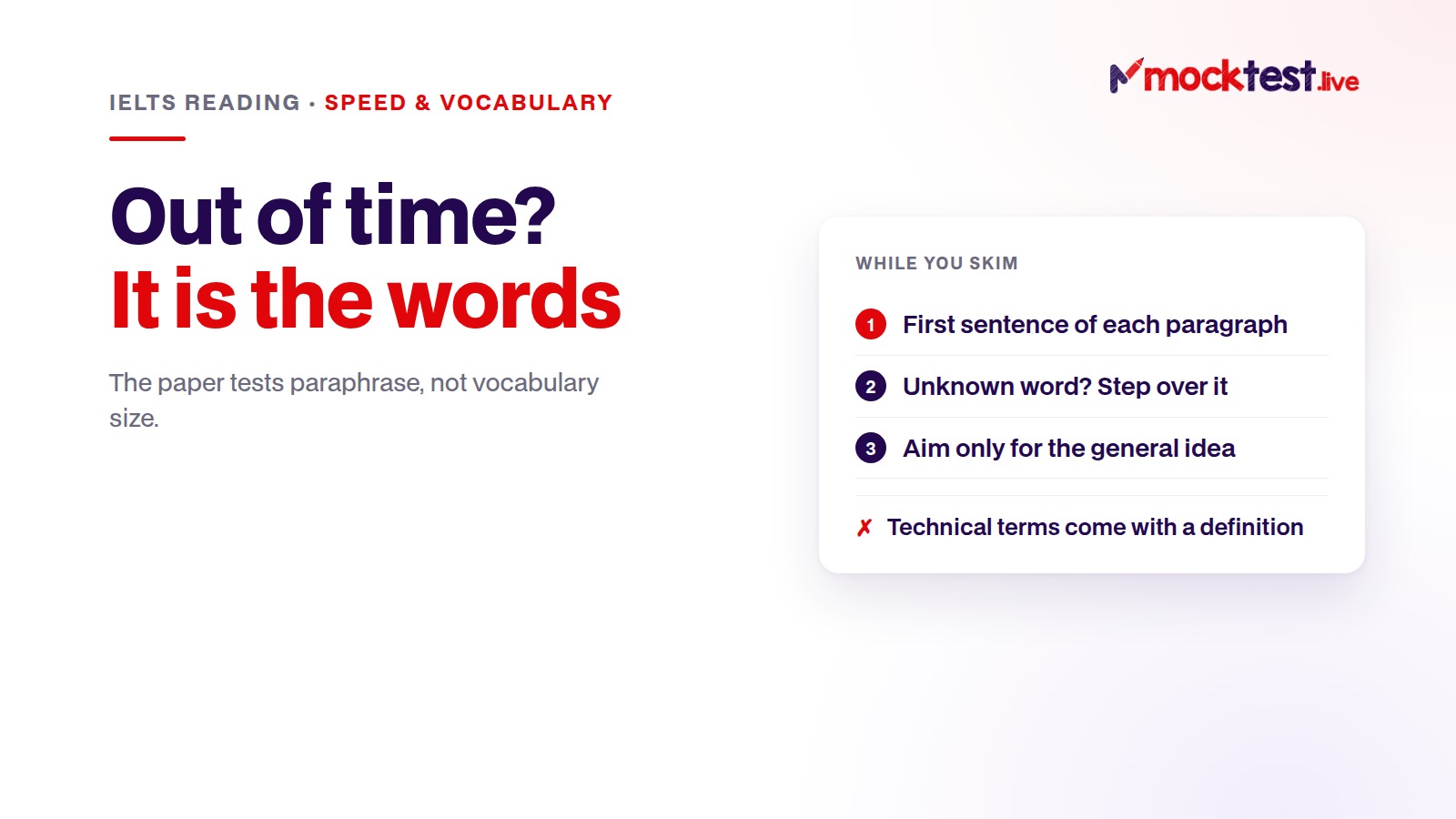
- Skim the passage. Two to three minutes. Title, headings, first sentence of each paragraph. Do not stop at a word you do not know.
- Read one question properly. The question tells you what to look for and, often, where — a name, a decade, a process.
- Decide the keywords, and their likely synonyms. "Cheap" in the question may be "low-cost", "inexpensive" or "affordable" in the passage. Proper nouns and numbers rarely change; adjectives almost always do.
- Scan for the location. Not for the answer — for the place.
- Read that place closely, and the sentence after it. Then answer, and go to the next question.
The step people skip is the first one, because it feels like reading without progress. It is the step that makes steps four and five fast: a scan without a map is a search of the whole passage, every time, for every question.
A keyword is a location, not an answer
Here is the trap, and it is the one that costs marks even when time is not the problem.
A candidate scans, finds their keyword in line twelve, reads that line, and answers. The line says what they expected it to say. The next line begins "However, subsequent trials found no such effect" — and the mark is gone.
Paraphrase is the whole design of the question. If the answer could be found by matching words, the test would measure eyesight. The fix is mechanical, and it takes four seconds: when you find the keyword, read to the end of the following sentence before you commit.
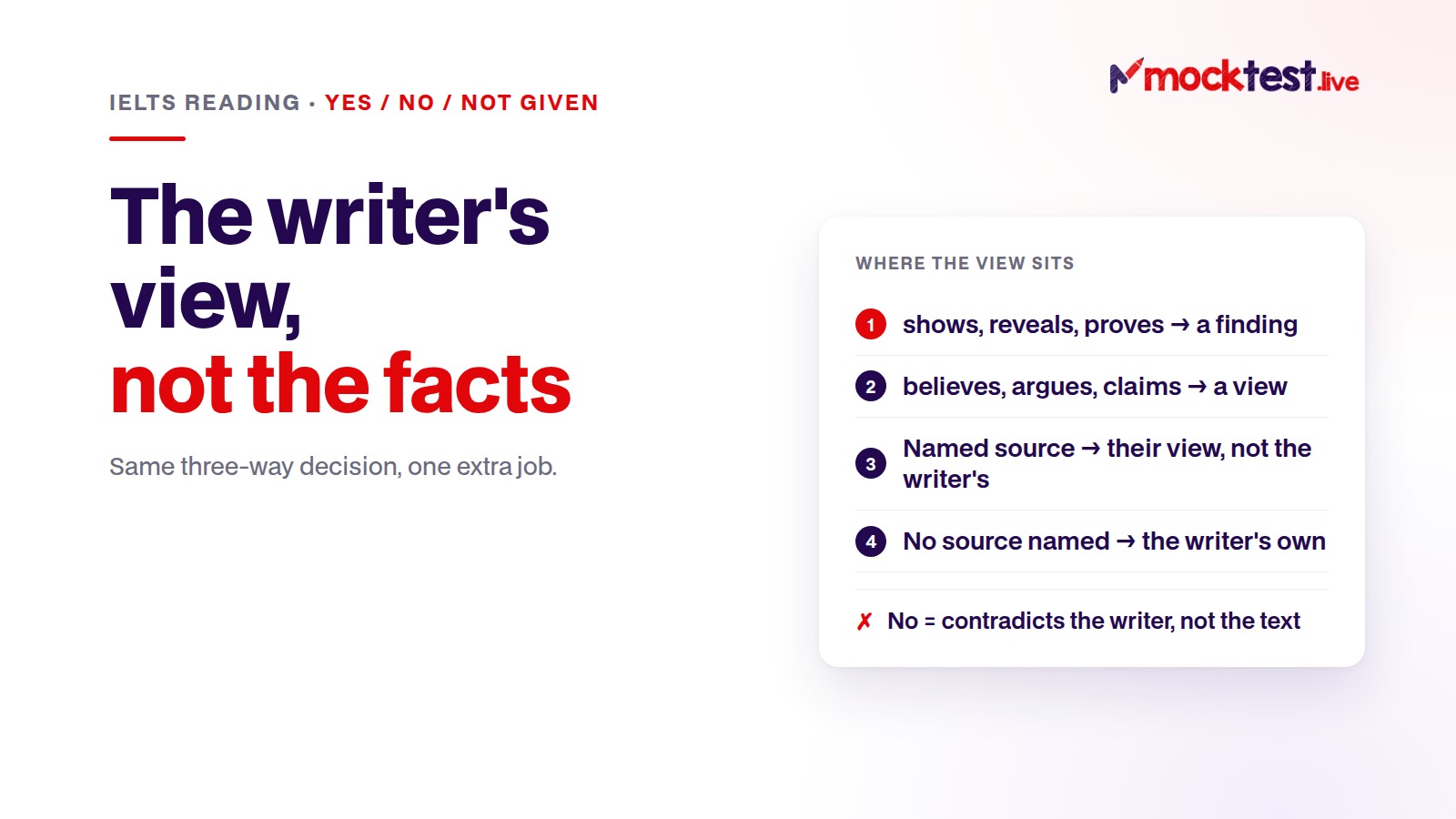
This is also why the two tasks that punish keyword-matching hardest are True/False/Not Given and Yes/No/Not Given. If those are where your marks leak, the problem is not your scanning technique but what counts as evidence: False versus Not Given, and the test that settles it.
Where skimming stops helping
Skimming and scanning are strategies for finding information. They do very little for the question types that ask you to judge the whole of something.
| Task | What skim and scan give you | What still has to be read closely |
|---|---|---|
| Sentence, note and summary completion | Almost everything — these tend to follow the order of the text | The sentence you land on, for grammar and word limit |
| Matching information | The paragraph map from the skim | Each candidate paragraph, because the items are not in text order |
| Matching headings | The first sentence of every paragraph, which is the skim itself | The paragraphs where two headings both look right |
| True/False/Not Given | The location only | The sentence, and the one after it |
ielts.org names four types where “the questions are in the same order as the information in the text” — multiple choice, sentence completion, matching sentence endings and short-answer. Matching information is not one of them: what it says there is that a paragraph may be used more than once and that not every paragraph may be used, which is a different thing and a worse one for your clock. That is why a good skim is worth more on that task than on any other: the map is the only thing standing between you and a full search per item.
If the clock is where your paper falls apart rather than the technique, the companion piece to this one is what ten blank answers actually cost you in bands, and how to budget by question type.
What to practise this week
Technique changes nothing until it survives an hour with no pausing. Three things, in this order:
- One passage, skim only. Three minutes, then close the passage and write four lines: what each paragraph was about. Check yourself against the text. Do this until your map is right more often than it is wrong.
- One passage, question by question. No time limit yet. For each question, write down where you found the answer — paragraph and line. If you cannot say where, you guessed, and the mark is luck.
- A full paper, 60 minutes, no stopping. Then count two numbers per question type: marks earned and minutes spent. That is the number that tells you what to fix next.
That is what our Reading papers are for: full-length papers in the style of the past Cambridge books, in a screen built to match the computer-delivered test, with the passage and questions side by side, a highlighter, a flag and the same clock. Reading and Listening are marked the moment you submit, against the answer key, so you can see exactly which of your located answers were the sentence before the "however". Every Cambridge paper is free. We are not affiliated with Cambridge, IDP or the British Council.
If the reading itself is slow rather than the method being wrong, the cause is usually further upstream: why running out of time is usually a vocabulary problem.
Format details and the quoted definitions were checked against ielts.org and IDP's guidance on 24 September 2026.