
In this guide8 sections
- What ten blank answers cost, in bands
- Where the 15-20-25 split actually comes from
- Reading never had transfer time
- Budget by question type, not by passage
- The screen you will actually sit at
- When the screen shuts down on you
- Extra time exists, but you arrange it weeks ahead
- Three full papers, on the clock, on a screen
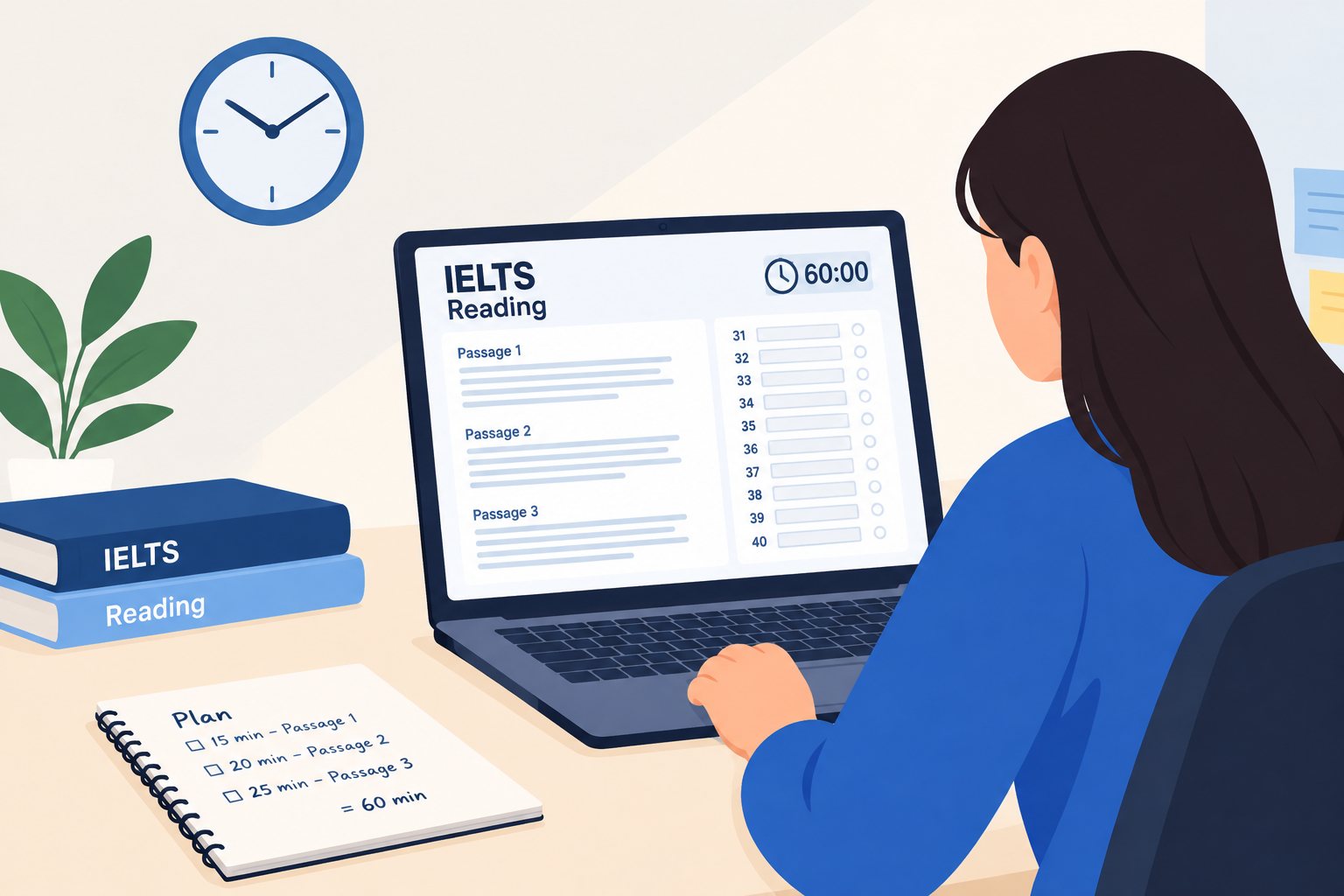
Questions 31 to 40, all blank. The stopwatch had been flashing for six minutes before you looked up at it, you typed four words into four boxes, and then the screen saved itself and shut down. That is what an IELTS Reading time management failure actually looks like.
That is the pattern I see most often in the practice Reading papers I go through with students, and time management is a slightly misleading name for what went wrong in it. The last ten questions were not lost in the last ten minutes. They were lost around minute twenty-two, in a matching task you would not let go of.
The shape of the test is fixed and published: 60 minutes, 40 questions, three passages, 2,150 to 2,750 words of text in Academic and 2,150 to 2,375 in General Training. What is not published, anywhere official, is how to spend the hour. Most of the advice filling that gap was written for a paper booklet that Bangladeshi candidates are now reported to have stopped sitting — IDP's Bangladesh pages list only computer-delivered tests, and IELTS has said paper will end globally from mid-2026.
What ten blank answers cost, in bands
IELTS publishes an indicative raw-score-to-band conversion, with its own caveat attached: "The precise number of marks needed to achieve these band scores will vary slightly from test version to test version."
| Correct out of 40 | Academic Reading | General Training Reading |
|---|---|---|
| 15 | Band 5 | Band 4 |
| 23 | Band 6 | Band 5 |
| 30 | Band 7 | Band 6 |
| 35 | Band 8 | Band 7 |
Now run your blank ten through it. If you never reach questions 31 to 40, you are answering 30 questions. In Academic, an indicative Band 7 sits at 30 correct, so you would need every single answer you did give to be right. One slip anywhere in the first two passages and 30 is out of reach for the day. In General Training the door is already shut: 35 correct is indicative of Band 7, and you only attempted 30.
The ten questions you never saw were never the difference between 7 and 6.5. They decide whether the band you want is still achievable or arithmetically gone before you read the first line of Passage 3.
Where the 15-20-25 split actually comes from
Nobody official will tell you, and I would rather say that than invent a number.
I went looking. The ielts.org Academic Reading format page gives the time, the question count, the number of sections and the word range, and says nothing at all about how to divide the hour between passages. Neither does the General Training page.
IDP publishes a suggestion, and then publishes a different one.
So when a coaching page calls 15-20-25 "the golden rule of IELTS Reading", what it means is that somebody wrote it down and everybody copied it. It is a convention. As a rough sanity check at the halfway mark it is fine, and I use it that way myself when I watch someone practise.
As a plan it fails for one reason: it assumes a mark in Passage 1 costs the same as a mark in Passage 3.
Reading never had transfer time
IDP's guidance is unusually blunt about this. "It's important to note that in IELTS Reading no extra time is given to transfer answers." Its dedicated Reading-timing page repeats it: "There's no extra time to transfer answers, especially for paper-based tests, so efficiency is essential."
The myth has a real ancestor. On paper, Listening gave you 10 minutes at the end to copy your answers from the question booklet onto the answer sheet, and that window was genuine. Reading never had one — however you worked, the hour was the hour. On computer there is no answer sheet at all, so there is nothing to transfer in either component. Listening ends with a short window to check what you have typed, commonly stated as two minutes. Reading ends. IDP's Bangladesh pages now list only computer-delivered tests, and paper-based IELTS is reported to have ended in Bangladesh from 1 February 2026, ahead of the global mid-2026 date IELTS has announced — timelines vary by market, so confirm with your test centre. Either way, any advice you have been given about pencils, booklets and transferring passage by passage is describing a test you will almost certainly not sit.
Budget by question type, not by passage
Pace by task, not by passage. The tasks differ enormously in what one mark costs you in minutes.
Academic Reading uses eleven question-type variations. Some of them behave as if they were close to linear: sentence completion, note completion, summary completion, short answer. In practice — and this is my observation from marking, not a published rule — the answers in these sets tend to turn up in the order the text presents them, so each item hands you a starting point roughly where the last one finished. Your eyes travel forward through the passage once.
Others do not work that way at all. ielts.org says “the questions are in the same order as the information in the text” under four types — multiple choice, sentence completion, matching sentence endings and short-answer — and says no such thing under matching information. What it does say there is that a paragraph may be used more than once and that not every paragraph may be used. Read that again as a time cost. Every item in that set is a fresh search across the whole passage, with no guarantee that the paragraph you eliminated for question 14 is eliminated for question 17.
| Task | Follows the order of the text? | What one mark costs |
|---|---|---|
| Sentence, note and summary completion | Usually, in my experience — not stated officially | A short forward scan from your last answer |
| True/False/Not Given, Yes/No/Not Given | Usually, in my experience — not stated officially | A located sentence, then a judgement |
| Matching information | No, IELTS states this explicitly | A search of the full passage, repeated per item |
| Matching headings, matching features | Not stated officially either way | In my experience, a full pass of the passage before the first answer is safe |
That last row is mine, from marking, not from IELTS. But it is why a candidate who meets matching headings in Passage 1 loses Passage 3 no matter how disciplined they were about the clock. They spent nineteen minutes to earn a handful of marks, felt on schedule because nineteen is under twenty, and never noticed that the same nineteen minutes spent on a completion set would very likely have earned more. Run the numbers on your own papers rather than trusting mine — that is the whole point of the exercise below.
So change what you measure in practice. Stop recording minutes per passage. Record minutes per mark, per task type, in your own handwriting, across three or four papers. Two matching-information sets in the same paper makes for a slow paper, and knowing that in advance is the difference between abandoning a set on purpose and abandoning ten questions by accident.
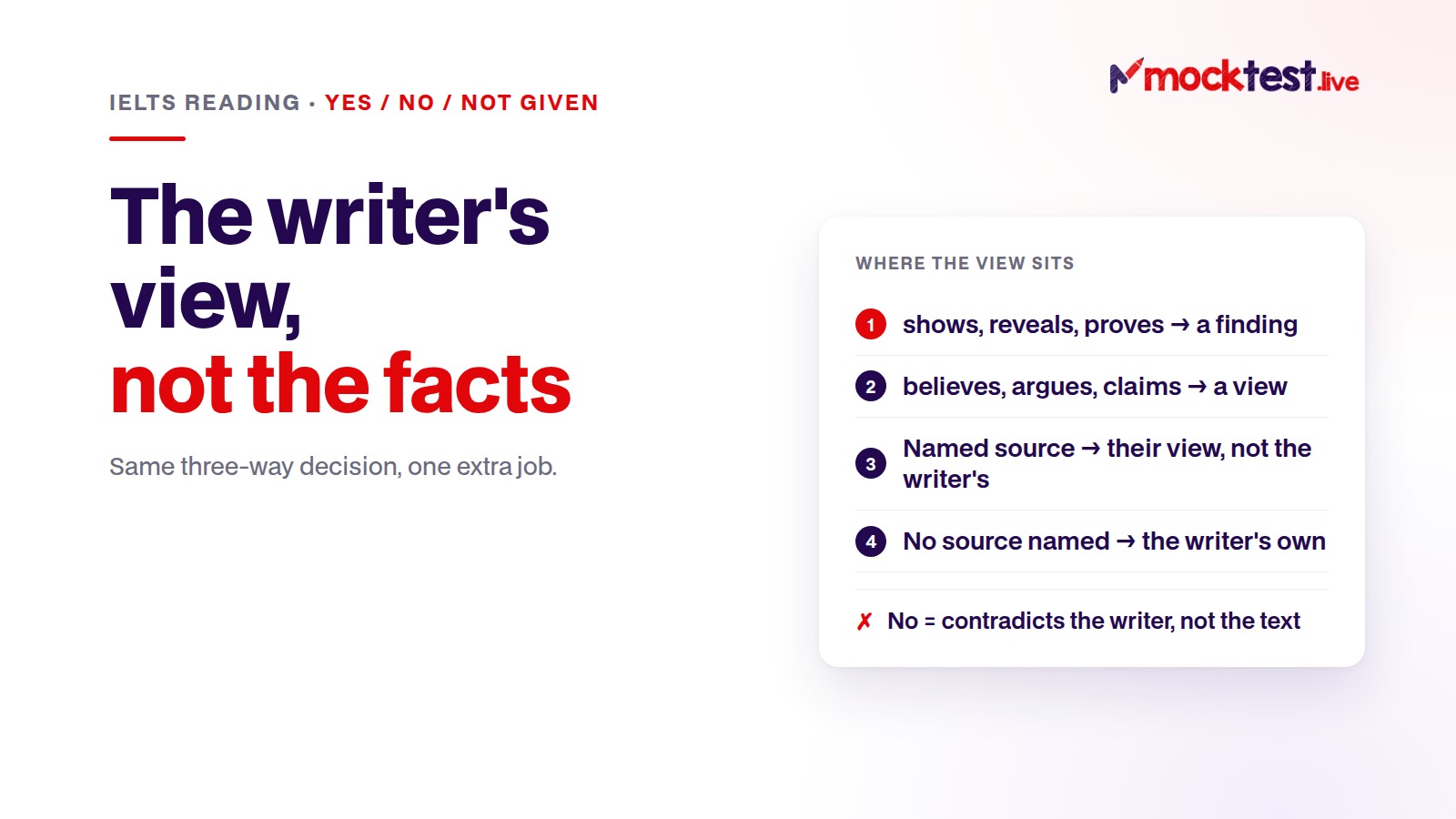
None of this tells you how to decide an individual item. If your minutes disappear inside True/False/Not Given specifically, the clock is a symptom and the fix is somewhere else entirely: False versus Not Given, and the evidence test that settles it.
The screen you will actually sit at
The computer test gives you recovery tools that the paper test could not, and in the practice sessions I sit in on, almost nobody touches the navigation panel until the stopwatch starts flashing.
What is officially there: a stopwatch in the upper middle of the screen, which starts to flash in the last 10 minutes and again 5 minutes before the test ends. A navigation button at the bottom that shows all 40 questions, with forward and backward arrows to move between them. Text you can select and right-click to highlight in a different colour, plus on-screen notes. A split view with the passage beside the questions and answers typed directly into the field. And the ability to review and modify every answer before final submission.
Treat the first flash as an instruction
Ten minutes left. What I tell candidates is to treat that flash as the end of solving and the start of sweeping: open the navigation panel, find every question with nothing in it, and go to the cheapest one first.
This is the opposite of what most people do, which is to keep working the question in front of them and hope. The question in front of you is worth one mark. So is every blank one behind it, and the blank ones are cheaper.
Five minutes. Now every field gets something in it, whether or not you have read the paragraph it came from — and yes, that includes the three completion items you were saving. A habit worth building well before test day, and this one is my opinion rather than anything IELTS publishes: never leave a field empty even in the middle of the hour. When you decide to abandon an item, type your best guess into it before you move on, then use the navigation panel to come back if there is time. Candidates who plan to "fill them in at the end" are relying on the end existing.
When the screen shuts down on you
The honest answer is less dramatic than the panic suggests. On computer, "when the time has run out, your answers are saved and the system automatically shuts down". Everything already typed counts. Nothing can be added. Your test is not void, your paper is not cancelled, and the questions you left blank simply score zero.
The free marks are the boxes you never typed anything into. Each correct answer receives one mark, and no penalty for wrong answers is described anywhere in the marking. IDP puts it in plain words: "There's no penalty for wrong answers in IELTS Reading — so if you're running out of time: Guess!"
For a three-option or four-option item that is real value. For a completion item where you have located the right paragraph and cannot pick between two words, it is still better than blank. IDP's own order-of-work advice ends with "check the clock every ten minutes". Candidates tell me they did check it, saw nineteen minutes gone on a matching set, and carried on anyway. The clock told them the truth and they overruled it.
Extra time exists, but you arrange it weeks ahead
Not on the day, and not by asking the invigilator. It is a formal access arrangement, and it is arranged when you book.
IELTS states that you can normally ask for an extra 25% of the time for a paper, and more than 25% if you are severely impacted by a specific learning difficulty. It has to be supported by a report prepared when you were aged 13 or older. And this is the part that catches people: "It can take six weeks for some arrangements to be made."
I am including this because of a pattern I see. Candidates with a diagnosed reading difficulty spend months hunting timing tips, sit four papers, finish none of them, and conclude they are bad at English. They are not searching for the thing that would actually help. If that description fits you, the next step is your test centre and your documentation, not another article about pacing.
Three full papers, on the clock, on a screen
You cannot fix this by reading about it, and you cannot fix it by doing question sets untimed. The failure only appears under an hour with no stopping, because the failure is a decision you make at minute twenty-two about a task you should have abandoned.
Sit three complete Reading papers. Timed at 60 minutes, all three passages, no pausing, on a screen with the passage and the questions side by side. After each one, write down two numbers per task type: marks earned and minutes spent. By the third paper you will know which task type is eating your hour, and it will not be the one you assumed.
That is what our papers are for. Full-length practice papers in the style of the past Cambridge books, laid out in a screen interface built to match the computer-delivered test — split view, navigation panel, flag, highlighter and the same flashing timer. We are not affiliated with Cambridge, IDP or the British Council. Reading and Listening are marked the second you submit against the answer key, with the raw score converted using the indicative raw-score-to-band table IELTS publishes — IELTS's own caveat is that the precise number of marks needed varies slightly from test version to test version, so treat the band as a guide and the raw score as the real number. Your errors sit beside the key. Writing and Speaking go to a human instructor who marks all four criteria separately. Every Cambridge paper is free.
If you are still deciding whether to book at all, the timing data from those three papers is one of the checks in the five things to confirm before you pay the fee. It is not a small fee. IDP's Bangladesh page currently lists IELTS on Computer at BDT 29,600 and One Skill Retake at BDT 18,600, and those figures move with the exchange rate, so check the official page rather than this one before you budget. A One Skill Retake must be taken in the same delivery mode as the original test.
Fees and format details checked on 11 September 2026.