
The IELTS test fee in Bangladesh was BDT 31,100 at IDP when we checked in September 2026. The preparation does not have to cost anything close to that. Most of what you need is free, as long as you use it in the right order.
This is the plan I would give a friend who has a job or classes, a month before their test, and no money set aside for a coaching centre. It is honest about what you can do alone and what you cannot.
Before you start: find out where you are
Most people start preparing by opening a vocabulary book. Do not. Start by sitting one full practice test, all four modules, under real timing.
It will probably be uncomfortable. That is the point. In three hours you learn two things nothing else tells you: which module is your weakest, and how far your current level is from the band you need.
Once you have your four bands, work out your overall band and look for the module pulling it down. That module is where most of your month should go.
Is 30 days enough?
It depends entirely on that first test.
If you are within half a band to a band of your target, thirty days is a reasonable amount of time. You can learn the format properly, fix your weakest module, and build the stamina to stay sharp for three hours.
If you need to go up a band and a half or more, a month is usually not enough to change your English that much. You can still improve your technique, but be realistic about the date. Moving your test costs BDT 3,000; sitting it too early and having to retake costs far more. The full breakdown of what IELTS costs in Bangladesh is worth reading before you book.
The free resources worth using
You do not need a shelf of books. You need a few good sources, used properly.
- ielts.org publishes free preparation resources and sample questions from the people who make the test. Use these to learn exactly what each part looks like.
- British Council's IELTS Ready has a free tier with practice material. If you book with British Council, more of it unlocks.
- Full practice papers. This is where free material is hardest to find, because a real practice test needs the full audio, the full passages and a correct answer key. Our Cambridge papers are free to sit, in the same computer-based format as the real test.
Be careful with random PDFs shared in Facebook groups. Some have wrong answer keys, and practising against a wrong key teaches you the wrong thing with complete confidence.
Practise on a computer, not on your phone
This matters more in Bangladesh than people realise. Paper-based IELTS is no longer offered here, so your test will be on a computer.
Typing a 280-word essay is not the same as writing one by hand. Reading a long passage on a monitor while scrolling is not the same as reading it on paper with a pencil. Moving between forty questions with a mouse takes getting used to.
Do at least your full mock tests on a laptop or desktop. Your phone is fine for vocabulary and listening on the bus, but not for rehearsing the real thing.
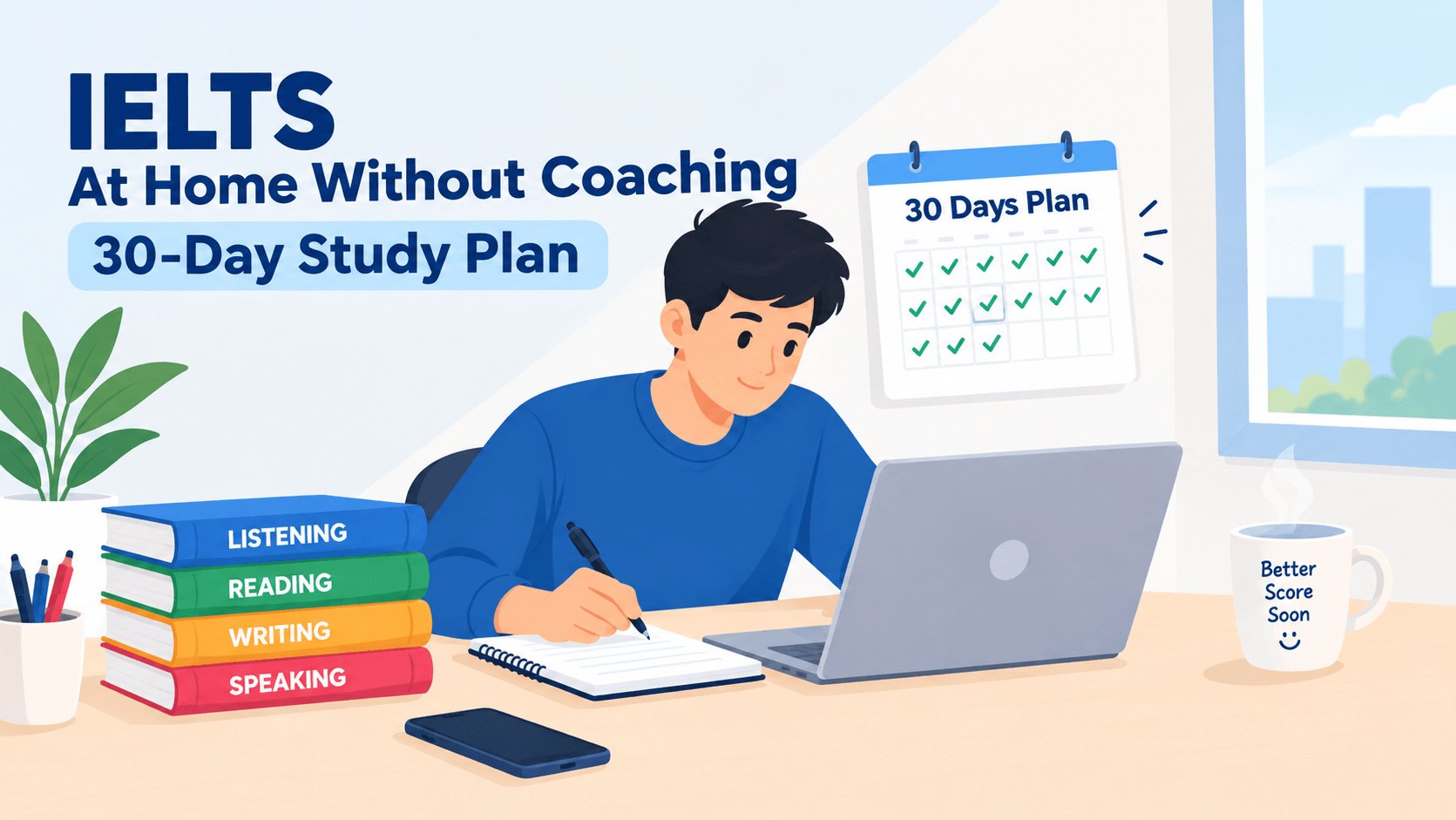
A 30-day plan
This assumes around two hours on weekdays and a longer session at the weekend. Adjust it around your weakest module.
Week 1: learn the test and find your weak spot
- Day 1: Sit a full practice test under real timing. Do not look anything up during it.
- Days 2 and 3: Go through every mistake. For Listening and Reading, work out why each wrong answer was wrong, not just what the right one was.
- Days 4 to 7: Learn the format of each part properly. Know how many questions, how long, and what each question type asks you to do.
Week 2: work on your weakest module
Spend about half your time each day on your weakest module, and the rest keeping the others ticking over.
- If it is Listening, do one section a day and replay the parts you missed with the transcript. Score each part separately rather than out of 40 — Parts 3 and 4 are usually where the marks go.
- If it is Reading, practise one passage a day against the clock. Time management is where most Reading marks are lost.
- If it is Writing or Speaking, start the Week 3 work early.
Week 3: Writing and Speaking
These two are where studying alone is hardest, because nobody can check your own essay against the band descriptors for you.
- Writing: Write at least three Task 2 essays in 40 minutes each. Use a clear four-paragraph structure and do not use a memorised template. Try to get feedback on at least one of them from someone who knows the criteria. If you are sitting Academic, give Task 1 its own 20 minutes too — the overview is the paragraph that decides most of that band.
- Speaking: Record yourself answering common Part 1 questions and one Part 2 cue card a day. Listen back once. Notice long pauses and repeated words, then record again the next day.
Week 4: full tests and rest
- Days 22 and 25: Sit a full practice test on each day, under real timing.
- Days between: Review mistakes only. Do not start anything new.
- Last two days: Light practice only. Sleep properly. Check your test centre location, your ID and your start time.
Your second full test at the end of the month is the one to trust. If it is close to your target, you are ready. If it is still well short, it is cheaper to move the date than to sit the test hoping.
What you cannot do alone
Being honest about this saves you money later.
Listening and Reading can be self-marked, because there is a right answer. Writing and Speaking cannot. You can improve a great deal alone by recording and rewriting, but at some point you need a person to tell you which criterion is holding you back. Whether that is a teacher, a friend who has scored well, or a marking service, plan for it rather than assuming your own judgement is enough.
If you are unsure whether you are ready at the end of the month, these five checks are more reliable than how confident you feel.
Start with one full test
Everything in this plan hangs on the first test. It tells you whether thirty days is enough, and which module to spend them on.